Belatacept
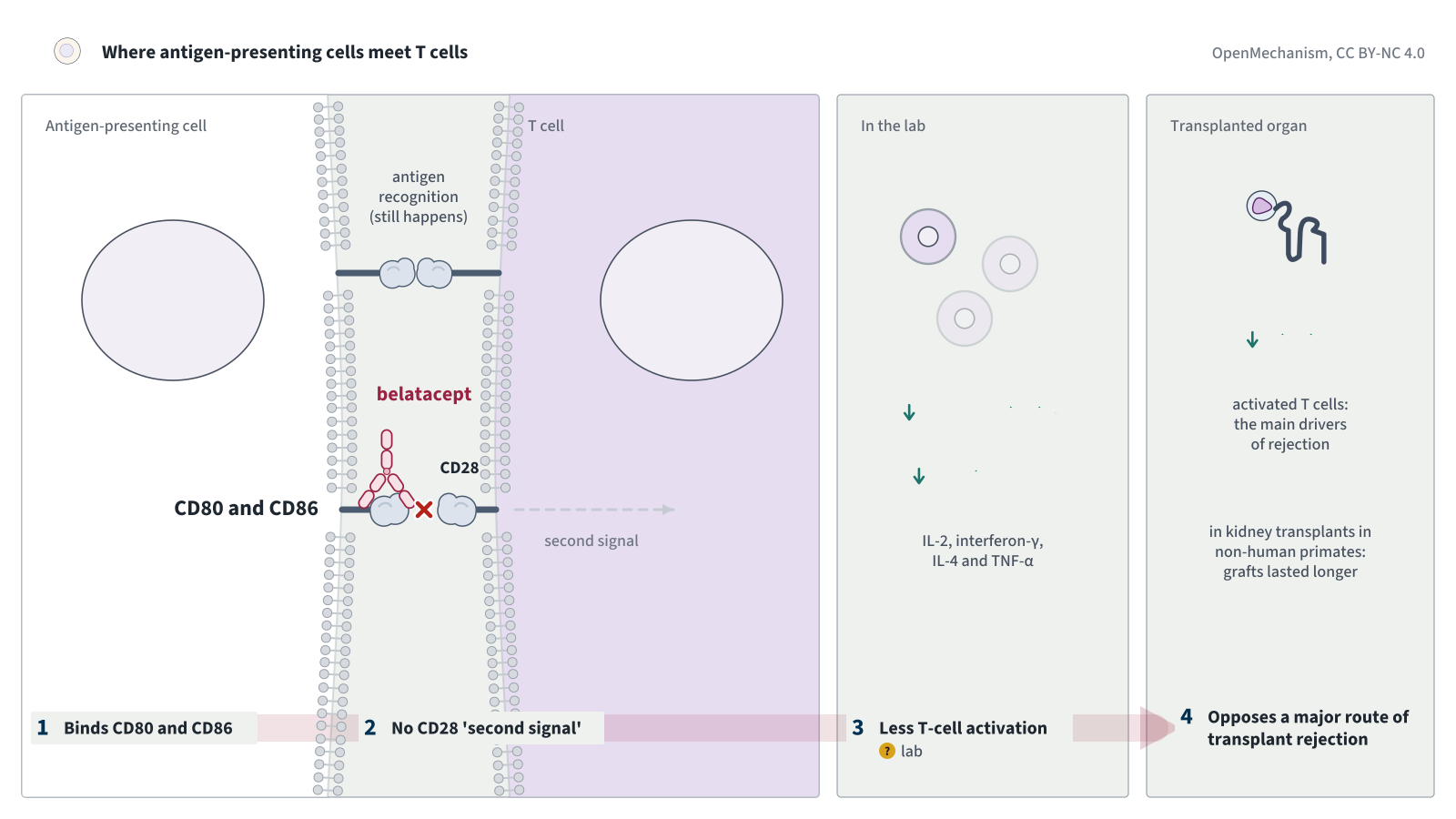
Belatacept binds and CD86 on antigen-presenting cells, so they cannot give the 'second signal' they need to activate. Less T-cell activation opposes a major route of transplant rejection.
- Acts on
- CD80 and CD86
- Where
- Where antigen-presenting cells meet T cells
- Medicine type
- Protein
- Used for
- Immune system
Also called Nulojix.
Step 3: lab
The Nulojix (belatacept) label says: In vitro, belatacept inhibits T lymphocyte proliferation and the production of the cytokines interleukin-2, interferon-γ, interleukin-4, and TNF-α.
Source 1: Nulojix (belatacept): FDA label, 12.1 Mechanism of Action
Clinical study: In a phase III trial (BENEFIT) in adults receiving a kidney transplant from a living or standard criteria deceased donor, a more or a less intensive belatacept regimen was compared with cyclosporine; the trial measured patient and graft survival, kidney function and acute rejection at 12 months, not T-cell activation in the lab: Belatacept was associated with superior renal function and similar patient/graft survival versus cyclosporine at 1 year posttransplant, despite a higher rate of early acute rejection.
Vincenti F et al., Am J Transplant 2010 (PMID 20415897)
This study was picked with a literature search and is not yet checked by our reviewer.
Key terms in this drawing (7)
- CD28
- CD28 protein. A T-cell protein that gives the 'second signal' needed for activation.
- CD80/CD86
- CD80 and CD86 proteins. Proteins on antigen-presenting cells that bind CD28 on T cells.
- cytokines
- Cytokines. Signal molecules involved in inflammation, such as interleukin-2, interferon-γ, interleukin-4 and TNF-α, which T cells make.
- IL-2
- Interleukin-2. One of the cytokines T cells produce; belatacept reduces its production (lab studies).
- IL-4
- Interleukin-4. A cytokine made by Th2 cells; with IL-13 it signals the switch from IgM to IgE antibodies.
- T cell
- T lymphocyte. A white blood cell of the immune system.
- TNF
- Tumor necrosis factor (TNF-α). A signaling molecule (cytokine) that drives inflammation.
How it works
Binds CD80 and CD86. Belatacept binds CD80 and CD86 on antigen-presenting cells.1
No CD28 'second signal'. This prevents CD28-mediated costimulation of T lymphocytes.1
Less T-cell activation. In vitro T-cell proliferation and selected production are inhibited.1
Opposes a major route of transplant rejection. Activated T cells are major mediators of immunologic rejection; the label includes supportive nonhuman-primate graft experiments.1
For teachers: download this drawing or build a slide deck.
See also
Condition pages: transplant rejection.
More medicines for immune system: adalimumab, anakinra, cyclosporine, eculizumab, filgrastim, fingolimod, infliximab, mycophenolate mofetil and 6 more.
Body system: immune system.
Sources
- 1Nulojix (belatacept): FDA label12.1 Mechanism of Action
- 2ChEMBL CHEMBL1742990Target and action classification: T-lymphocyte activation antigen CD80 inhibitor; T-lymphocyte activation antigen CD86 inhibitor
- 3A phase III study of belatacept-based immunosuppression regimens versus cyclosporine in renal transplant recipients (BENEFIT study)Vincenti F et al. Am J Transplant 2010 (abstract)
Spotted a mistake? Report an error (hello@openmechanism.com). Since launch, every published error we fix is listed on the corrections page.
Notes and limits
- A schematic teaching drawing: not to scale, not exact structures, binding poses or a complete pathway, and not a guide to dosing, treatment or how a person will respond.
- The steps are in the order that explains them; one step is said to cause the next only where the source says so.
- This selected costimulation story does not erase antigen-recognition signaling or calculate graft survival.
All recorded limits are on the evidence page, and notes that apply to every page are on How to read a page. Version 1.0.0, not yet medically reviewed.
Cite this page
Tran D. Belatacept [Internet]. OpenMechanism; 2026 [updated 2026 Oct 15; cited 2026 Oct 15]. Available from: https://openmechanism.com/medicines/belatacept