Hormones & metabolism
How insulin and other hormones control fuel use around the body.
For teachers: download this drawing.
Key terms in this drawing
- GLP-1
- Glucagon-like peptide-1. A gut hormone that increases insulin release when blood glucose is normal or high.
How it works
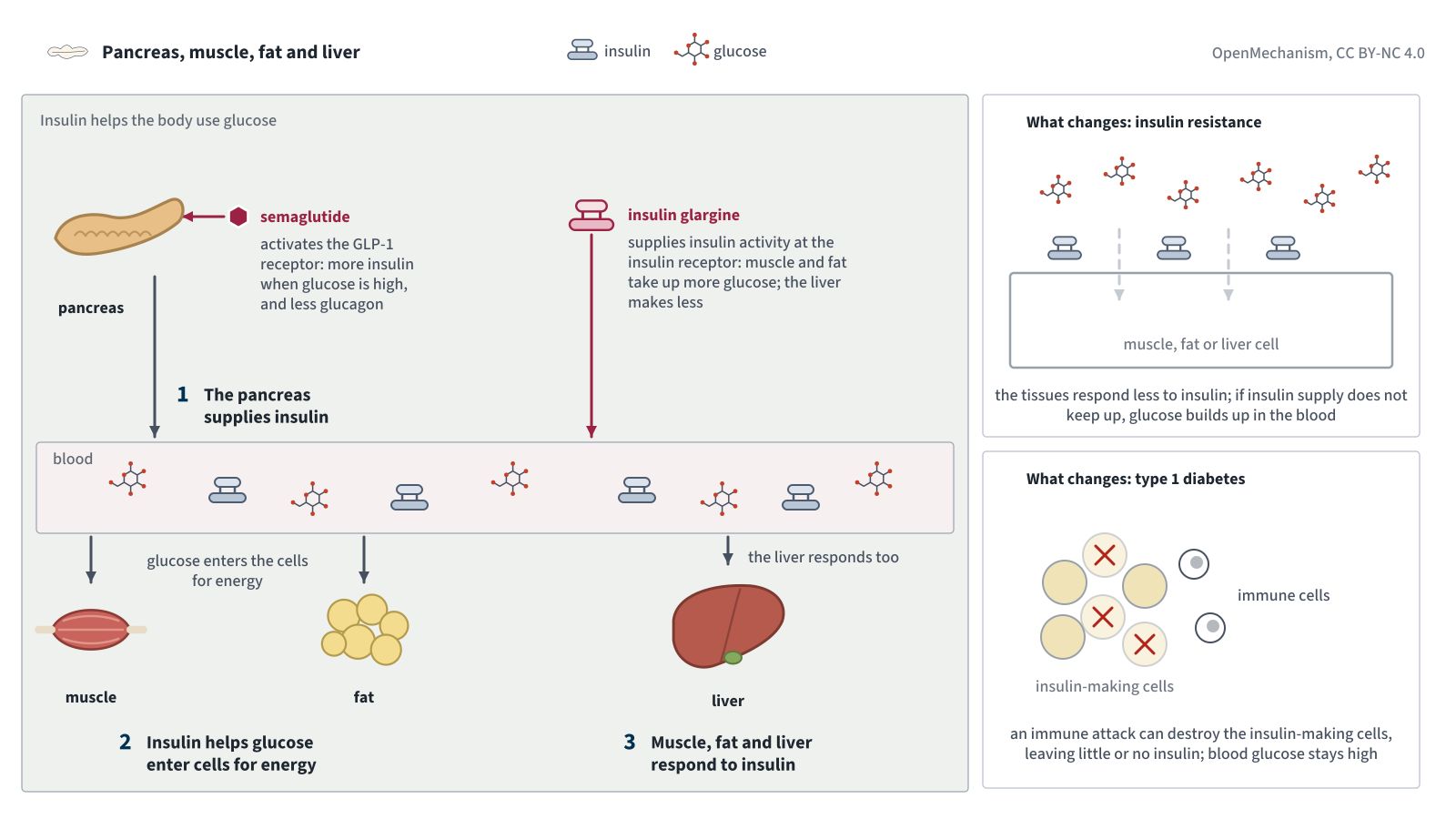
The pancreas supplies insulin. The pancreas's islets make hormones. Their beta cells, about 75 percent of each islet, make insulin, and high blood glucose makes them release it.1
What the source says
“Its pancreatic islets—clusters of cells formerly known as the islets of Langerhans—secrete the hormones glucagon, insulin, somatostatin, and pancreatic polypeptide (PP).”
Source 1“The beta cell produces the hormone insulin and makes up approximately 75 percent of each islet.”
Source 1“Elevated blood glucose levels stimulate the release of insulin.”
Source 1Insulin helps glucose enter cells for energy. Glucose is the preferred fuel of the body's cells. Insulin's actions run through a single receptor, a tyrosine kinase. How it lets glucose in is not entirely clear: the receptor appears to set off signals that bring glucose transporters to the cell's surface, and glucose moves in through them.1,2
What the source says
“Glucose is required for cellular respiration and is the preferred fuel for all body cells.”
Source 1“Precisely how insulin facilitates glucose uptake is not entirely clear.”
Source 1“However, insulin appears to activate a tyrosine kinase receptor, triggering the phosphorylation of many substrates within the cell.”
Source 1“The pleiotropic actions of insulin are mediated by a single receptor tyrosine kinase.”
Source 2“Insulin triggers the rapid movement of a pool of glucose transporter vesicles to the cell membrane, where they fuse and expose the glucose transporters to the extracellular fluid.”
Source 1“The transporters then move glucose by facilitated diffusion into the cell interior.”
Source 1Muscle, fat and liver respond to insulin. Skeletal muscle and fat cells are insulin's main targets, and insulin makes the liver turn extra glucose into glycogen for storage.1
What changes in disease
Insulin resistance. In type 2 diabetes, the body's cells become resistant to the effects of insulin, and the pancreas releases more insulin in response.1
What the source says
“In type 2 diabetes, cells become resistant to the effects of insulin.”
Source 1“In response, the pancreas increases its insulin secretion”
Source 1Over time the beta cells become exhausted. A failing supply of insulin, or cells that respond poorly to it, can lead to diabetes mellitus, and blood glucose that stays high injures tissues throughout the body, especially the blood vessels and nerves.1
What the source says
“In response, the pancreas increases its insulin secretion, but over time, the beta cells become exhausted.”
Source 1“Dysfunction of insulin production and secretion, as well as the target cells’ responsiveness to insulin, can lead to a condition called diabetes mellitus.”
Source 1“Over time, persistently high levels of glucose in the blood injure tissues throughout the body, especially those of the blood vessels and nerves.”
Source 1Type 1 diabetes. Type 1 diabetes is an autoimmune disease of the beta cells. They no longer make insulin, so insulin has to be given by injection or infusion.1
What the source says
“Type 1 diabetes is an autoimmune disease affecting the beta cells of the pancreas.”
Source 1“The beta cells of people with type 1 diabetes do not produce insulin; thus, synthetic insulin must be administered by injection or infusion.”
Source 1When blood glucose is very high, it draws water into the urine. The body's cells cannot reach the glucose in the blood, so the person may also feel persistently hungry.1
Where medicines act
- c
Insulin glargine
Supplies insulin activity at the insulin receptor: muscle and fat take up more glucose, and the liver makes less.
- d
Semaglutide
Activates the GLP-1 receptor: more insulin when glucose is high, and less glucagon.
See also
Conditions
- Absent periods (secondary amenorrhea)
- Acromegaly
- Adrenal insufficiency
- Binge eating disorder
- Cystinosis
- Diabetes insipidus
- Fabry disease
- Growth hormone deficiency
- Hereditary tyrosinemia type 1
- High calcium from cancer
- Homocystinuria
- Hyperthyroidism
- Hypoparathyroidism
- Hypothyroidism
- Low blood sugar (hypoglycemia)
- Low testosterone (male hypogonadism)
- Obesity
- Pheochromocytoma and paraganglioma
- Pompe disease
- Primary aldosteronism
- Primary hyperoxaluria type 1
- Primary hyperparathyroidism
- Secondary hyperparathyroidism
- Severe high triglycerides
- Type 1 diabetes
- Type 2 diabetes
- Zollinger-Ellison syndrome
More medicines for this area
- Alglucosidase alfa
- Betaine
- Cinacalcet
- Cysteamine
- Dapagliflozin
- Desmopressin
- Dexamethasone
- Dulaglutide
- Empagliflozin
- Fludrocortisone acetate
- Glimepiride
- Glipizide
- Glucagon
- Hydrocortisone
- Insulin aspart
- Insulin lispro
- Levothyroxine
- Lumasiran
- Metformin
- Methimazole
- Methylprednisolone
- Migalastat
- Nitisinone
- Octreotide
- Phentermine
- Pioglitazone
- Prednisone
- Sitagliptin
- Somatropin
- Tirzepatide
- Vasopressin
Sources
- 1The endocrine pancreasOpenStax Anatomy and Physiology 2e, section 17.9 (CC BY-NC-SA 4.0). Saved copy
- 2The insulin receptor and its cellular targetsKido Y et al. J Clin Endocrinol Metab 2001 (abstract). Saved copy
- 3Lantus (insulin glargine): FDA label1 Indications and Usage; 12.1 Mechanism of Action. Saved copy
- 4Ozempic (semaglutide): FDA label12.1 Mechanism of Action. Saved copy
Notes and limits
Spotted a mistake? Report an error (hello@openmechanism.com). Since launch, every published error we fix is listed on the corrections page.
Cite this page
Tran D. Hormones & metabolism [Internet]. OpenMechanism; 2026 [updated 2026 Nov 13; cited 2026 Nov 13]. Available from: https://openmechanism.com/body/metabolism