Lumasiran
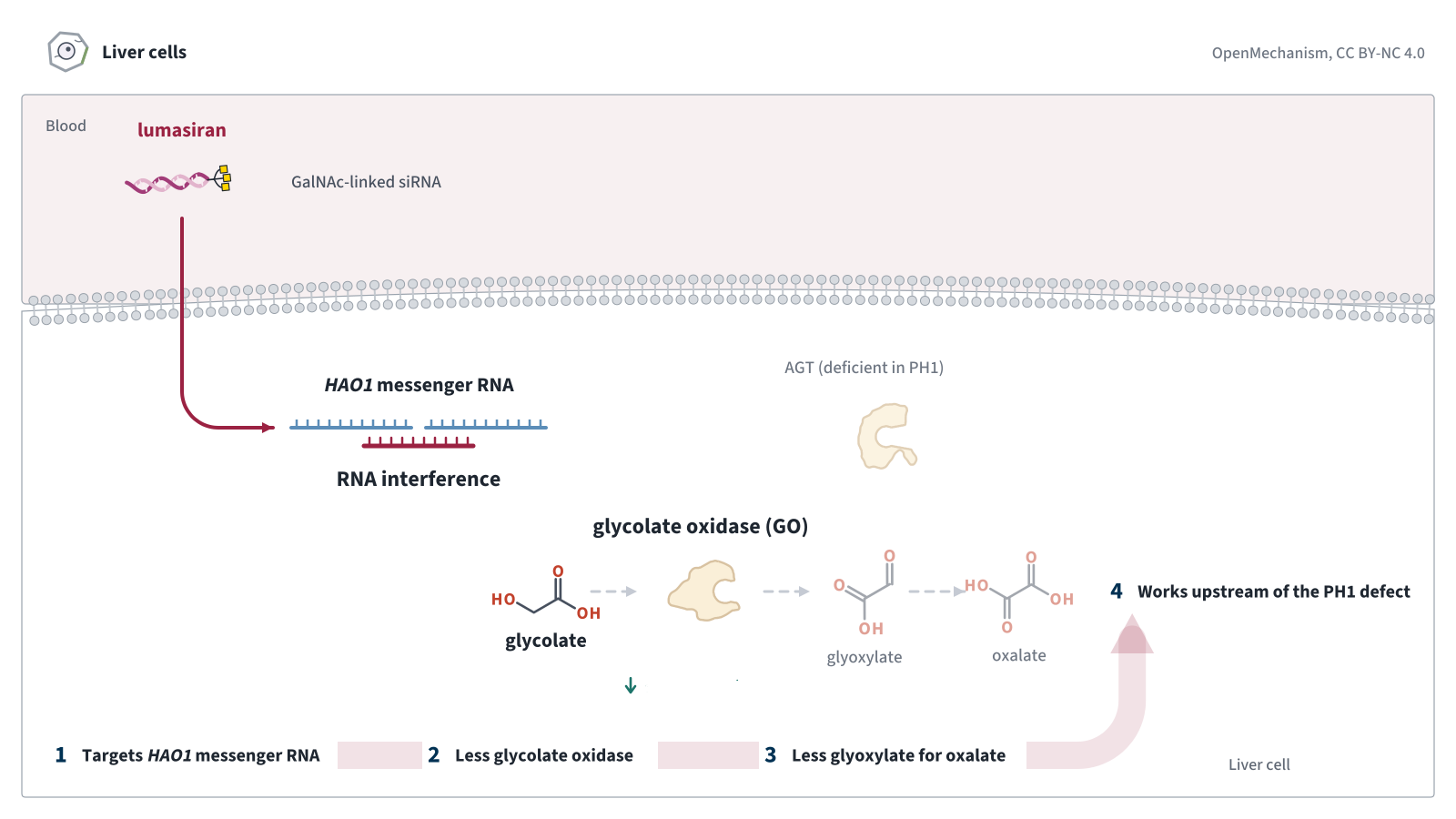
Lumasiran is a that targets the in liver cells. Less glycolate oxidase is made, so less glyoxylate is available for making oxalate. It acts before the faulty enzyme of primary hyperoxaluria type 1, whatever the mutation.
- Acts on
- Hydroxyacid oxidase 1 (HAO1) messenger RNA
- Where
- Liver cells
- Medicine type
- Oligonucleotide
- Used for
- Hormones & metabolism
Also called Oxlumo.
Key terms in this drawing (8)
- AGT
- Alanine-glyoxylate aminotransferase. A liver enzyme of oxalate metabolism; a mutation in its gene, AGXT, causes primary hyperoxaluria type 1.
- GalNAc
- N-acetylgalactosamine. A sugar; attached to a medicine, it helps liver cells take it up.
- GO
- Glycolate oxidase. A liver enzyme; less of it means less glyoxylate, the raw material for oxalate. Lumasiran lowers it.
- HAO1
- HAO1 gene (hydroxyacid oxidase 1). The gene whose messenger RNA codes for glycolate oxidase; lumasiran targets that message in liver cells.
- mRNA
- Messenger RNA. A copy of a gene that a cell reads to make a protein.
- PH1
- Primary hyperoxaluria type 1. A rare, severe inherited disease of oxalate metabolism, caused by a mutation in the AGXT gene.
- RNA
- Ribonucleic acid. A molecule copied from DNA; messenger RNA carries a gene's instructions.
- siRNA
- Small interfering RNA. A short double-stranded RNA that guides the cell to destroy a matching messenger RNA.
How it works
Targets HAO1 messenger RNA. Lumasiran, a small interfering RNA linked to N-acetylgalactosamine (), targets the hydroxyacid oxidase 1 (HAO1) messenger RNA in liver cells through interference.1
Less glycolate oxidase. This reduces levels of the enzyme glycolate oxidase ().1
Less glyoxylate for oxalate. Less GO reduces the amount of available glyoxylate, a substrate for oxalate production.1
Works upstream of the PH1 defect. GO acts upstream of alanine:glyoxylate aminotransferase (AGT), the enzyme that is deficient in primary hyperoxaluria type 1 (), so lumasiran works whatever the gene mutation; it is not expected to work in PH2 or PH3.1
For teachers: download this drawing.
See also
Condition pages: primary hyperoxaluria type 1.
More medicines for hormones & metabolism: alglucosidase alfa, betaine, calcitriol, cinacalcet, cysteamine, dapagliflozin, desmopressin, dexamethasone and 26 more.
Related drawings: fomepizole (blocks alcohol dehydrogenase, which starts ethylene glycol's breakdown to glycolate and oxalate).
Body system: hormones & metabolism.
Sources
- 1Oxlumo (lumasiran) injection: FDA label11 Description; 12.1 Mechanism of Action
- 2ChEMBL CHEMBL4297779Target and action classification: Hydroxyacid oxidase 1 mRNA RNAi inhibitor
Also used for the drawing
The glycolate oxidase and AGT outlines are traced from the crystal structures below.
- 3Human glycolate oxidase with an inhibitorPDB 2RDT; Murray, M.S. et al. Biochemistry 2008; 47:2439-2449
- 4Human alanine:glyoxylate aminotransferase (AGT) with its cofactorPDB 1H0C; Zhang, X. et al. J.Mol.Biol. 2003; 331:643
Spotted a mistake? Report an error (hello@openmechanism.com). Since launch, every published error we fix is listed on the corrections page.
Notes and limits
- A schematic teaching drawing: not to scale, not exact structures, binding poses or a complete pathway, and not a guide to dosing, treatment or how a person will respond.
All recorded limits are on the evidence page, and notes that apply to every page are on How to read a page. Version 1.0.0, not yet medically reviewed.
Cite this page
Tran D. Lumasiran [Internet]. OpenMechanism; 2026 [updated 2026 Oct 10; cited 2026 Oct 10]. Available from: https://openmechanism.com/medicines/lumasiran