Metformin
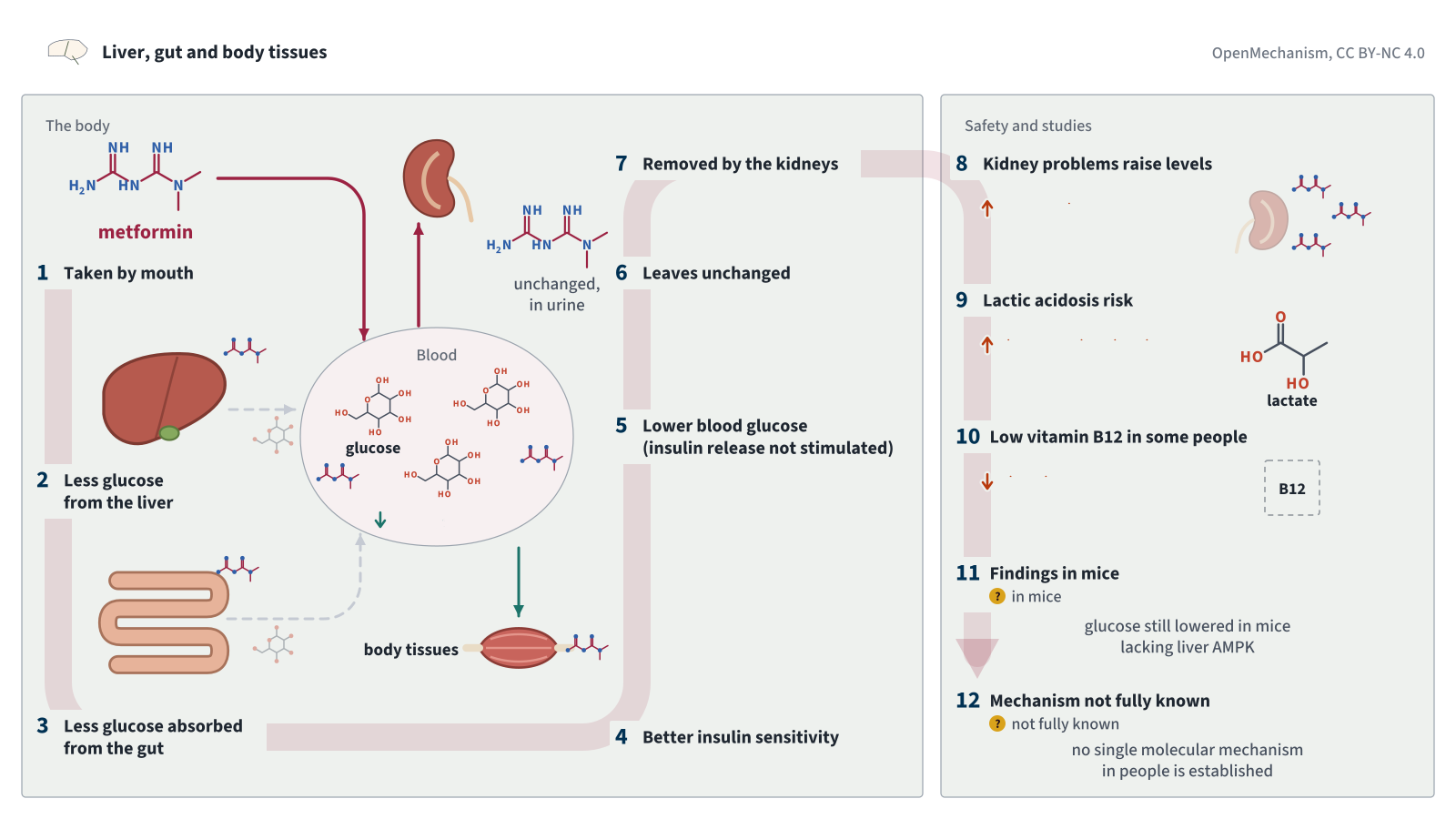
In people with type 2 diabetes, metformin lowers blood glucose without stimulating insulin release. It reduces glucose production by the liver and glucose absorption from the gut, and improves insulin sensitivity in other tissues. The label and the mouse study do not establish a single molecular mechanism in people.
- Where
- Liver, gut and other tissues
- Medicine type
- Small molecule
- Used for
- Hormones & metabolism
Step 11: in mice
Foretz and colleagues' 2010 study in mice found that metformin still lowered blood glucose in mice without liver AMPK: in mice lacking AMPK in the liver, blood glucose levels were comparable to those in wild-type mice, and the hypoglycemic effect of metformin was maintained.
Clinical study: In UKPDS 34 (1998), a randomized controlled trial of intensive blood-glucose control with metformin or a conventional policy, mainly diet, in 753 overweight people with newly diagnosed type 2 diabetes, followed for a median of 10.7 years; the trial measured blood glucose and diabetes-related outcomes in people, not how metformin works: Median glycated haemoglobin (HbA1c) was 7.4% in the metformin group compared with 8.0% in the conventional group.
UK Prospective Diabetes Study (UKPDS) Group, Lancet 1998 (PMID 9742977)
Step 12: not fully known
The metformin label describes what metformin does in the body, without naming a molecular target: Metformin decreases hepatic glucose production, decreases intestinal absorption of glucose, and improves insulin sensitivity by increasing peripheral glucose uptake and utilization.
Key terms in this drawing
- AMPK
- AMP-activated protein kinase. A protein kinase (an enzyme); a pathway through it, LKB1/AMPK, had been proposed to carry metformin's effect on the liver's glucose production.
- vitamin B12
- Vitamin B12 (cobalamin). A vitamin the body needs for growth, cell division, making blood cells and making myelin.
How it works
Taken by mouth. Metformin extended-release tablets, the form the cited label covers, are absorbed after being taken by mouth.1
Less glucose from the liver. Metformin decreases hepatic glucose production.1
Less glucose absorbed from the gut. Metformin decreases intestinal glucose absorption.1
Better insulin sensitivity. Metformin improves insulin sensitivity by increasing peripheral glucose uptake and utilization.1
Lower blood glucose (insulin release not stimulated). In people with type 2 diabetes, metformin lowers both basal and postprandial glucose without stimulating insulin secretion.1
Leaves unchanged. Metformin is excreted unchanged in urine; human metabolites have not been identified.1
Removed by the kidneys. Renal tubular secretion is the major route of metformin elimination.1
Kidney problems raise levels. Renal impairment reduces metformin clearance and increases accumulation risk.1
Lactic acidosis risk. Metformin lowers the liver's uptake of lactate, raising lactate in the blood, which may increase the risk of lactic acidosis, especially in people at risk; the risk rises with the severity of kidney impairment, and some reported cases were fatal.1
Low vitamin B12 in some people. In 29-week clinical trials of metformin hydrochloride tablets, levels that had been normal fell below normal in about 7% of patients.1
Findings in mice. The pathway had been proposed to carry metformin's effect on the liver's glucose production, but metformin still lowered blood glucose in mice lacking AMPK in the liver, and in mouse liver cells lacking AMPK or LKB1 it cut glucose production even more than in normal cells.2
Mechanism not fully known. The label and the mouse study do not establish a single molecular mechanism in people.1,2
For teachers: download this drawing or build a slide deck.
More detail
Effects on the liver, gut and other tissues
Taken by mouth. Metformin extended-release tablets, the form the cited label covers, are absorbed after being taken by mouth.1
Less glucose from the liver. Metformin decreases hepatic glucose production.1
Less glucose absorbed from the gut. Metformin decreases intestinal glucose absorption.1
Better insulin sensitivity. Metformin improves insulin sensitivity by increasing peripheral glucose uptake and utilization.1
Lower blood glucose (insulin release not stimulated). In people with type 2 diabetes, metformin lowers both basal and postprandial glucose without stimulating insulin secretion.1
What the source says
“Metformin is an antihyperglycemic agent which improves glucose tolerance in patients with type 2 diabetes mellitus, lowering both basal and postprandial plasma glucose.”
Source 1
“Metformin decreases hepatic glucose production, decreases intestinal absorption of glucose, and improves insulin sensitivity by increasing peripheral glucose uptake and utilization.”
Source 1
“With metformin therapy, insulin secretion remains unchanged while fasting insulin levels and day-long plasma insulin response may decrease.”
Source 1
Removed unchanged by the kidneys
Leaves unchanged. Metformin is excreted unchanged in urine; human metabolites have not been identified.1
Removed by the kidneys. Renal tubular secretion is the major route of metformin elimination.1
Kidney problems raise levels. Renal impairment reduces metformin clearance and increases accumulation risk.1
What the source says
“Intravenous single-dose studies in normal subjects demonstrate that metformin is excreted unchanged in the urine and does not undergo hepatic metabolism (no metabolites have been identified in humans) nor biliary excretion.”
Source 1
“Renal clearance (see Table 4) is approximately 3.5 times greater than creatinine clearance, which indicates that tubular secretion is the major route of metformin elimination.”
Source 1
“The risk of metformin accumulation and metformin-associated lactic acidosis increases with the severity of renal impairment because metformin is substantially excreted by the kidney.”
Source 1
Lactic acidosis and vitamin B12
Lactic acidosis risk. Metformin lowers the liver's uptake of lactate, raising lactate in the blood, which may increase the risk of lactic acidosis, especially in people at risk; the risk rises with the severity of kidney impairment, and some reported cases were fatal.1
Low vitamin B12 in some people. In 29-week clinical trials of metformin hydrochloride tablets, vitamin B12 levels that had been normal fell below normal in about 7% of patients.1
What the source says
“There have been postmarketing cases of metformin-associated lactic acidosis, including fatal cases.”
Source 1
“Metformin decreases liver uptake of lactate increasing lactate blood levels which may increase the risk of lactic acidosis, especially in patients at risk.”
Source 1
“In clinical trials of 29-week duration with metformin hydrochloride tablets, a decrease to subnormal levels of previously normal serum vitamin B 12 levels was observed in approximately 7% of patients.”
Source 1
What studies in mice show, and what is not known
Findings in mice. The AMPK pathway had been proposed to carry metformin's effect on the liver's glucose production, but metformin still lowered blood glucose in mice lacking AMPK in the liver, and in mouse liver cells lacking AMPK or LKB1 it cut glucose production even more than in normal cells.2
Mechanism not fully known. The label and the mouse study do not establish a single molecular mechanism in people.1,2
What the source says
“Recently the LKB1/AMP-activated protein kinase (LKB1/AMPK) pathway was proposed to mediate the action of metformin on hepatic gluconeogenesis.”
Source 2
“in mice lacking AMPK in the liver, blood glucose levels were comparable to those in wild-type mice, and the hypoglycemic effect of metformin was maintained.”
Source 2
“Surprisingly, metformin-induced inhibition of glucose production was amplified in both AMPK- and LKB1-deficient compared with wild-type hepatocytes.”
Source 2
See also
Condition pages: type 2 diabetes.
Explained: why metformin can cause lactic acidosis; what the body does with metformin; and why PPIs and metformin can lower vitamin B12.
Body system: hormones & metabolism.
Sources
- 1Metformin hydrochloride extended-release tablets: FDA label1 Indications and Usage; 12.1 Mechanism of Action; 12.3 Pharmacokinetics; 5.1 Lactic Acidosis; 5.2 Vitamin B12 Deficiency; 5.3 Hypoglycemia with Concomitant Use with Insulin and Insulin Secretagogues
- 2Metformin inhibits hepatic gluconeogenesis in mice independently of the LKB1/AMPK pathway via a decrease in hepatic energy stateForetz M et al., J Clin Invest 2010 (abstract)
- 3ChEMBL CHEMBL1431Target and action classification: Mitochondrial complex I (NADH dehydrogenase) inhibitor; Mitochondrial glycerol-3-phosphate dehydrogenase inhibitor
- 4Effect of intensive blood-glucose control with metformin on complications in overweight patients with type 2 diabetes (UKPDS 34)UK Prospective Diabetes Study (UKPDS) Group. Lancet 1998 (abstract)
Spotted a mistake? Report an error (hello@openmechanism.com). Since launch, every published error we fix is listed on the corrections page.
Notes and limits
- A schematic teaching drawing: not to scale, not exact structures, binding poses or a complete pathway, and not a guide to dosing, treatment or how a person will respond.
- The steps are in the order that explains them; one step is said to cause the next only where the source says so.
- Findings in mice and in isolated mouse liver cells are not taken to show what causes effects in people, or to hold for every formulation or concentration.
- Absorption is shown for the extended-release tablets only; it is not assumed to be the same for other forms of metformin.
- Physiological effect; precise molecular mediator is not specified.
- The label does not say how much each effect, in the liver, gut or other tissues, adds to the overall lowering of blood glucose.
- Peripheral sites and one exclusive molecular mediator are not resolved here.
- The label says metformin may increase the risk of low blood sugar (hypoglycemia) when combined with insulin or with medicines that increase insulin release, such as a sulfonylurea.
- Not a prediction for an individual; exposure depends on the clinical context.
- Lactic acidosis is a risk, not a certain outcome.
- The label gives only a possible cause for the fall in vitamin B12: interference with B12 absorption.
- Model- and concentration-dependent result; not proof that AMPK never contributes in humans.
- In the mouse liver cells, less glucose production went with less cell energy (ATP); that link does not identify one molecular target.
- In vivo glucose excursions and isolated-cell glucose production are different measurements.
- That no single mechanism in people is established is our reading of these sources, not the finding of any one study.
All recorded limits are on the evidence page, and notes that apply to every page are on How to read a page. Version 1.0.1, medically reviewed by Daniel Tran, PharmD, on 30 October 2026.
Cite this page
Tran D. Metformin [Internet]. OpenMechanism; 2026 [updated 2026 Oct 30; cited 2026 Oct 30]. Available from: https://openmechanism.com/medicines/metformin