Betaine
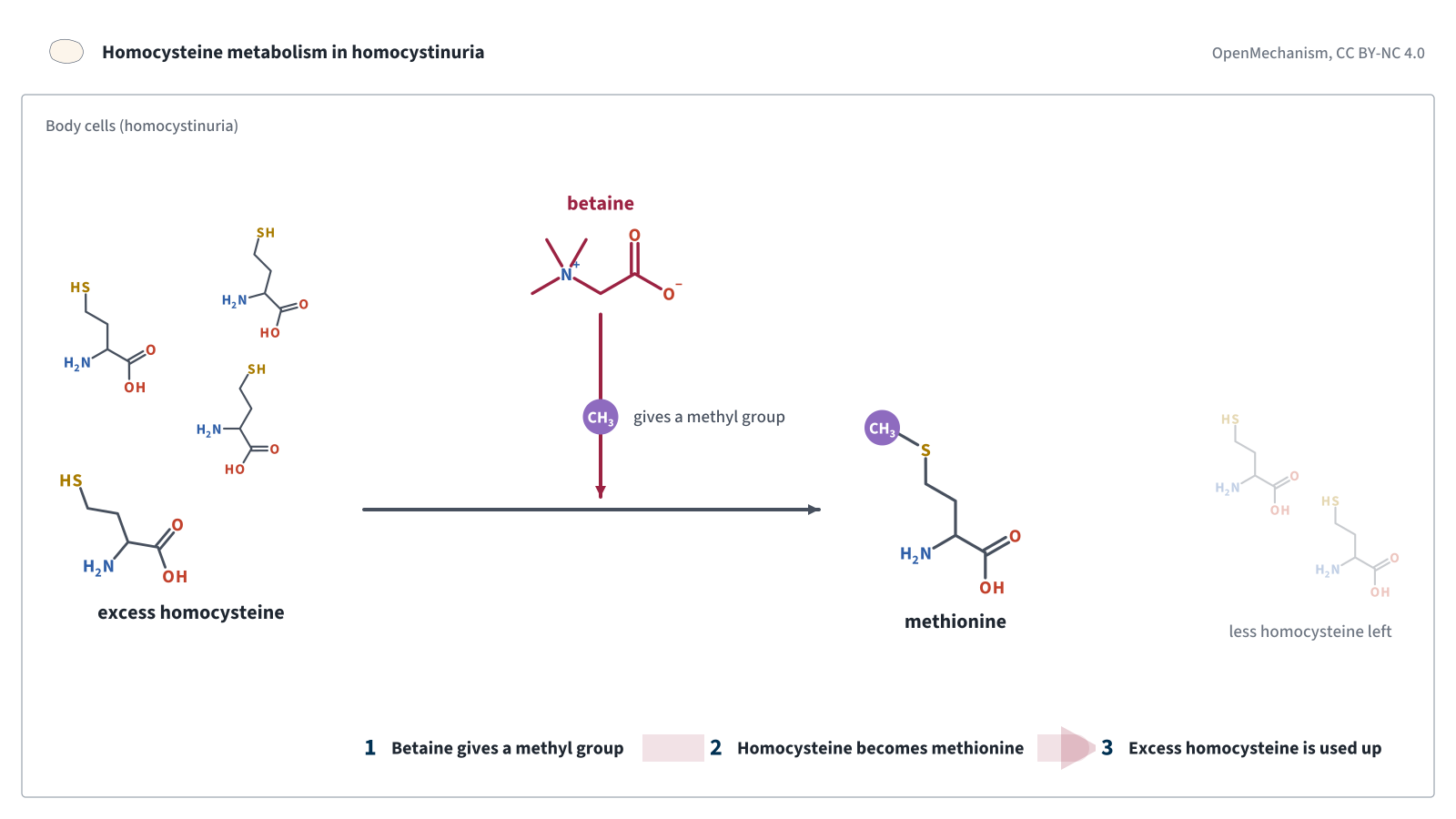
In homocystinuria, homocysteine builds up. Betaine donates a methyl group that converts homocysteine into methionine, using up the excess.
- Acts on
- Homocysteine remethylation
- Where
- Homocysteine metabolism in homocystinuria
- Medicine type
- Small molecule
- Used for
- Hormones & metabolism
How it works
Betaine gives a methyl group. Betaine supplies a methyl group for the remethylation reaction.1
Homocysteine becomes methionine. The methyl-transfer reaction converts homocysteine to methionine.1
Excess homocysteine is used up. The selected pathway consumes homocysteine rather than inhibiting its remethylation.1
For teachers: download this drawing or build a slide deck.
See also
Condition pages: homocystinuria.
More medicines for hormones & metabolism: alglucosidase alfa, calcitriol, cinacalcet, cysteamine, dapagliflozin, desmopressin, dexamethasone, dulaglutide and 26 more.
Body system: hormones & metabolism.
Sources
- 1Betaine: FDA label12.1 Mechanism of Action
- 2ChEMBL CHEMBL95889Target and action classification: Betaine-homocysteine S-methyltransferase substrate
Spotted a mistake? Report an error (hello@openmechanism.com). Since launch, every published error we fix is listed on the corrections page.
Notes and limits
- A schematic teaching drawing: not to scale, not exact structures, binding poses or a complete pathway, and not a guide to dosing, treatment or how a person will respond.
- Other medicines in the same family may not follow every step or share the same clinical endpoint.
- The steps are in the order that explains them; one step is said to cause the next only where the source says so.
- The selected label identifies methyl donation; the precise enzyme structure and intracellular flux are not reconstructed.
- Substrate consumption is a chemical route, not a patient-specific plasma reduction prediction.
All recorded limits are on the evidence page, and notes that apply to every page are on How to read a page. Version 1.0.0, not yet medically reviewed.
Cite this page
Tran D. Betaine [Internet]. OpenMechanism; 2026 [updated 2026 Oct 14; cited 2026 Oct 14]. Available from: https://openmechanism.com/medicines/betaine