We’re looking for volunteer reviewers in pharmacy, medicine and pharmacology. How to volunteerWe’re looking for volunteer reviewers.

Thyroid hormone

From the thyroid in the neck down to thyroid hormone at its receptor on the DNA: normal, in hypothyroidism, and with levothyroxine.

Zoom
Compare

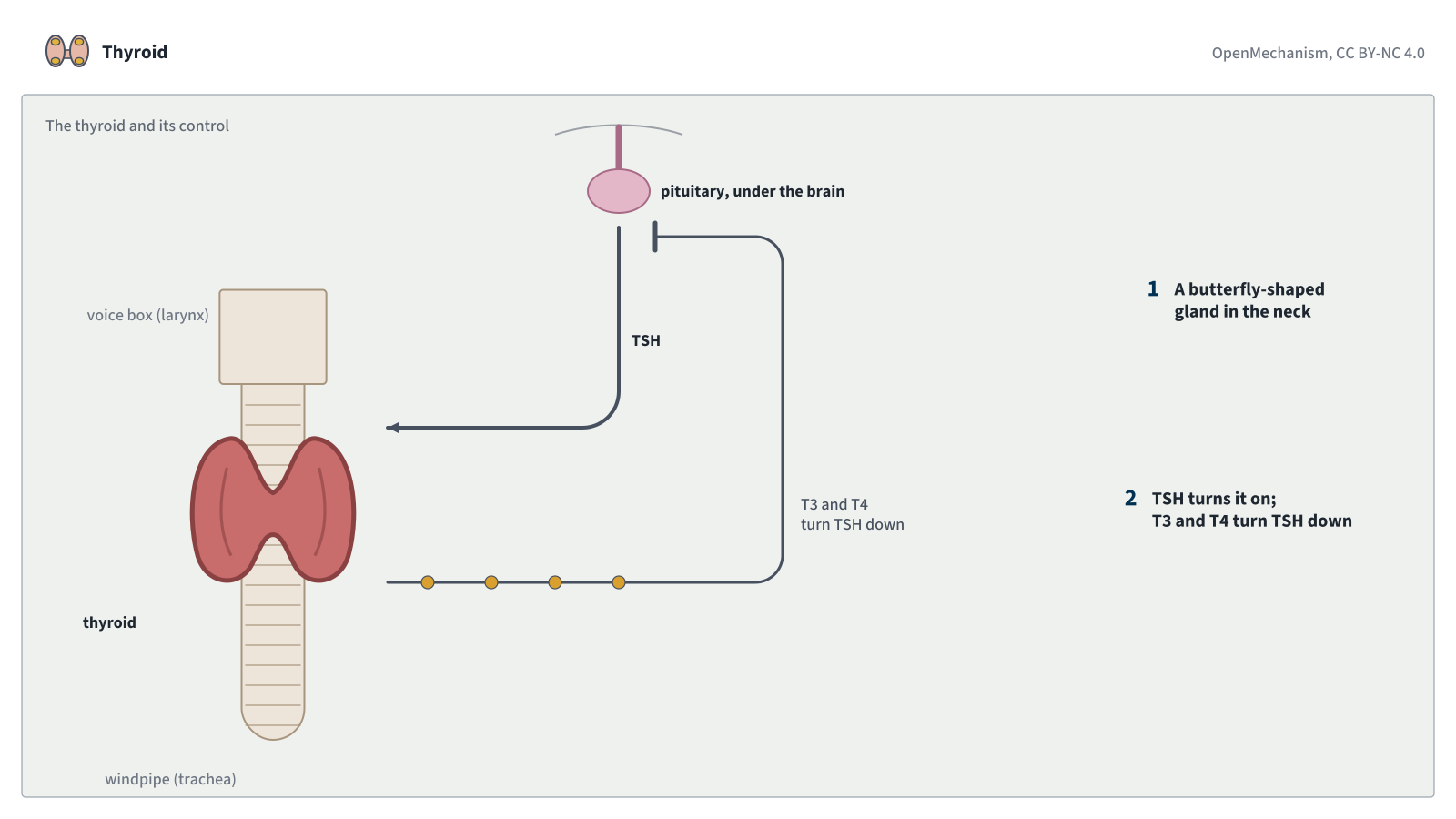
The thyroid and its control, normal

Drawing: The thyroid and its control, normal. 1: A butterfly-shaped gland in the neck. 2: TSH turns it on; T3 and T4 turn TSH down.
Schematic, not to scale. License CC BY-NC 4.0.

For teachers: download this drawing.

  1. A butterfly-shaped gland in the neck. The thyroid is a butterfly-shaped gland in front of the windpipe (trachea), just below the voice box (larynx).1

    What the source says

    “A butterfly-shaped organ, the thyroid gland is located anterior to the trachea, just inferior to the larynx”

    Source 1
  2. TSH turns it on; T3 and T4 turn TSH down. from the pituitary makes the thyroid release and , and rising T3 and T4 turn TSH down again (negative feedback).1

    What the source says

    “In turn, TSH stimulates the thyroid gland to secrete T3 and T4.”

    Source 1

    “The levels of TRH, TSH, T3, and T4 are regulated by a negative feedback system in which increasing levels of T3 and T4 decrease the production and secretion of TSH.”

    Source 1

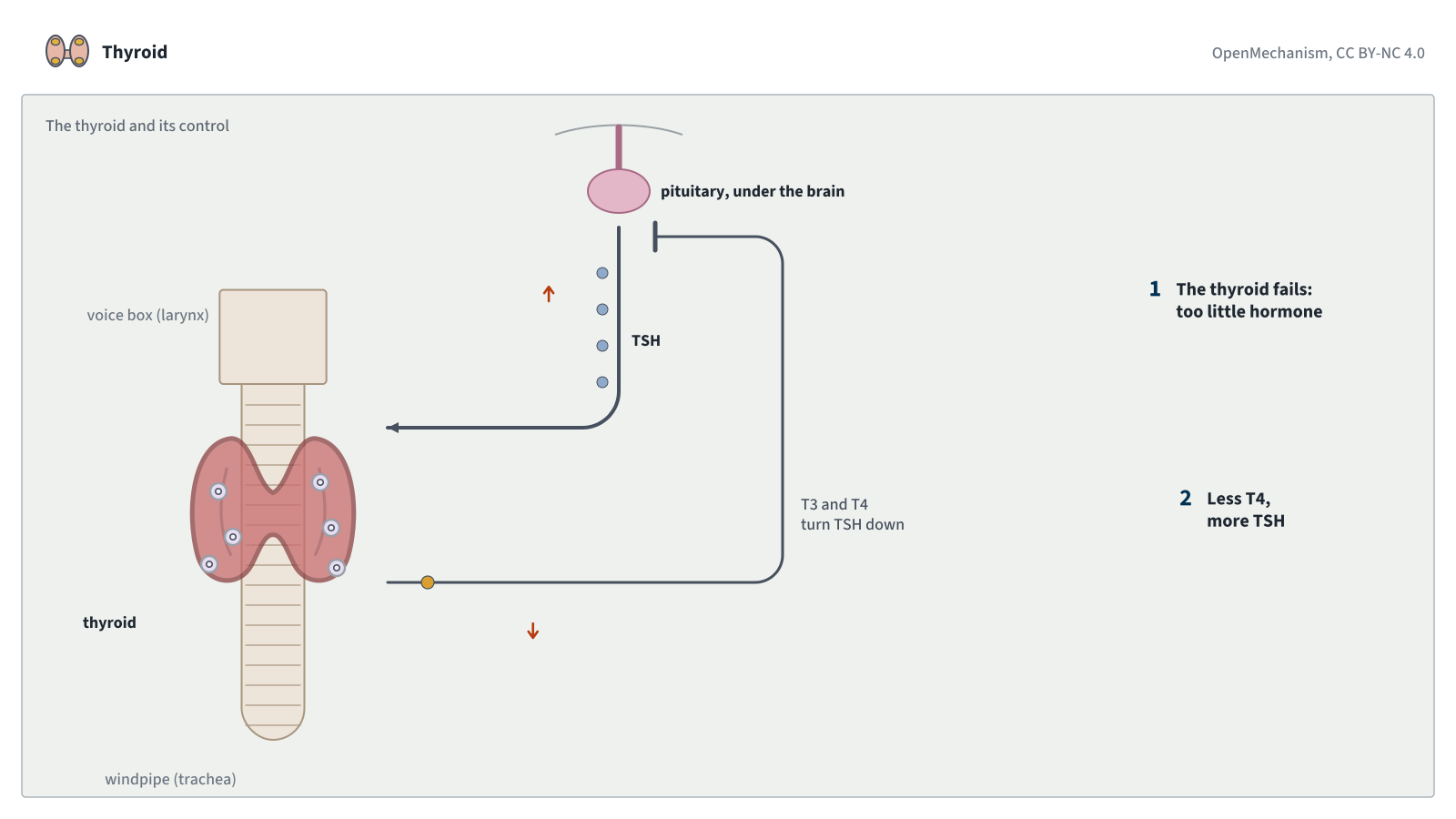
The thyroid and its control, hypothyroidism

Drawing: The thyroid and its control, hypothyroidism. 1: The thyroid fails: too little hormone. 2: Less T4, more TSH.
Schematic, not to scale. License CC BY-NC 4.0.

For teachers: download this drawing.

  1. The thyroid fails: too little hormone. Hypothyroidism is too little thyroid hormone. Its most common cause is long-lasting autoimmune inflammation of the thyroid (Hashimoto's thyroiditis).2

    What the source says

    “Hypothyroidism, the deficiency of thyroid hormone, is a common condition worldwide.”

    Source 2

    “The most common cause of hypothyroidism is chronic autoimmune thyroiditis (Hashimoto's thyroiditis), although other causes, including drugs (such as amiodarone, lithium, and immune checkpoint inhibitors), radioactive-iodine treatment, and thyroid surgery, are frequent.”

    Source 2
  2. Less T4, more TSH. In overt primary hypothyroidism, TSH is high and free thyroxine (T4) is below the normal range.3

    What the source says

    “Overt primary hypothyroidism is defined as elevated thyroid-stimulating hormone (TSH) concentration in combination with free thyroxine”

    Source 3

    “concentration below the reference range”

    Source 3

More on the condition: hypothyroidism.

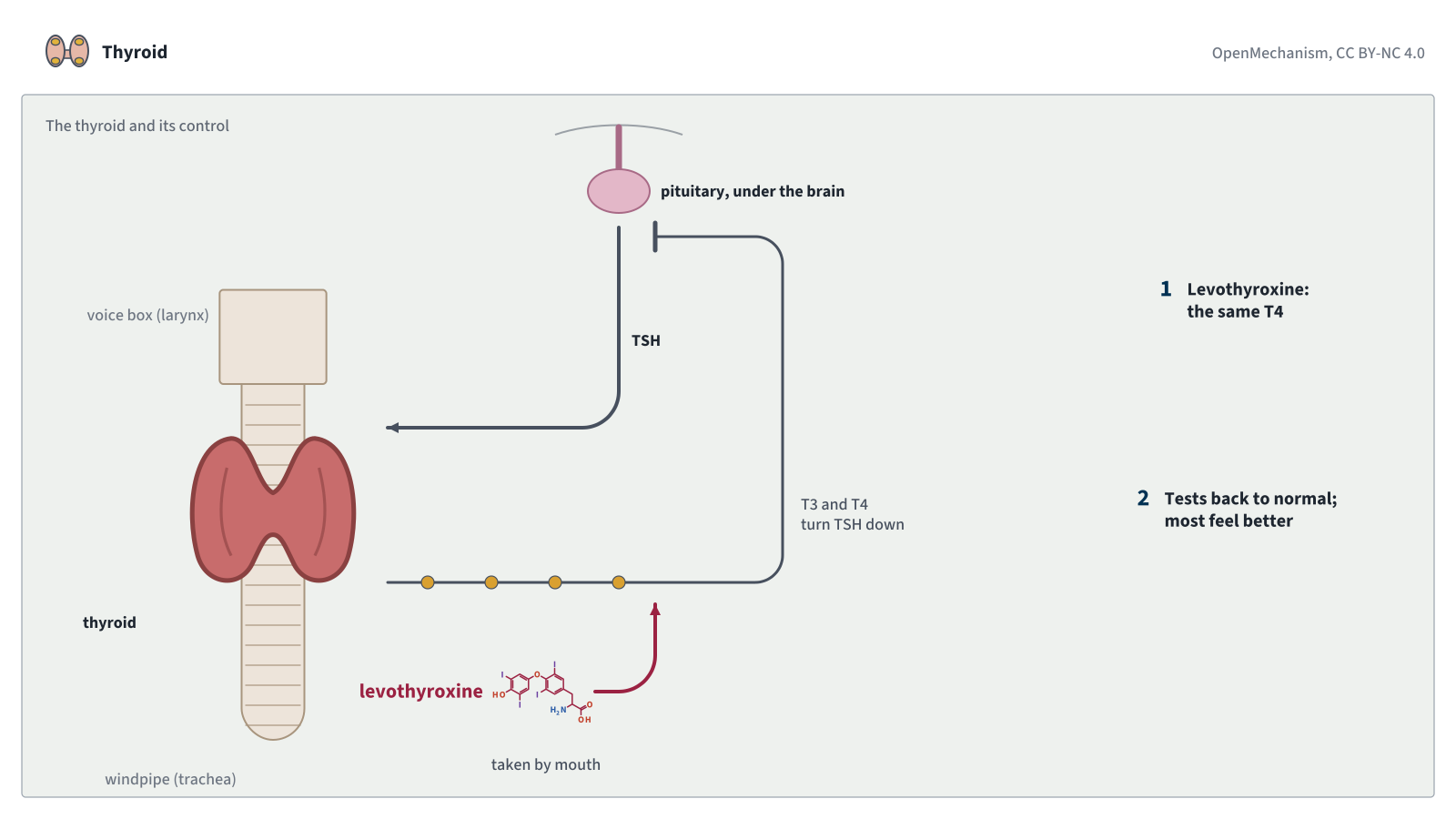
The thyroid and its control, with levothyroxine

Drawing: The thyroid and its control, with levothyroxine. 1: Levothyroxine: the same T4. 2: Tests back to normal; most feel better.
Schematic, not to scale. License CC BY-NC 4.0.

For teachers: download this drawing.

  1. Levothyroxine: the same T4. Levothyroxine is synthetic T4, chemically identical to the T4 the thyroid makes, and keeps T4 levels normal when there is too little.4

    What the source says

    “Synthetic T4 is chemically identical to that produced in the human thyroid gland.”

    Source 4

    “Oral levothyroxine sodium is a synthetic T4 hormone that exerts the same physiologic effect as endogenous T4, thereby maintaining normal T4 levels when a deficiency is present.”

    Source 4
  2. Tests back to normal; most feel better. It is the standard treatment: it brings thyroid function tests back into the normal range and improves symptoms in most patients, though about 10% still feel unwell.2

    What the source says

    “Levothyroxine monotherapy is the standard treatment for hypothyroidism; it is safe and inexpensive, restores thyroid function tests to within the reference range, and improves symptoms in the majority of patients.”

    Source 2

    “However, 10% of patients have persistent symptoms of ill health despite normalisation of thyroid function tests biochemically”

    Source 2

More on the medicine: levothyroxine.

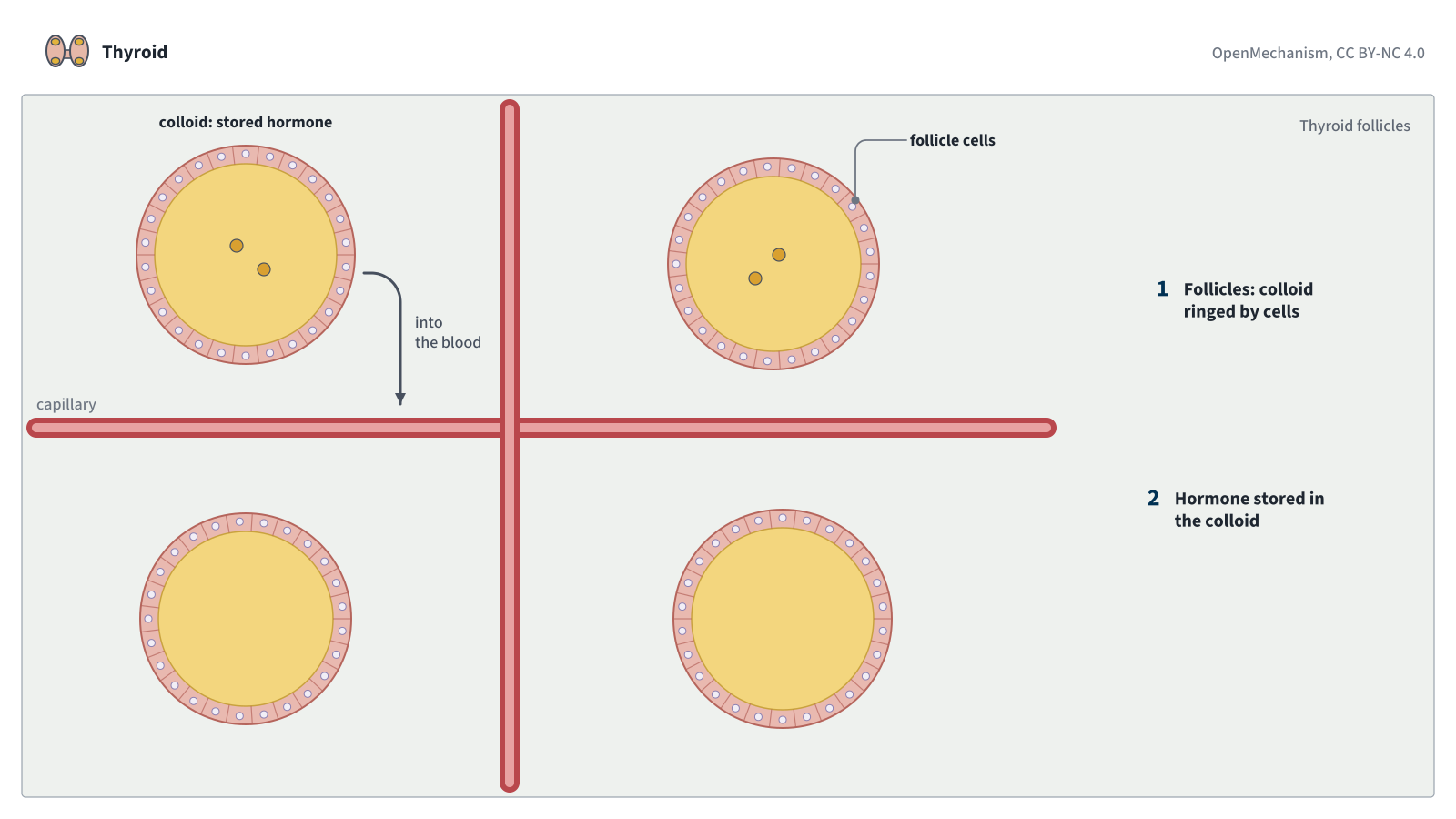
Thyroid follicles, normal

Drawing: Thyroid follicles, normal. 1: Follicles: colloid ringed by cells. 2: Hormone stored in the colloid.
Schematic, not to scale. License CC BY-NC 4.0.

For teachers: download this drawing.

  1. Follicles: colloid ringed by cells. The thyroid is made mostly of follicles: a central space filled with a sticky fluid, the colloid, inside a wall of follicle cells.1

    What the source says

    “The tissue of the thyroid gland is composed mostly of thyroid follicles.”

    Source 1

    “The follicles are made up of a central cavity filled with a sticky fluid called colloid.”

    Source 1

    “Surrounded by a wall of epithelial follicle cells, the colloid is the center of thyroid hormone production”

    Source 1
  2. Hormone stored in the colloid. T3 and T4 stay in the colloid until TSH makes the follicle cells take colloid back in; there they are freed and pass into the blood.1

    What the source says

    “These hormones remain in the colloid center of the thyroid follicles until TSH stimulates endocytosis of colloid back into the follicle cells.”

    Source 1

    “There, lysosomal enzymes break apart the thyroglobulin colloid, releasing free T3 and T4, which diffuse across the follicle cell membrane and enter the bloodstream.”

    Source 1

Thyroid follicles, hypothyroidism

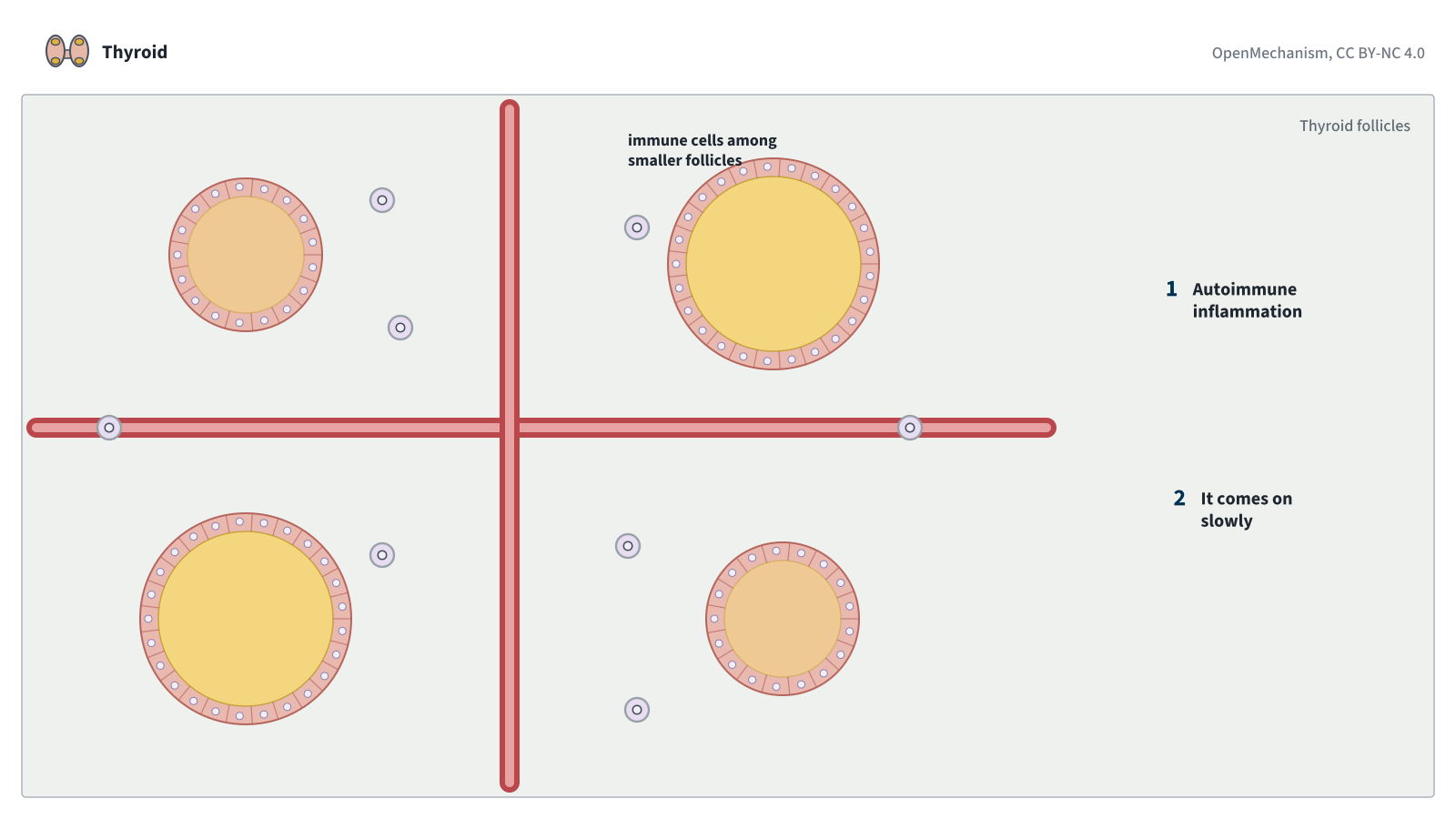
Drawing: Thyroid follicles, hypothyroidism. 1: Autoimmune inflammation. 2: It comes on slowly.
Schematic, not to scale. License CC BY-NC 4.0.

For teachers: download this drawing.

  1. Autoimmune inflammation. Where there is enough iodine, primary hypothyroidism is most often caused by chronic autoimmune thyroiditis; severe iodine deficiency can also cause it.1,3

    What the source says

    “Acquired primary hypothyroidism is the most prevalent form and can be caused by severe iodine deficiency but is more frequently caused by chronic autoimmune thyroiditis in iodine-replete areas.”

    Source 3

    “Instead, inflammation of the thyroid gland is the more common cause of low blood levels of thyroid hormones.”

    Source 1
  2. It comes on slowly. It usually comes on slowly, and symptoms may appear late.3

    What the source says

    “The onset of hypothyroidism is insidious in most cases and symptoms may present relatively late in the disease process.”

    Source 3

More on the condition: hypothyroidism.

Thyroid follicles, with levothyroxine

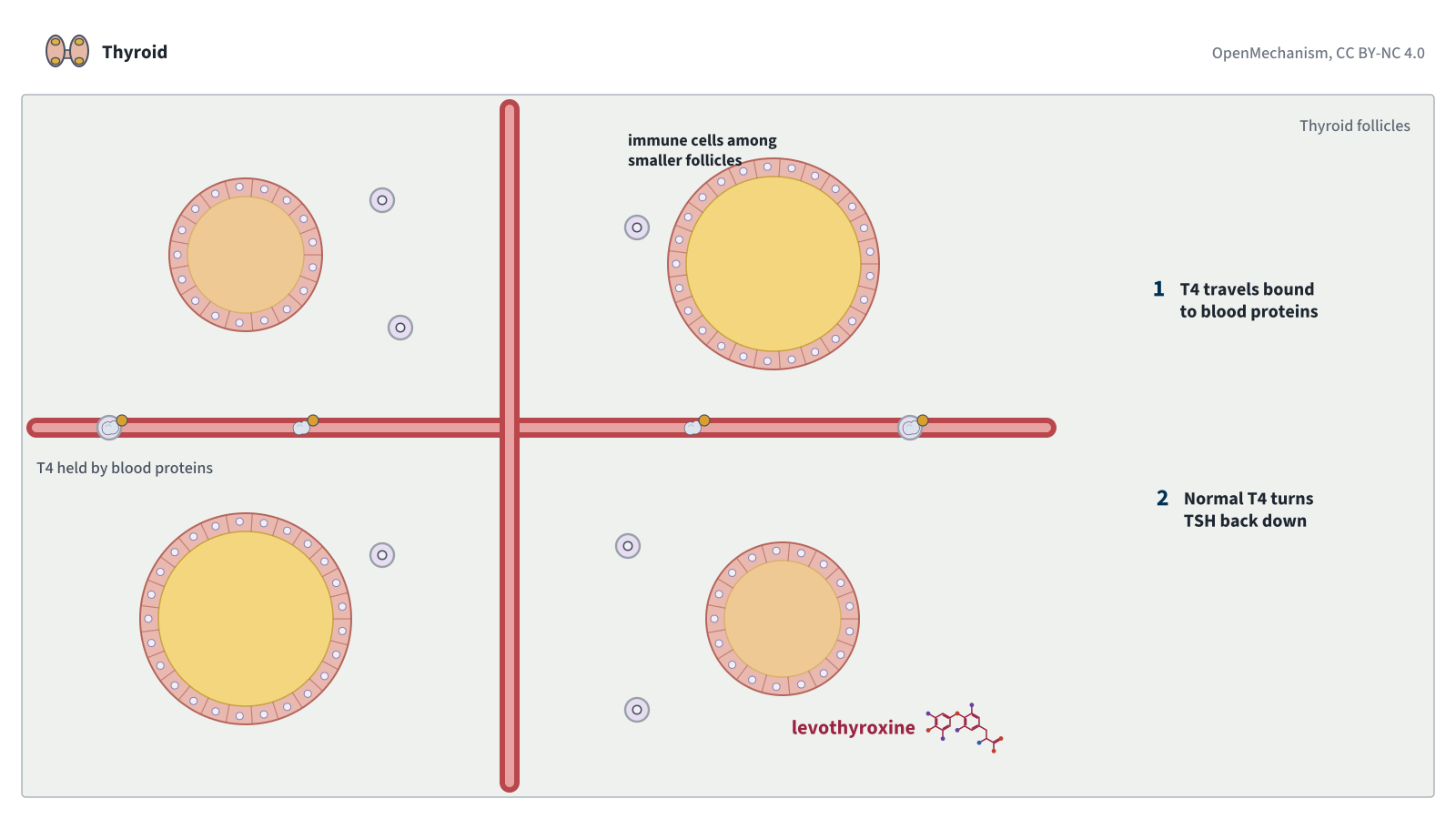
Drawing: Thyroid follicles, with levothyroxine. 1: T4 travels bound to blood proteins. 2: Normal T4 turns TSH back down.
Schematic, not to scale. License CC BY-NC 4.0.

For teachers: download this drawing.

  1. T4 travels bound to blood proteins. In the blood more than 99% of thyroid hormone is bound to proteins such as thyroxine-binding globulin; only the unbound hormone is active.4

    What the source says

    “Circulating thyroid hormones are greater than 99% bound to plasma proteins, including thyroxine-binding globulin (TBG), thyroxine-binding prealbumin (TBPA), and albumin (TBA), whose capacities and affinities vary for each hormone.”

    Source 4

    “Only unbound hormone is metabolically active.”

    Source 4
  2. Normal T4 turns TSH back down. With T4 back to normal, the negative feedback turns TSH down again, and thyroid function tests return to the normal range.1,2

    What the source says

    “The levels of TRH, TSH, T3, and T4 are regulated by a negative feedback system in which increasing levels of T3 and T4 decrease the production and secretion of TSH.”

    Source 1

    “restores thyroid function tests to within the reference range”

    Source 2

More on the medicine: levothyroxine.

Cells that make and use it, normal

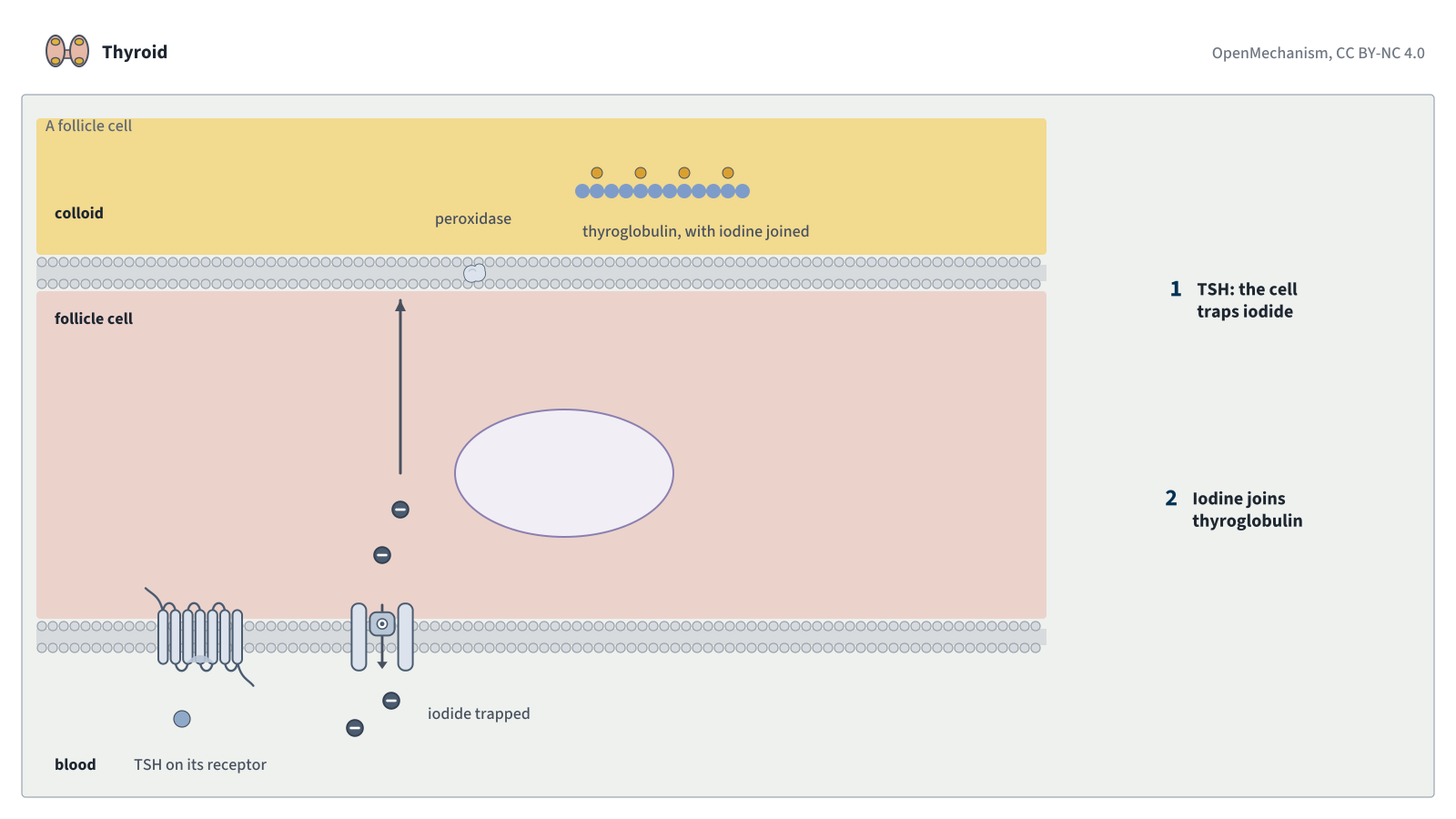
Drawing: Cells that make and use it, normal. 1: TSH: the cell traps iodide. 2: Iodine joins thyroglobulin.
Schematic, not to scale. License CC BY-NC 4.0.

For teachers: download this drawing.

  1. TSH: the cell traps iodide. When TSH binds its receptors on a follicle cell, the cell actively takes up iodide from the blood, trapping it at many times its level in the blood.1

    What the source says

    “Binding of TSH to its receptors in the follicle cells of the thyroid gland causes the cells to actively transport iodide ions (I–) across their cell membrane, from the bloodstream into the cytosol.”

    Source 1

    “As a result, the concentration of iodide ions “trapped” in the follicular cells is many times higher than the concentration in the bloodstream.”

    Source 1
  2. Iodine joins thyroglobulin. In the colloid, peroxidase enzymes link iodine to the tyrosines of thyroglobulin, a protein the follicle cells secrete there, building the hormones.1

    What the source says

    “Hormones are produced in the colloid when atoms of the mineral iodine attach to a glycoprotein, called thyroglobulin, that is secreted into the colloid by the follicle cells.”

    Source 1

    “In the colloid, peroxidase enzymes link the iodine to the tyrosine amino acids in thyroglobulin to produce two intermediaries: a tyrosine attached to one iodine and a tyrosine attached to two iodines.”

    Source 1

Cells that make and use it, hypothyroidism

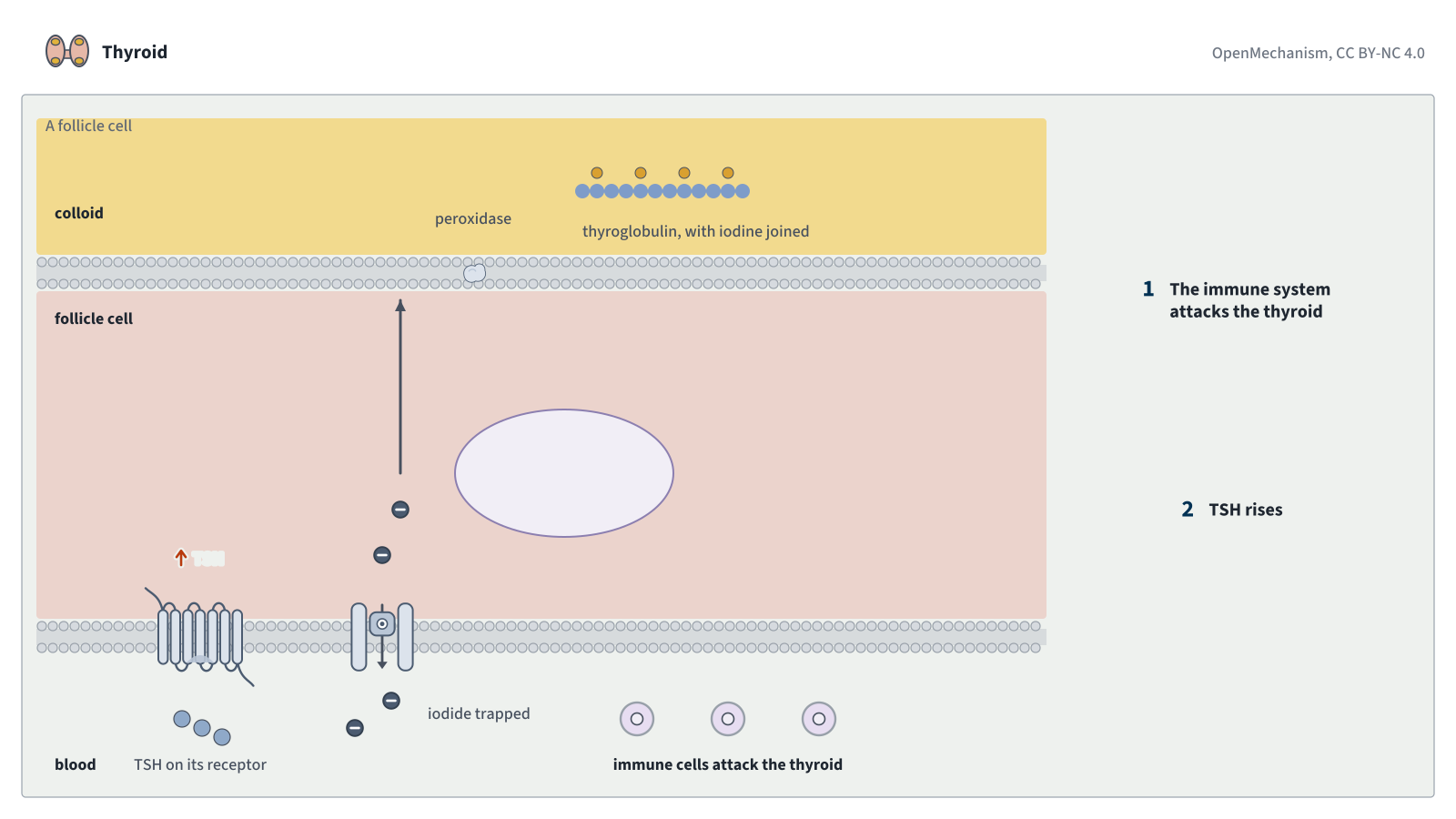
Drawing: Cells that make and use it, hypothyroidism. 1: The immune system attacks the thyroid. 2: TSH rises.
Schematic, not to scale. License CC BY-NC 4.0.

For teachers: download this drawing.

  1. The immune system attacks the thyroid. In chronic autoimmune thyroiditis (Hashimoto's), the immune system mistakes the thyroid's own cells for an enemy.2,5

    What the source says

    “The most common cause of hypothyroidism is chronic autoimmune thyroiditis (Hashimoto's thyroiditis)”

    Source 2

    “Although the immune system protects the body by attacking invading “enemies” (pathogens), in some cases, the immune system can mistakenly identify the body’s own cells as the enemy, resulting in autoimmune disease.”

    Source 5
  2. TSH rises. With too little T4 to turn it down, TSH from the pituitary rises.1,3

    What the source says

    “The levels of TRH, TSH, T3, and T4 are regulated by a negative feedback system in which increasing levels of T3 and T4 decrease the production and secretion of TSH.”

    Source 1

    “Overt primary hypothyroidism is defined as elevated thyroid-stimulating hormone (TSH) concentration in combination with free thyroxine”

    Source 3

    “concentration below the reference range”

    Source 3

More on the condition: hypothyroidism.

Cells that make and use it, with levothyroxine

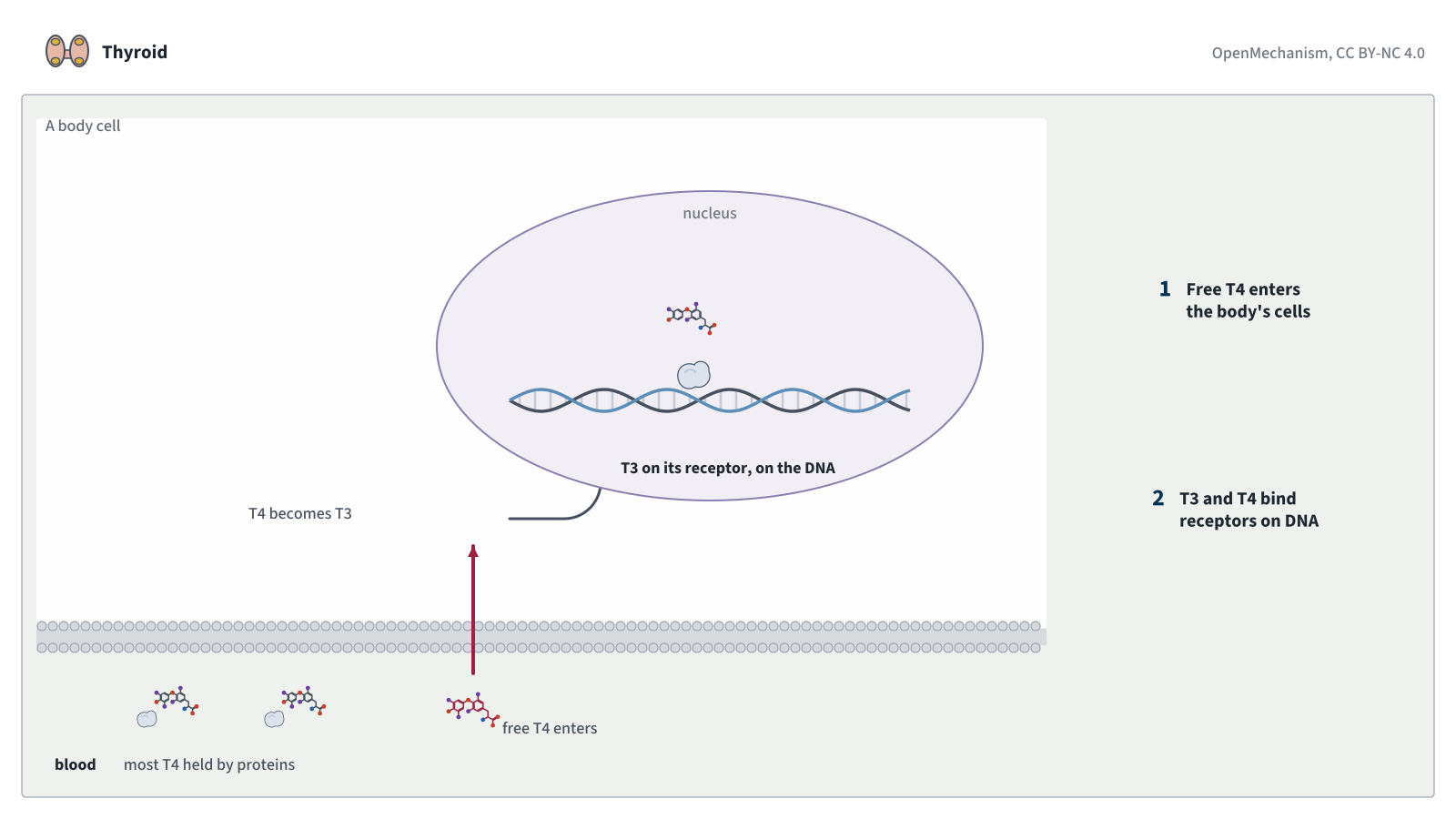
Drawing: Cells that make and use it, with levothyroxine. 1: Free T4 enters the body's cells. 2: T3 and T4 bind receptors on DNA.
Schematic, not to scale. License CC BY-NC 4.0.

For teachers: download this drawing.

  1. Free T4 enters the body's cells. Only the small free part of T3 and T4 crosses cell membranes into cells; the rest travels bound to proteins.1

    What the source says

    “This free T3 and T4 can cross the lipid bilayer of cell membranes and be taken up by cells.”

    Source 1

    “The remaining 99 percent of circulating T3 and T4 is bound to specialized transport proteins called thyroxine-binding globulins (TBGs), to albumin, or to other plasma proteins.”

    Source 1
  2. T3 and T4 bind receptors on DNA. T3 and T4 move into the nucleus and bind thyroid hormone receptors on the , switching on genes and protein making.4

    What the source says

    “Triiodothyronine (T3) and L-thyroxine (T4) diffuse into the cell nucleus and bind to thyroid receptor proteins attached to DNA.”

    Source 4

    “This hormone nuclear receptor complex activates gene transcription and synthesis of messenger RNA and cytoplasmic proteins.”

    Source 4

More on the medicine: levothyroxine.

T4, T3 and their receptor, normal

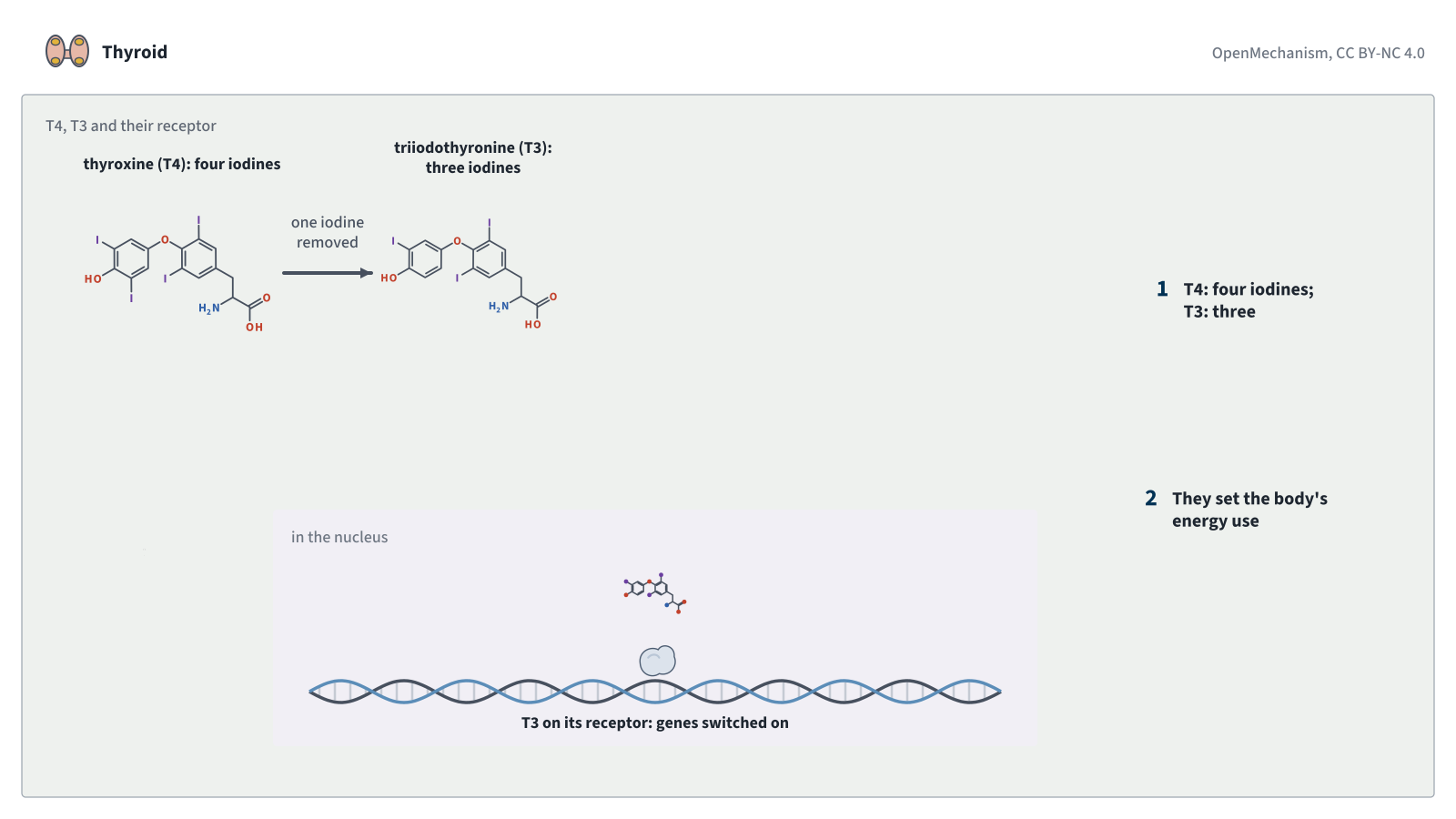
Drawing: T4, T3 and their receptor, normal. 1: T4: four iodines; T3: three. 2: They set the body's energy use.
Schematic, not to scale. License CC BY-NC 4.0.

For teachers: download this drawing.

  1. T4: four iodines; T3: three. Thyroxine (T4) carries four iodines and triiodothyronine (T3) three; the thyroid makes much more T4.1

    What the source says

    “When one of each of these intermediaries is linked by covalent bonds, the resulting compound is triiodothyronine (T3), a thyroid hormone with three iodines.”

    Source 1

    “Much more commonly, two copies of the second intermediary bond, forming tetraiodothyronine, also known as thyroxine (T4), a thyroid hormone with four iodines.”

    Source 1
  2. They set the body's energy use. T3 and T4 set the basal metabolic rate, the energy the body uses at rest: they speed the breakdown of nutrients and switch on genes for burning glucose.1

    What the source says

    “The thyroid hormones, T3 and T4, are often referred to as metabolic hormones because their levels influence the body’s basal metabolic rate, the amount of energy used by the body at rest.”

    Source 1

    “When T3 and T4 bind to intracellular receptors located on the mitochondria, they cause an increase in nutrient breakdown and the use of oxygen to produce ATP.”

    Source 1

    “In addition, T3 and T4 initiate the transcription of genes involved in glucose oxidation.”

    Source 1

T4, T3 and their receptor, hypothyroidism

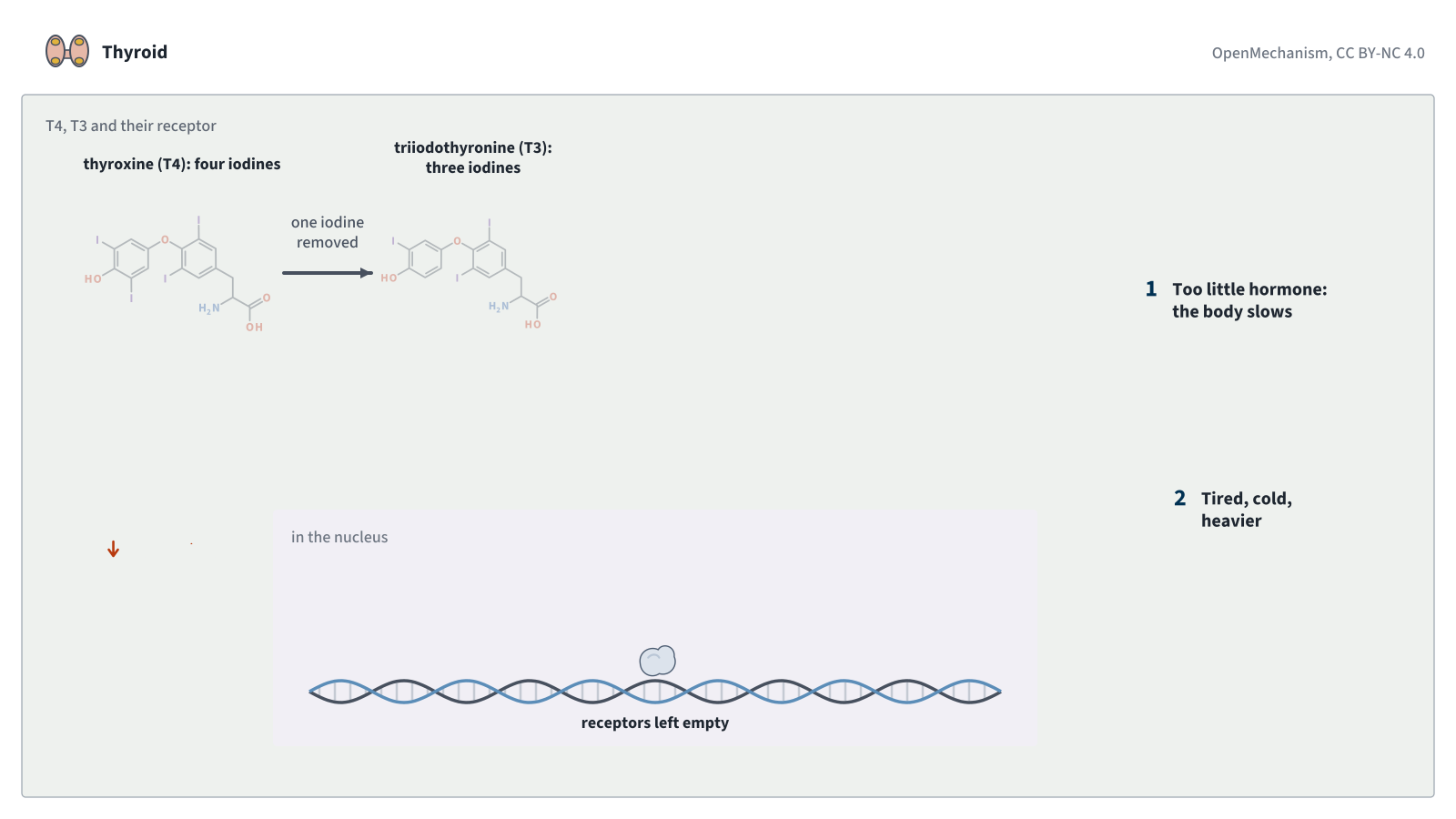
Drawing: T4, T3 and their receptor, hypothyroidism. 1: Too little hormone: the body slows. 2: Tired, cold, heavier.
Schematic, not to scale. License CC BY-NC 4.0.

For teachers: download this drawing.

  1. Too little hormone: the body slows. With too little hormone the metabolic rate is low; weight gain, cold hands and feet, constipation and slowed thinking can follow.1

    What the source says

    “Called hypothyroidism, the condition is characterized by a low metabolic rate, weight gain, cold extremities, constipation, reduced libido, menstrual irregularities, and reduced mental activity.”

    Source 1
  2. Tired, cold, heavier. The classic symptoms are tiredness, lethargy, weight gain and feeling the cold, but they are not specific: blood tests make the diagnosis.2

    What the source says

    “The classic symptoms of hypothyroidism include fatigue, lethargy, weight gain, and cold intolerance; however, these symptoms are non-specific and the diagnosis is typically made on biochemical grounds through serum thyroid function tests.”

    Source 2

More on the condition: hypothyroidism.

T4, T3 and their receptor, with levothyroxine

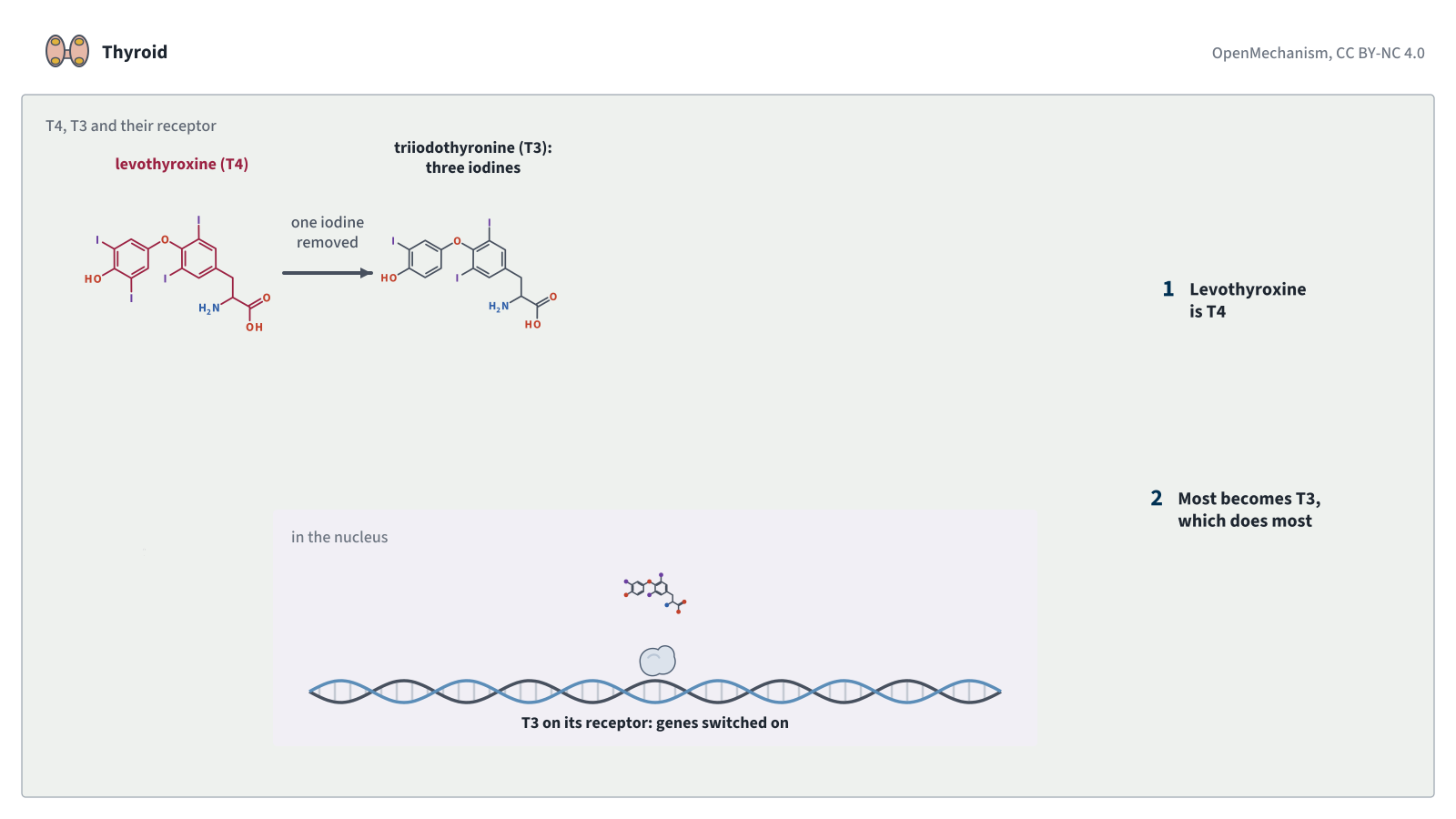
Drawing: T4, T3 and their receptor, with levothyroxine. 1: Levothyroxine is T4. 2: Most becomes T3, which does most.
Schematic, not to scale. License CC BY-NC 4.0.

For teachers: download this drawing.

  1. Levothyroxine is T4. Levothyroxine is L-thyroxine (T4) itself, made synthetically: the same four-iodine molecule.4

    What the source says

    “SYNTHROID (levothyroxine sodium tablets, USP) is L-thyroxine (T4) and contains synthetic crystalline L-3,3',5,5'-tetraiodothyronine sodium salt.”

    Source 4

    “Synthetic T4 is chemically identical to that produced in the human thyroid gland.”

    Source 4
  2. Most becomes T3, which does most. Thyroid hormones act mostly through T3, and about 80% of T3 is made from T4 in the body's tissues by removing one iodine.4

    What the source says

    “The physiological actions of thyroid hormones are produced predominantly by T3, the majority of which (approximately 80%) is derived from T4 by deiodination in peripheral tissues.”

    Source 4

More on the medicine: levothyroxine.

Key terms in these drawings

DNA
Deoxyribonucleic acid. The molecule that stores genes.
T3
Triiodothyronine. The more active thyroid hormone, made mostly from T4.
T4
Thyroxine. A hormone made in the thyroid gland; the body converts much of it to T3.
TSH
Thyroid-stimulating hormone. Thyroid-stimulating hormone; a high TSH with low free thyroxine (T4) defines overt primary hypothyroidism.

See also

Body system: hormones & metabolism.

Condition: hypothyroidism.

Medicine: levothyroxine.

Sources

  1. 1
    The thyroid glandOpenStax Anatomy and Physiology 2e, section 17.4 (CC BY-NC-SA 4.0). Saved copy
  2. 2
    HypothyroidismTaylor PN et al. Lancet 2024 (abstract). Saved copy
  3. 3
    HypothyroidismChaker L et al. Nat Rev Dis Primers 2022 (abstract). Saved copy
  4. 4
    Synthroid (levothyroxine): FDA label11 Description; 12 Clinical Pharmacology. Saved copy
  5. 5
    Autoimmune disordersOpenStax Microbiology, section 19.2 (CC BY-NC-SA 4.0). Saved copy
Notes and limits
  • Thyroid tests and symptoms do not always move together: some patients on levothyroxine still feel unwell, and treatment thresholds are debated.2
  • The drawings are schematic and not to scale; each shows only what the statements under it say.

Spotted a mistake? Report an error (hello@openmechanism.com). Since launch, every published error we fix is listed on the corrections page.

Cite this page

Tran D. Thyroid hormone [Internet]. OpenMechanism; 2026 [updated 2026 Nov 13; cited 2026 Nov 13]. Available from: https://openmechanism.com/body/scales/thyroid