Severe high triglycerides
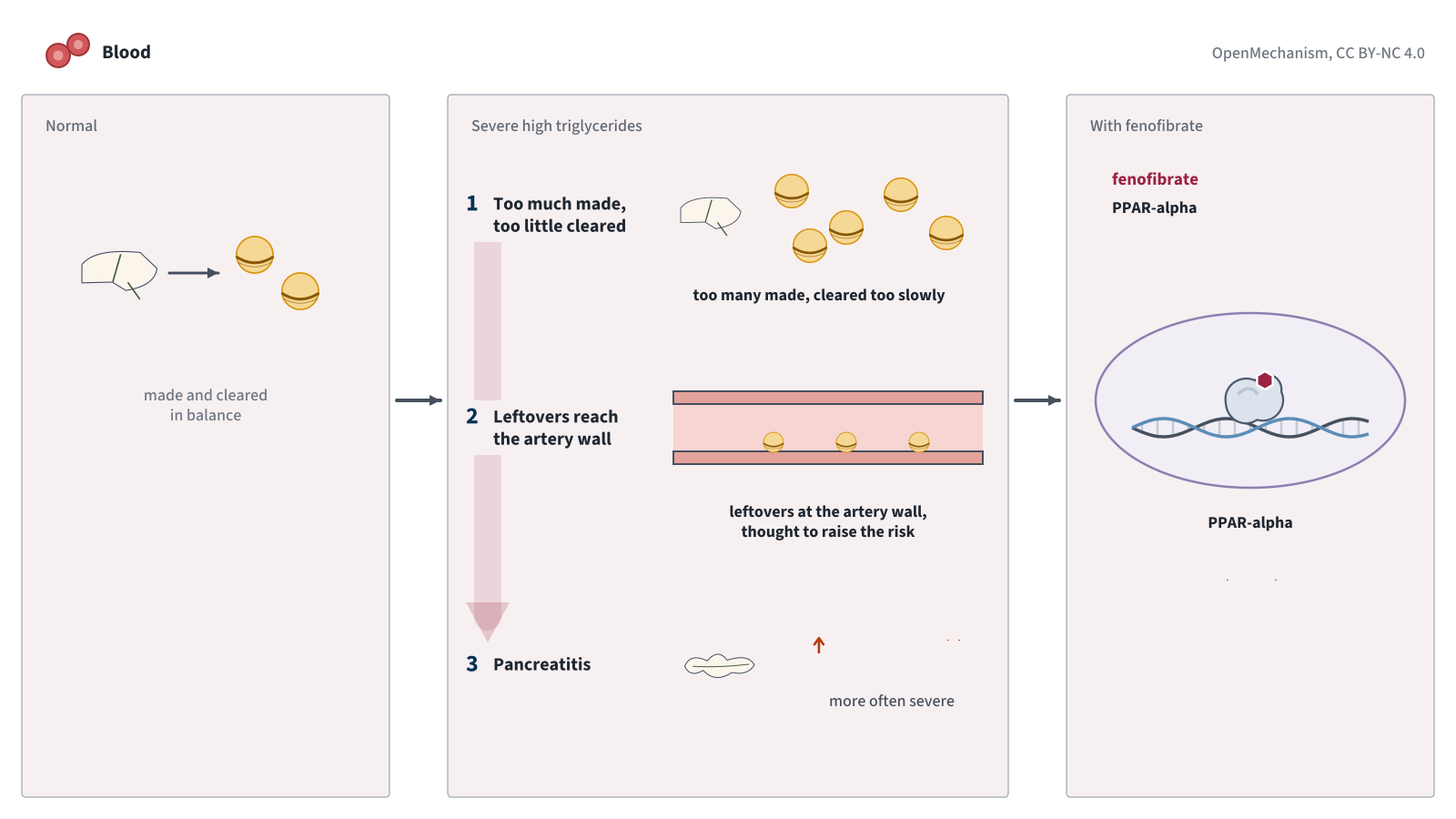
High triglycerides come from making too many triglyceride-rich particles and clearing them too slowly. Their leftovers are thought to raise the risk of artery disease, and very high levels can cause acute pancreatitis, which is then more often severe. Fenofibrate switches on PPAR-alpha and treats severe high triglycerides.
- Where
- Blood
- Body systems
- Heart, vessels & cholesterol; Hormones & metabolism
- Medicines
- 1 medicine
For teachers: download this drawing.
Key terms in this drawing
- PPARα
- Peroxisome proliferator-activated receptor alpha. A receptor that fenofibrate switches on; studies in mice and in cultured human liver cells explain how this clears triglyceride-rich particles from the blood faster.
What goes wrong
Too much made, too little cleared. High triglycerides come from making too many triglyceride-rich particles ( and chylomicrons) and clearing them too slowly.1
What the source says
“Elevations in plasma triglyceride are the result of overproduction and impaired clearance of triglyceride-rich lipoproteins-very low-density lipoproteins (VLDL) and chylomicrons.”
Source 1Leftovers reach the artery wall. Leftover particles (remnants) and small, dense build up; their contact with the artery wall is thought to raise the risk of artery disease.1
What the source says
“increased concentrations of remnant lipoproteins and small, dense low-density lipoprotein (LDL).”
Source 1“The elevated risk of atherosclerotic cardiovascular disease in hypertriglyceridemia is believed to result from the exposure of the artery wall to these aberrant lipoprotein species.”
Source 1Pancreatitis. High triglycerides are the third most common cause of acute pancreatitis, which is then more often severe.2
Where medicines act
- A
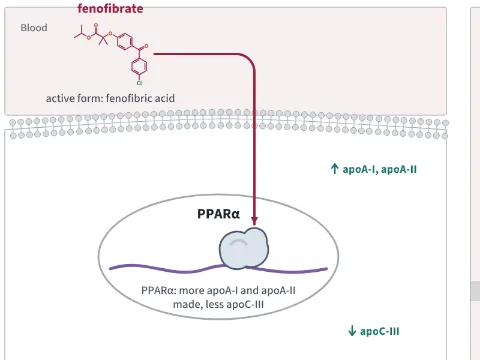
Fenofibrate: PPAR-alpha switched on
Fenofibrate switches on , a receptor that controls fat handling. It treats adults with severe high triglycerides.3
See also
Body systems: heart, vessels & cholesterol; and hormones & metabolism.
Other conditions: high LDL cholesterol; pheochromocytoma and paraganglioma; and primary aldosteronism.
Sources
- 1Causes and consequences of hypertriglyceridemiaPackard CJ et al. Front Endocrinol 2020 (abstract). Saved copy
- 2Hypertriglyceridemia and acute pancreatitisYang AL, McNabb-Baltar J. Pancreatology 2020 (abstract). Saved copy
- 3Tricor (fenofibrate): FDA label1 Indications and Usage. Saved copy
Notes and limits
- Fenofibrate was not shown to lower heart disease or deaths in people with type 2 diabetes.3
- How lowering triglycerides relates to less artery disease is not yet clear.1
Notes that apply to every page are on How to read a page.
Spotted a mistake? Report an error (hello@openmechanism.com). Since launch, every published error we fix is listed on the corrections page.
Cite this page
Tran D. Severe high triglycerides [Internet]. OpenMechanism; 2026 [updated 2026 Oct 16; cited 2026 Oct 16]. Available from: https://openmechanism.com/conditions/severe-high-triglycerides