Growth hormone deficiency
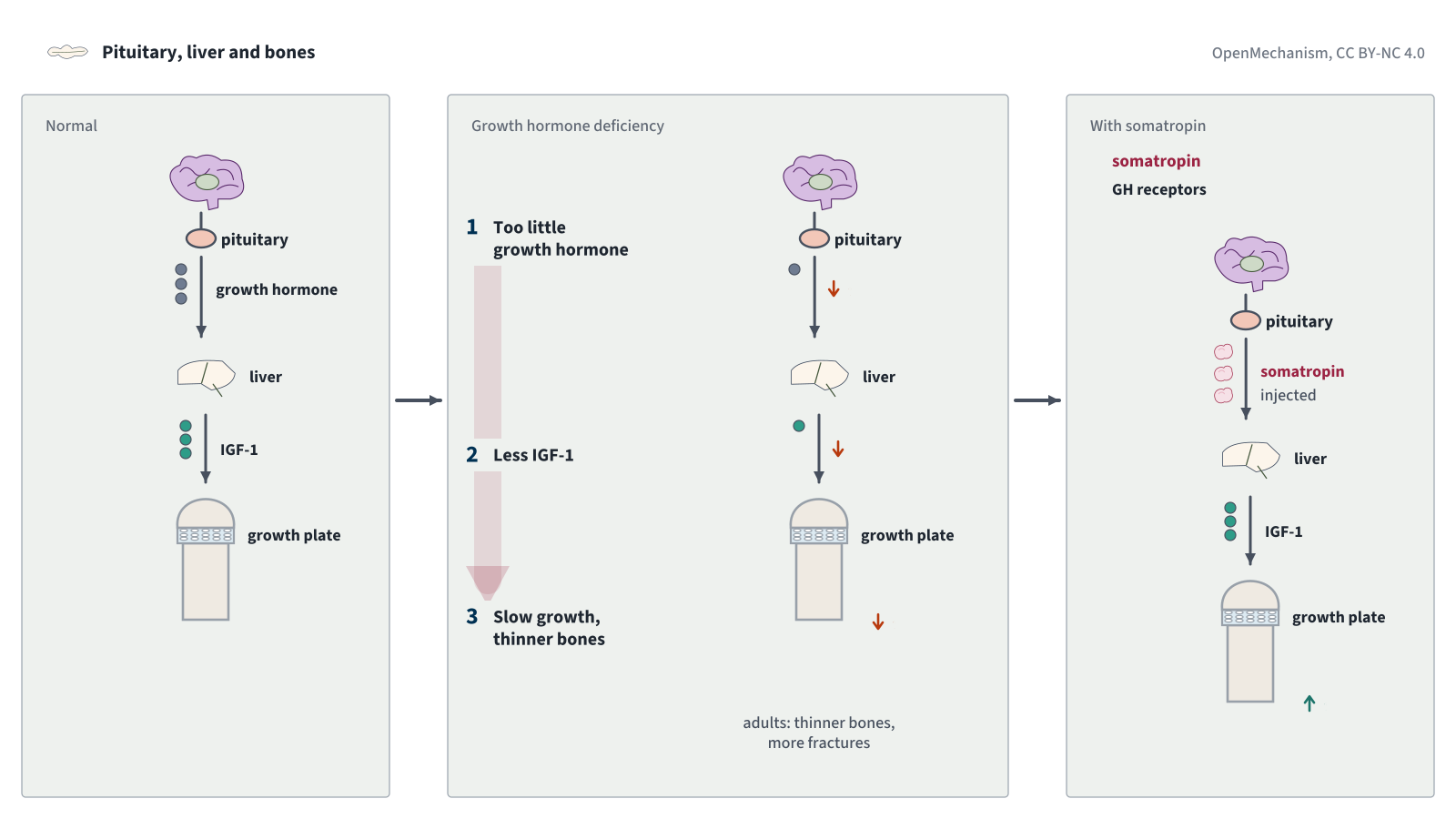
In growth hormone deficiency the pituitary releases too little growth hormone (GH), so less IGF-1 is made, much of it in the liver. In children growth slows; in adults bones can thin. Somatropin, a recombinant human growth hormone, replaces it.
- Where
- Pituitary, liver and bones
- Body systems
- Hormones & metabolism; Muscles, bones & joints
- Medicines
- 1 medicine
For teachers: download this drawing.
What goes wrong
Too little growth hormone. The hypothalamus controls the pituitary's release of growth hormone (GH) through neurons making growth hormone-releasing hormone (GHRH) and somatostatin, and GH is released in pulses. In GH deficiency the pituitary releases too little. It can start in childhood or later in life; in children with isolated GH deficiency, changes in known genes, such as those for GH itself or the GHRH receptor, are found in only a small share of cases.1,2,3,4
What the source says
“the intra- and extrahypothalamic neuronal networks connecting growth hormone releasing hormone (GHRH) and somatostatin hypophysiotropic neurons and the integration between regulators of food intake/metabolism and GH release.”
Source 1“One important event was the application of deconvolution analysis to the pulsatile patterns of GH secretion in different mammalian species, including Man, according to gender, hormonal environment and ageing.”
Source 1“growth failure due to inadequate secretion of endogenous growth hormone (GH)”
Source 2“GHD can persist from childhood or be newly acquired.”
Source 3“With respect to the genetic etiology of isolated GHD (IGHD), mutations in known genes such as those encoding GH (GH1), GHRH receptor (GHRHR), or transcription factors involved in pituitary development, are identified in a relatively small percentage of patients suggesting the involvement of other, yet unidentified, factors.”
Source 4Less IGF-1. GH works through its receptors on target cells, which then make GH-dependent proteins such as IGF-1. IGF-1 is made in many tissues but most in the liver, and it carries most of GH's effects on bone. In people born with too little GH because of a faulty GHRH receptor, a review describes life-long low IGF-1 in the blood.2,5,6,7
What the source says
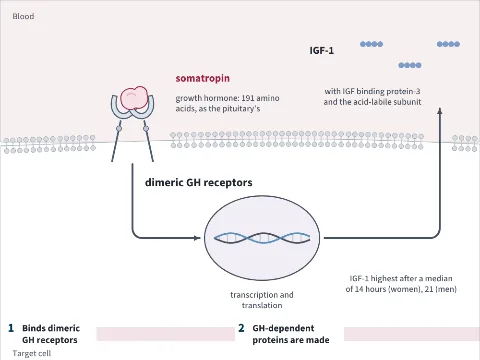
“Somatropin binds to dimeric GH receptors located within the cell membranes of target tissue cells. This interaction results in intracellular signal transduction and subsequent induction of transcription and translation of GH-dependent proteins including IGF-1, IGF BP-3 and acid-labile subunit.”
Source 2“IGF-I is expressed in virtually every tissue of the body, but with much higher expression in the liver than in any other tissue.”
Source 5“Although GH may act directly on skeletal cells, most of its effects are mediated by IGF-I, which is present in the systemic circulation and is synthesized by peripheral tissues.”
Source 6“Data obtained in humans with IGHD type 1B, owing to a mutation of the GHRH receptor gene, in the Itabaianinha County, Brazil, provide a unique opportunity to study the impact of severe reduction in GH signaling on age-related characteristics, health, and functionality.”
Source 7“We think that low, but detectable, residual GH secretion combined with life-long reduction of circulating IGF-1 and with some tissue levels of IGF-1 and/or IGF-2 preserved may account for the normal longevity and apparent extension of healthspan in these individuals.”
Source 7Slow growth, thinner bones. GH and IGF-1 are central to the normal growth of the long bones and to bone mass. Children with too little GH grow too slowly (growth failure); in one inherited form, people are short but in proportion, with fat around the middle. Adults with GH deficiency can develop thin bones (osteoporosis) with a high risk of fractures.2,6,7
What the source says
“GH and IGF-I are important regulators of bone homeostasis and are central to the achievement of normal longitudinal bone growth and bone mass.”
Source 6“growth failure due to inadequate secretion of endogenous growth hormone (GH)”
Source 2“Individuals with IGHD are characterized by proportional short stature, doll facies, high-pitched voices, and central obesity.”
Source 7“Adult GH deficiency causes low bone turnover osteoporosis with high risk of vertebral and nonvertebral fractures, and the low bone mass can be partially reversed by GH replacement.”
Source 6
Where medicines act
The liver and the growth plates
- A
Somatropin targets Growth hormone receptors
Replaces growth hormone: raises IGF-1 and speeds growth at the growth plates.2
Used forGrowth failure from too little growth hormone: in childrenGrowth hormone deficiency: in adults, as replacementShort stature: in Turner syndrome and other listed conditions
What the label says
“HUMATROPE is a recombinant human growth hormone indicated for: Pediatric Patients: growth failure due to inadequate secretion of endogenous growth hormone (GH); short stature associated with Turner syndrome; Idiopathic Short Stature (ISS), height standard deviation score (SDS) <-2.25, and associated with growth rates unlikely to permit attainment of adult height in the normal range; short stature or growth failure in short stature homeobox-containing gene (SHOX) deficiency; short stature born small for gestational age (SGA) with no catch-up growth by 2 years to 4 years of age. ( 1.1 ) Adult Patients: replacement of endogenous GH in adults with GH deficiency. ( 1.2 )”
Source 2“Somatropin binds to dimeric GH receptors located within the cell membranes of target tissue cells. This interaction results in intracellular signal transduction and subsequent induction of transcription and translation of GH-dependent proteins including IGF-1, IGF BP-3 and acid-labile subunit.”
Source 2“Somatropin stimulates skeletal growth in pediatric patients with GHD as a result of effects on the growth plates (epiphyses) of long bones. The stimulation of skeletal growth increases linear growth rate (height velocity) in most somatropin-treated pediatric patients.”
Source 2“Subcutaneous administration of a single dose of Humatrope (0.033 mg/kg body weight) in healthy volunteers (10 males, 10 females) resulted in an increased median IGF-1 level from 202 ng/mL (men) and 107 ng/mL (women) predose to maximal level of 362 ng/mL (men) and 234 ng/mL (women) after a median of 21 hours (men) and 14 hours (women).”
Source 2
See also
Body systems: hormones & metabolism; and muscles, bones & joints.
Other conditions: acromegaly, osteoporosis, diabetes insipidus, hypoparathyroidism, Pompe disease and primary hyperparathyroidism.
Sources
- 1Neuroendocrine regulation of growth hormone secretionSteyn FJ et al. Compr Physiol 2016 (abstract). Saved copy
- 2Humatrope (somatropin): FDA label1 Indications and Usage; 12.1 Mechanism of Action; 12.2 Pharmacodynamics. Saved copy
- 3Evaluation and treatment of adult growth hormone deficiency: an Endocrine Society clinical practice guidelineMolitch ME et al. J Clin Endocrinol Metab 2011 (abstract). Saved copy
- 4Isolated growth hormone deficiency (GHD) in childhood and adolescence: recent advancesAlatzoglou KS et al. Endocr Rev 2014 (abstract). Saved copy
- 5The role of liver-derived insulin-like growth factor-IOhlsson C et al. Endocr Rev 2009 (abstract). Saved copy
- 6Growth hormone, insulin-like growth factors, and the skeletonGiustina A et al. Endocr Rev 2008 (abstract). Saved copy
- 7Growth hormone deficiency: health and longevityAguiar-Oliveira MH, Bartke A. Endocr Rev 2019 (abstract). Saved copy
Notes and limits
- After many years of research, the causes, diagnosis and treatment of isolated GH deficiency in children are still debated. It may affect children's health and development more widely, and how far GH treatment reverses this is unknown; GH's long-term safety is still debated and studied.4
- In adults, a 2011 guideline says GH treatment offers benefits in body composition, exercise capacity, bone and quality of life, most likely in those with more severe deficiency, and that its risks are low.3
Notes that apply to every page are on How to read a page.
Spotted a mistake? Report an error (hello@openmechanism.com). Since launch, every published error we fix is listed on the corrections page.
Cite this page
Tran D. Growth hormone deficiency [Internet]. OpenMechanism; 2026 [updated 2026 Nov 18; cited 2026 Nov 18]. Available from: https://openmechanism.com/conditions/growth-hormone-deficiency