Sitagliptin
Sitagliptin blocks , the enzyme that quickly inactivates the gut hormones and . With more of them active for longer, insulin release rises and glucagon falls, but only when glucose is normal or high.
- Acts on
- DPP-4, the enzyme that inactivates incretins
- Where
- The blood and pancreas
- Medicine type
- Small molecule
- Used for
- Hormones & metabolism
- Drug class
- DPP-4 inhibitors
Also called Januvia.
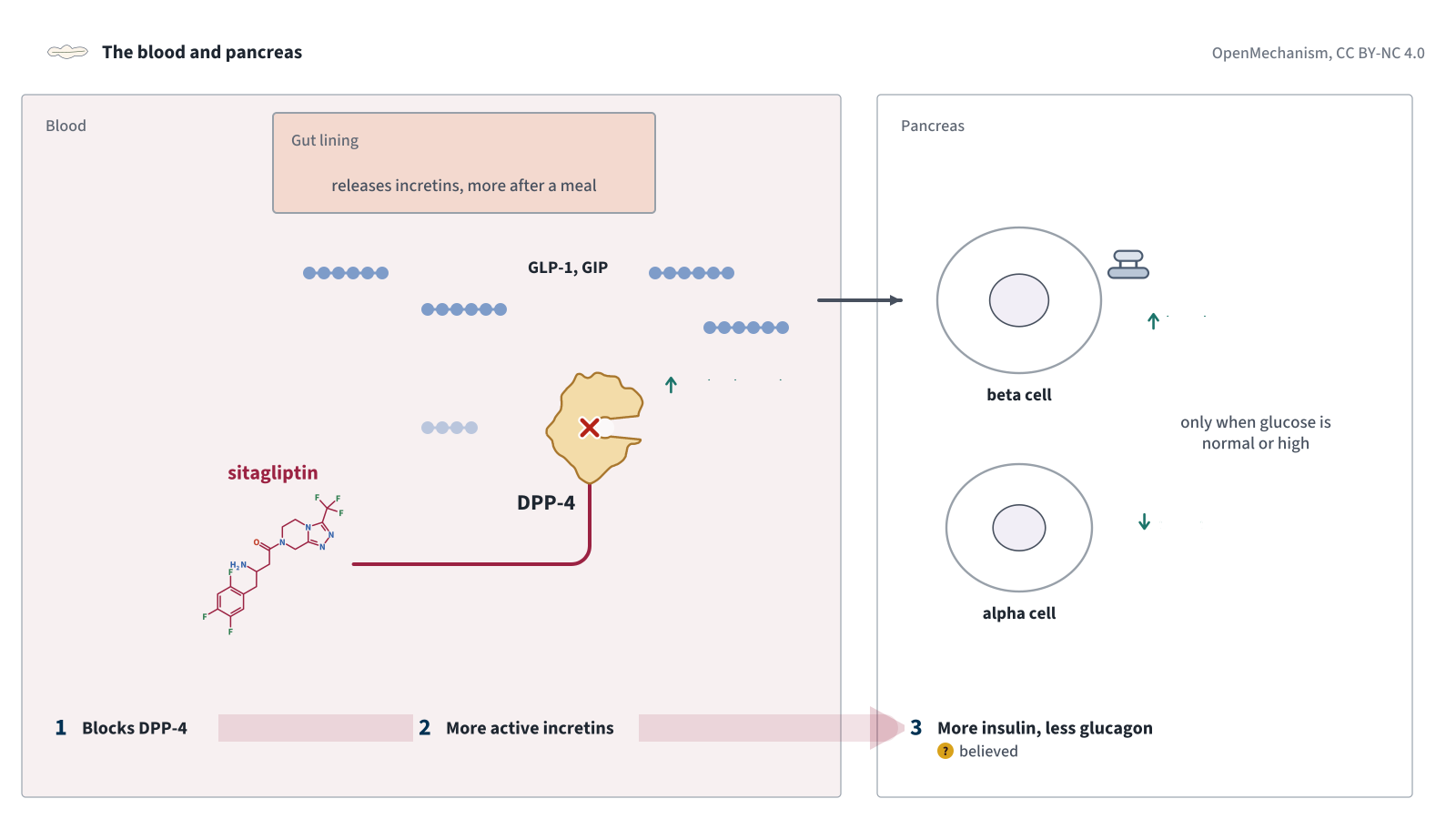
Step 3: believed
The Januvia label says: Sitagliptin is a DPP-4 inhibitor, which is believed to exert its actions in patients with type 2 diabetes mellitus by slowing the inactivation of incretin hormones.
Source 1: Januvia (sitagliptin): FDA label, 12.1 Mechanism of Action
Clinical study: In a 24-week randomized trial against placebo in 741 people with type 2 diabetes; the trial measured blood sugar control, not incretin hormones: In this 24-week study, once-daily sitagliptin monotherapy improved glycemic control in the fasting and postprandial states, improved measures of beta-cell function, and was well tolerated in patients with type 2 diabetes.
Aschner P et al., Diabetes Care 2006 (PMID 17130196)
This study was picked with a literature search and is not yet checked by our reviewer.
Key terms in this drawing
- DPP-4
- Dipeptidyl peptidase-4. The enzyme that rapidly inactivates the incretin hormones, such as GLP-1 and GIP.
- GIP
- Glucose-dependent insulinotropic polypeptide. An incretin hormone, like GLP-1: the gut releases it through the day, and more after a meal.
- GLP-1
- Glucagon-like peptide-1. A gut hormone that increases insulin release when blood glucose is normal or high.
How it works
Blocks DPP-4. Sitagliptin blocks DPP-4, the enzyme that quickly inactivates the gut's incretin hormones, GLP-1 and GIP. At treatment levels it does not block DPP-8 or DPP-9.1
More active incretins. So more of the active, intact hormones circulate, and for longer. The gut releases incretins through the day, more after a meal.1
More insulin, less glucagon. When blood glucose is normal or high, GLP-1 and GIP increase insulin making and release from beta cells (through cyclic AMP), and GLP-1 lowers glucagon from alpha cells, so the liver makes less glucose. This is how sitagliptin is believed to act in type 2 diabetes.1
For teachers: download this drawing.
See also
Condition pages: type 2 diabetes.
Body system: hormones & metabolism.
Sources
- 1Januvia (sitagliptin): FDA label12.1 Mechanism of Action
- 2ChEMBL CHEMBL1422Target and action classification: Dipeptidyl peptidase IV inhibitor
- 3Effect of the dipeptidyl peptidase-4 inhibitor sitagliptin as monotherapy on glycemic control in patients with type 2 diabetesAschner P et al. Diabetes Care 2006 (abstract)
Also used for the drawing
The DPP-4 outline is traced from the crystal structure below.
- 4Human dipeptidyl peptidase-4 (DPP-4) with sitagliptinPDB 1X70; Kim, D. et al. J.Med.Chem. 2005; 48:141-151
Spotted a mistake? Report an error (hello@openmechanism.com). Since launch, every published error we fix is listed on the corrections page.
Notes and limits
- A schematic teaching drawing: not to scale, not exact structures, binding poses or a complete pathway, and not a guide to dosing, treatment or how a person will respond.
- The label says sitagliptin is believed to exert its actions in type 2 diabetes by slowing the inactivation of incretin hormones.
All recorded limits are on the evidence page, and notes that apply to every page are on How to read a page. Version 1.0.0, not yet medically reviewed.
Cite this page
Tran D. Sitagliptin [Internet]. OpenMechanism; 2026 [updated 2026 Oct 11; cited 2026 Oct 11]. Available from: https://openmechanism.com/medicines/sitagliptin