Hereditary tyrosinemia type 1
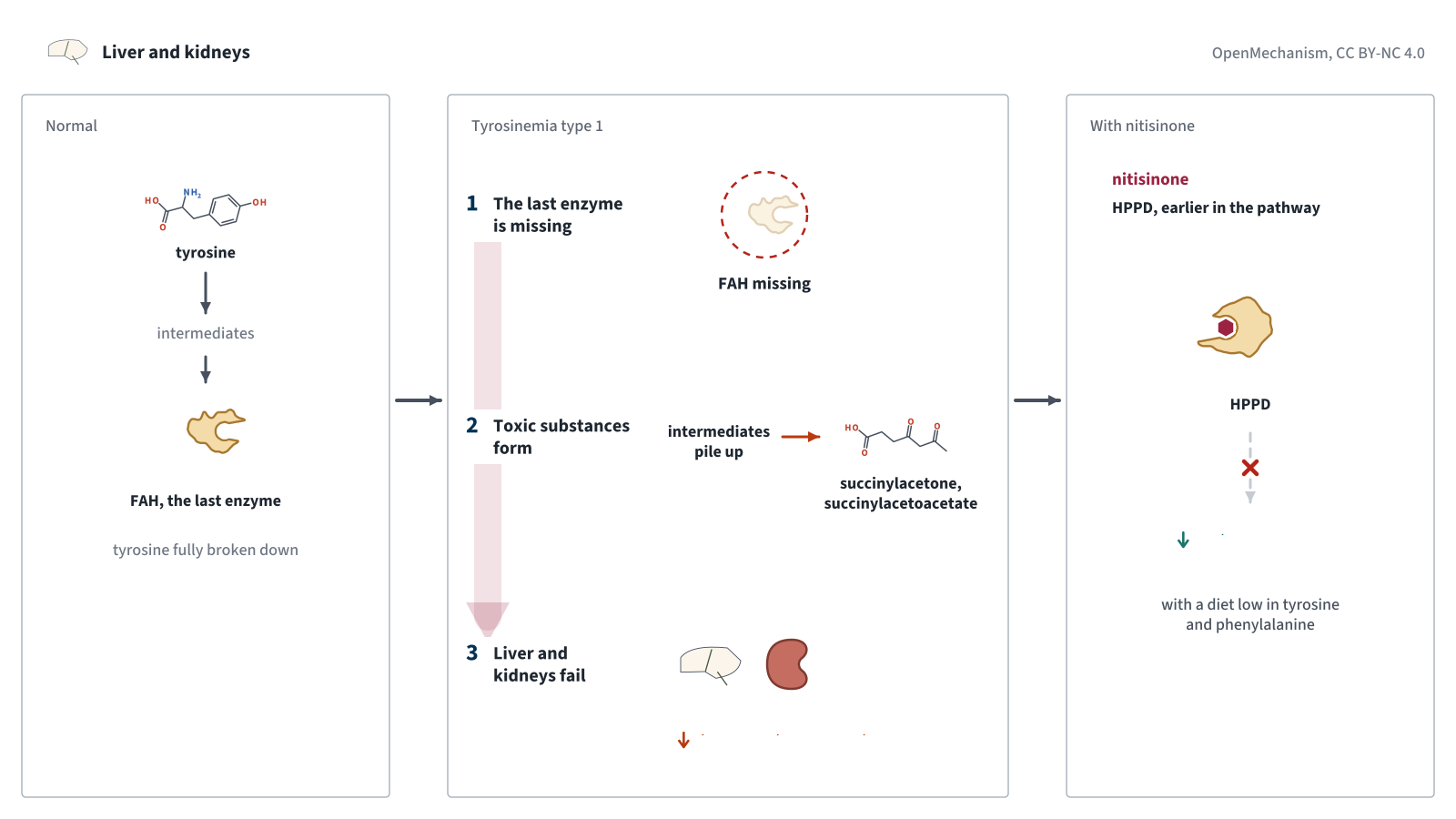
Hereditary tyrosinemia type 1 is an inherited lack of fumarylacetoacetate hydrolase (FAH), the last enzyme in tyrosine breakdown. Intermediates build up and turn into toxic substances that damage the liver and kidneys. Nitisinone blocks an enzyme earlier in the pathway, so they do not build up; it is used with a diet low in tyrosine and phenylalanine.
- Where
- Liver and kidneys
- Body system
- Hormones & metabolism
- Medicines
- 1 medicine
For teachers: download this drawing.
Key terms in this drawing
- FAH
- Fumarylacetoacetate hydrolase. The last enzyme in tyrosine breakdown; deficient in tyrosinemia type 1.
- HPPD
- 4-Hydroxyphenylpyruvate dioxygenase. An enzyme early in the breakdown of tyrosine.
What goes wrong
The last enzyme is missing. It is an inherited (autosomal recessive) lack of fumarylacetoacetate hydrolase (), the last enzyme in the breakdown of tyrosine.1
What the source says
“HT1 is an autosomal recessive disease caused by a deficiency of fumarylacetoacetate hydrolase (FAH), the last enzyme of the tyrosine catabolic pathway.”
Source 1Toxic substances form. Intermediates of the pathway pile up and turn into the toxic substances succinylacetone and succinylacetoacetate.2
What the source says
“In patients with HT-1, these catabolic intermediates are converted to the toxic metabolites succinylacetone and succinylacetoacetate, which are responsible for the observed liver and kidney toxicity.”
Source 2Liver and kidneys fail. The acute form starts early with severe liver failure; the chronic form starts later and also affects the kidneys.1
What the source says
“The acute form of the disease is characterized by an early onset and severe liver failure while the chronic form appears later and also involves renal dysfunctions.”
Source 1
Where medicines act
- A
Nitisinone: the pathway blocked upstream
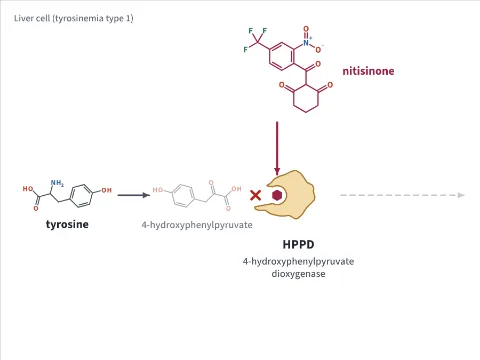
Nitisinone blocks 4-hydroxyphenylpyruvate dioxygenase, an enzyme earlier in the pathway, so the intermediates that turn toxic do not build up. It treats HT-1 together with a diet low in tyrosine and phenylalanine.2
What the source says
“Nitisinone is a competitive inhibitor of 4-hydroxyphenyl-pyruvate dioxygenase, an enzyme upstream of fumarylacetoacetate hydrolase (FAH) in the tyrosine catabolic pathway.”
Source 2“By inhibiting the normal catabolism of tyrosine in patients with HT-1, nitisinone prevents the accumulation of the catabolic intermediates maleylacetoacetate and fumarylacetoacetate.”
Source 2“is indicated for the treatment of adult and pediatric patients with hereditary tyrosinemia type 1 (HT-1) in combination with dietary restriction of tyrosine and phenylalanine.”
Source 2
See also
Body system: hormones & metabolism.
Sources
- 1Biochemical and clinical aspects of hereditary tyrosinemia type 1Morrow G, Tanguay RM. Adv Exp Med Biol 2017 (abstract). Saved copy
- 2Orfadin (nitisinone): FDA label1 Indications and Usage; 12.1 Mechanism of Action. Saved copy
- 3Human fumarylacetoacetate hydrolase (FAH) with its active-site calcium and a small stabilizing moleculePDB 9SQS; Scarin, R. et al. J.Med.Chem. 2026;69:11948-11960. The FAH outline in the drawing is traced from this structure. Saved copy
- 4Human 4-hydroxyphenylpyruvate dioxygenase (HPPD) with nitisinone (NTBC)PDB 8IM2; Dong, J. et al. Structure 2023;31:1604. The HPPD outline in the drawing is traced from this structure. Saved copy
Notes and limits
- Even with nitisinone and the diet, people remain at risk of liver cancer.1
Notes that apply to every page are on How to read a page.
Spotted a mistake? Report an error (hello@openmechanism.com). Since launch, every published error we fix is listed on the corrections page.
Cite this page
Tran D. Hereditary tyrosinemia type 1 [Internet]. OpenMechanism; 2026 [updated 2026 Oct 16; cited 2026 Oct 16]. Available from: https://openmechanism.com/conditions/hereditary-tyrosinemia-type-1