Insulin glargine
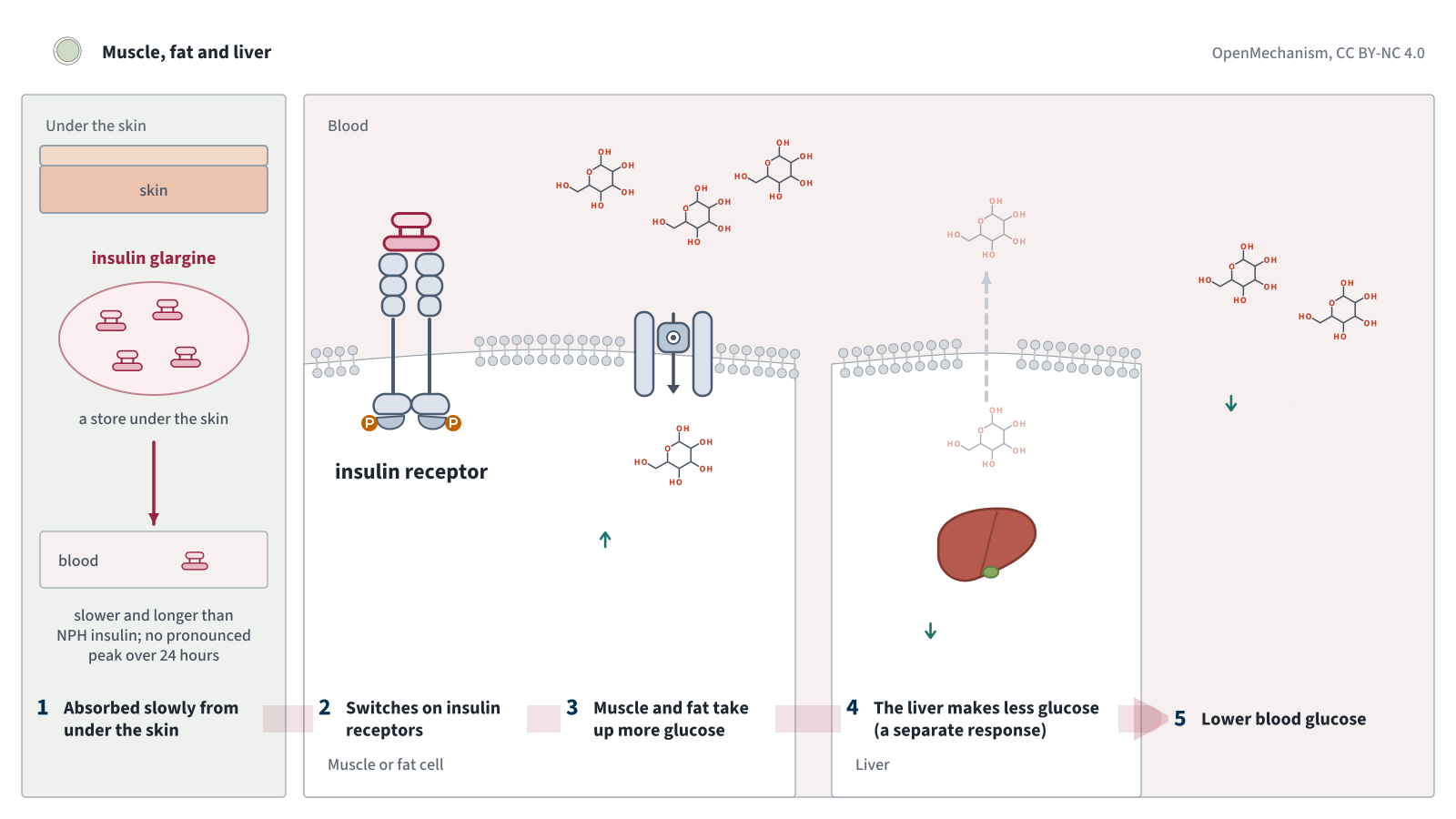
Insulin glargine is absorbed slowly from under the skin and activates insulin receptors. Muscle and fat take up more glucose and the liver makes less, so blood glucose falls.
- Acts on
- Insulin receptor
- Where
- Muscle, fat and liver
- Medicine type
- Protein
- Used for
- Hormones & metabolism
- Drug class
- Insulins
Also called Lantus and Lantus Solostar (prefilled pen).
How it works
Absorbed slowly from under the skin. After injection under the skin in healthy people and in people with diabetes, insulin glargine was absorbed more slowly and for longer, with a relatively constant level over 24 hours and no pronounced peak, compared with NPH insulin.1
Switches on insulin receptors. Insulin glargine binds the insulin receptor on cells, and the binding induces auto-phosphorylation of the receptor's kinase domain, which the receptor needs to be activated.2
Muscle and fat take up more glucose. Insulin activity stimulates glucose uptake, especially in skeletal muscle and fat.1
The liver makes less glucose (a separate response). Insulin, including glargine, also inhibits glucose production by the liver (hepatic glucose production), separately from the uptake in step 3.1
Lower blood glucose. The combined responses reduce blood glucose.1
For teachers: download this drawing or build a slide deck.
More detail
A slow-release store under the skin
How glargine differs from human insulin. Glargine differs from human insulin in two places: glycine replaces the asparagine at position A21, and two arginines are added to the C-terminus (end) of the B chain.1
Absorbed slowly, with no pronounced peak compared with NPH insulin. After injection under the skin in healthy people and in people with diabetes, insulin glargine was absorbed more slowly and for longer, with a relatively constant level over 24 hours and no pronounced peak, compared with NPH insulin.1
Partly changed into active M1 and M2. A metabolism study in people indicates that, in the store under the skin, glargine is partly broken down at the carboxyl end of its B chain into two metabolites, M1 and M2, whose activity in lab tests (in vitro) is similar to that of human insulin; unchanged glargine and these products are also found in the blood.1
What the source says
“Insulin glargine differs from human insulin in that the amino acid asparagine at position A21 is replaced by glycine and two arginines are added to the C-terminus of the B-chain.”
Source 1
“After subcutaneous injection of LANTUS in healthy subjects and in patients with diabetes, the insulin serum concentrations indicated a slower, more prolonged absorption and a relatively constant concentration/time profile over 24 hours with no pronounced peak in comparison to NPH insulin.”
Source 1
“A metabolism study in humans indicates that insulin glargine is partly metabolized at the carboxyl terminus of the B chain in the subcutaneous depot to form two active metabolites with in vitro activity similar to that of human insulin, M1 (21 A -Gly-insulin) and M2 (21 A -Gly-des-30 B -Thr-insulin). Unchanged drug and these degradation products are also present in the circulation.”
Source 1
Switching on the insulin receptor (lab test)
Activates the insulin receptor in a lab test. Binding of insulin analogs, including glargine, to the human insulin receptor on cells induces auto-phosphorylation of the receptor's kinase domain; FDA researchers validated a lab assay of this for insulin glargine.2
What the source says
“Binding of human insulin or insulin analogs to the human insulin receptor on cells induces the auto-phosphorylation of the receptor’s kinase domain, a modification which is necessary for kinase activity and receptor activation.”
Source 2
“CDER researchers have validated this assay for three common types of insulin: insulin glargine, insulin aspart, and insulin lispro.”
Source 2
Lowering blood glucose
Muscle and fat take up more glucose. Insulin, including glargine, stimulates glucose uptake particularly in skeletal muscle and fat.1
The liver makes less glucose. Insulin, including glargine, inhibits hepatic glucose production.1
Blood glucose falls. Increased peripheral uptake and reduced hepatic production lower blood glucose.1
Less fat and protein breakdown. Insulin inhibits lipolysis and proteolysis and enhances protein synthesis.1
Low blood glucose and low potassium
Low blood glucose; recovery may be slow. Hypoglycemia is the most common adverse reaction associated with insulins, including insulin glargine; severe hypoglycemia can cause seizures and may be life-threatening or cause death, and glargine's long-acting effect may delay recovery.1
Low blood potassium. Insulin shifts potassium into cells; this can lead to hypokalemia, which may be life-threatening.1
What the source says
“Hypoglycemia is the most common adverse reaction associated with insulins, including LANTUS. Severe hypoglycemia can cause seizures, may be life-threatening or cause death.”
Source 1
“The long-acting effect of LANTUS may delay recovery from hypoglycemia.”
Source 1
“All insulins, including LANTUS, cause a shift in potassium from the extracellular to intracellular space, possibly leading to hypokalemia. Untreated hypokalemia may cause respiratory paralysis, ventricular arrhythmia, and death.”
Source 1
See also
Condition pages: type 1 diabetes and type 2 diabetes.
Side effects: low blood potassium (hypokalemia) and low blood sugar (hypoglycemia).
Other insulins: insulin aspart and insulin lispro.
Explained: why beta-blockers can hide low blood sugar; and why insulin and albuterol can lower potassium.
Body system: hormones & metabolism.
Inside the body: insulin.
Sources
- 1Lantus (insulin glargine): FDA label1 Indications and Usage; 12.1 Mechanism of Action; 11 Description; 12.2 Pharmacodynamics; 12.3 Pharmacokinetics; 5.3 Hypoglycemia; 5.6 Hypokalemia
- 2Establishment and validation of an in vitro cell-based assay to assess the biological activity of insulin productsFDA Center for Drug Evaluation and Research, 2024. A method to assess the biological activity or bioidentity of insulin analogs in vitro; A method to assess biological activity
- 3ChEMBL CHEMBL1201497Target and action classification: Insulin receptor agonist
Spotted a mistake? Report an error (hello@openmechanism.com). Since launch, every published error we fix is listed on the corrections page.
Notes and limits
- A schematic teaching drawing: not to scale, not exact structures, binding poses or a complete pathway, and not a guide to dosing, treatment or how a person will respond.
- The steps are in the order that explains them; one step is said to cause the next only where the source says so.
- Insulin glargine 100 units/mL (Lantus) and the label's studies in people; no extrapolation to other glargine concentrations.
- Receptor activation is supported by a validated in-vitro assay; metabolic outcomes are label-described.
- Receptor identity and activation are supported by an additional FDA regulatory-science source; no exact tissue-specific downstream network is drawn.
All recorded limits are on the evidence page, and notes that apply to every page are on How to read a page. Version 1.1.1, medically reviewed by Daniel Tran, PharmD, on 30 October 2026.
Cite this page
Tran D. Insulin glargine [Internet]. OpenMechanism; 2026 [updated 2026 Oct 30; cited 2026 Oct 30]. Available from: https://openmechanism.com/medicines/insulin-glargine