Hyperthyroidism
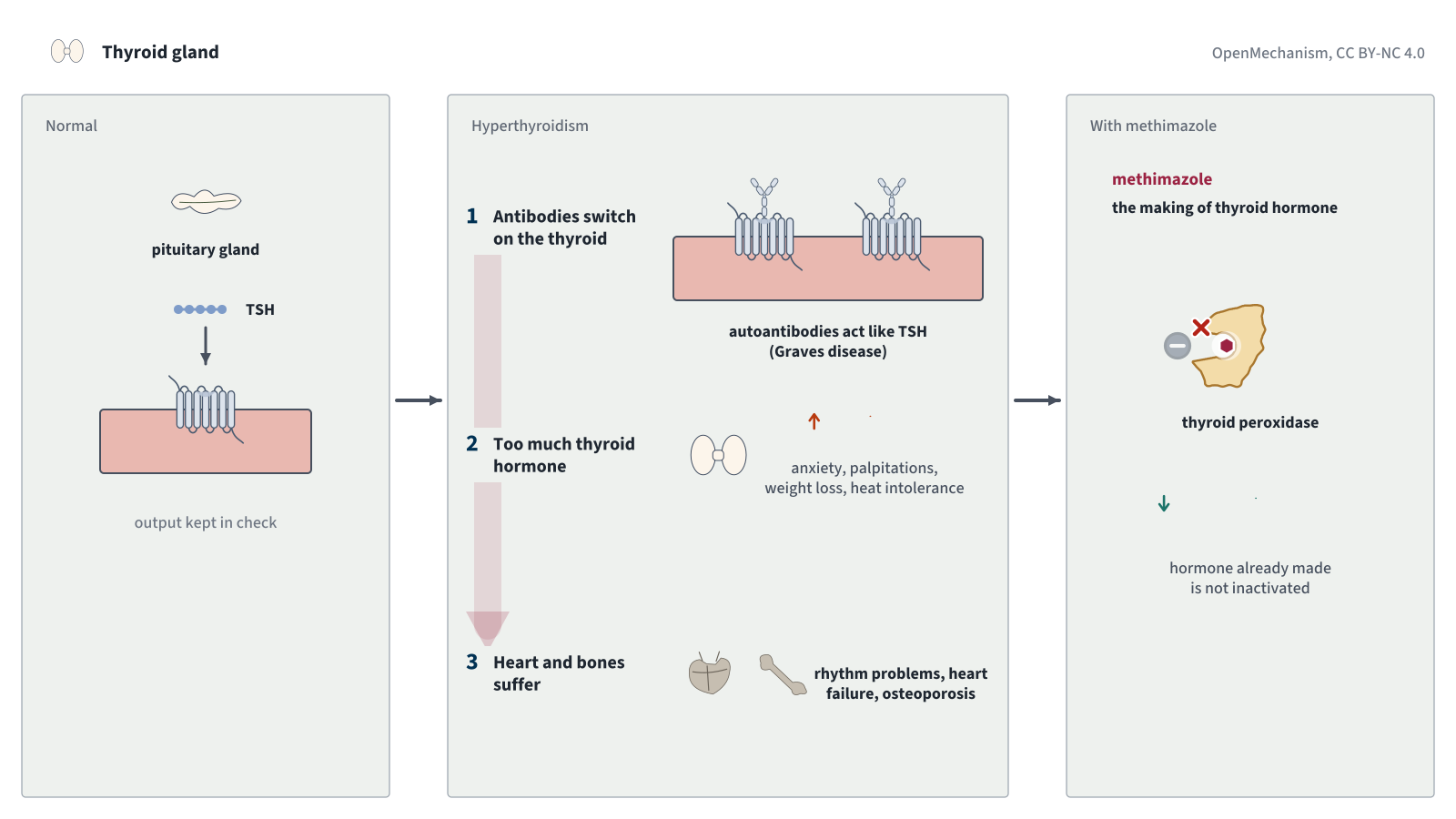
In hyperthyroidism the thyroid makes and releases too much hormone. Most often the cause is Graves disease, in which autoantibodies switch on the TSH receptor; toxic nodular goiter comes next. Symptoms include anxiety, a racing heart, weight loss and heat intolerance; untreated, it can cause heart rhythm problems, heart failure and osteoporosis. Methimazole blocks the making of thyroid hormone.
- Where
- Thyroid gland
- Body system
- Hormones & metabolism
- Medicines
- 1 medicine
For teachers: download this drawing.
Key terms in this drawing
- TSH
- Thyroid-stimulating hormone. Thyroid-stimulating hormone; a high TSH with low free thyroxine (T4) defines overt primary hypothyroidism.
What goes wrong
Antibodies switch on the thyroid. In Graves disease, the most common cause, autoantibodies act on the receptor like TSH itself and drive too much hormone release, freeing the gland from the pituitary's control; toxic nodular goiter is the next most common cause.1,2
What the source says
“Graves' hyperthyroidism is caused by autoantibodies to the thyroid-stimulating hormone receptor (TSHR) that act as agonists and induce excessive thyroid hormone secretion, releasing the thyroid gland from pituitary control.”
Source 1“The most common cause of hyperthyroidism is Graves' disease, followed by toxic nodular goitre.”
Source 2Too much thyroid hormone. The thyroid makes and releases more hormone; common symptoms are anxiety, poor sleep, palpitations, weight loss, diarrhea and heat intolerance.2,3
Heart and bones suffer. Untreated, it can cause heart rhythm problems, heart failure, osteoporosis and problems in pregnancy.3
What the source says
“Untreated hyperthyroidism can cause cardiac arrhythmias, heart failure, osteoporosis, and adverse pregnancy outcomes.”
Source 3
Where medicines act
- A
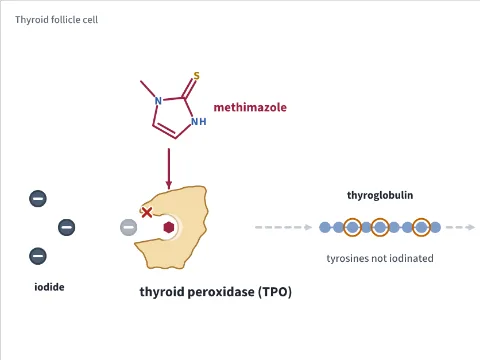
Methimazole: less hormone made
Methimazole stops the thyroid making its hormones; it does not inactivate hormone already stored or in the blood. It treats Graves disease and toxic multinodular goiter when surgery or radioactive iodine is not suitable.4
What the source says
“Methimazole inhibits the synthesis of thyroid hormones and thus is effective in the treatment of hyperthyroidism.”
Source 4“The drug does not inactivate existing thyroxine and tri-iodothyronine that are stored in the thyroid or circulating in the blood”
Source 4“In patients with Graves' disease with hyperthyroidism or toxic multinodular goiter for whom surgery or radioactive iodine therapy is not an appropriate treatment option.”
Source 4
See also
Body system: hormones & metabolism.
Side effects: why amiodarone can upset the thyroid.
Sources
- 1Graves' diseaseDavies TF et al. Nat Rev Dis Primers 2020 (abstract). Saved copy
- 2HyperthyroidismDe Leo S et al. Lancet 2016 (abstract). Saved copy
- 3Hyperthyroidism: a reviewLee SY, Pearce EN. JAMA 2023 (abstract). Saved copy
- 4Methimazole tablets: FDA labelIndications and Usage; Clinical Pharmacology. Saved copy
- 5Goat lactoperoxidase with methimazole bound at its haemPDB 5FF1; Singh, R.P. et al. Febs Open Bio 2016;6:640-650. The thyroid peroxidase outline in the drawing is traced from this structure. Saved copy
Notes and limits
- What starts Graves disease is unknown; there is a strong genetic part with chance triggers from the environment.1
- In toxic nodular goiter, antithyroid medicines are not usually used long term because it often comes back when they stop.2
Notes that apply to every page are on How to read a page.
Spotted a mistake? Report an error (hello@openmechanism.com). Since launch, every published error we fix is listed on the corrections page.
Cite this page
Tran D. Hyperthyroidism [Internet]. OpenMechanism; 2026 [updated 2026 Oct 19; cited 2026 Oct 19]. Available from: https://openmechanism.com/conditions/hyperthyroidism