Type 1 diabetes
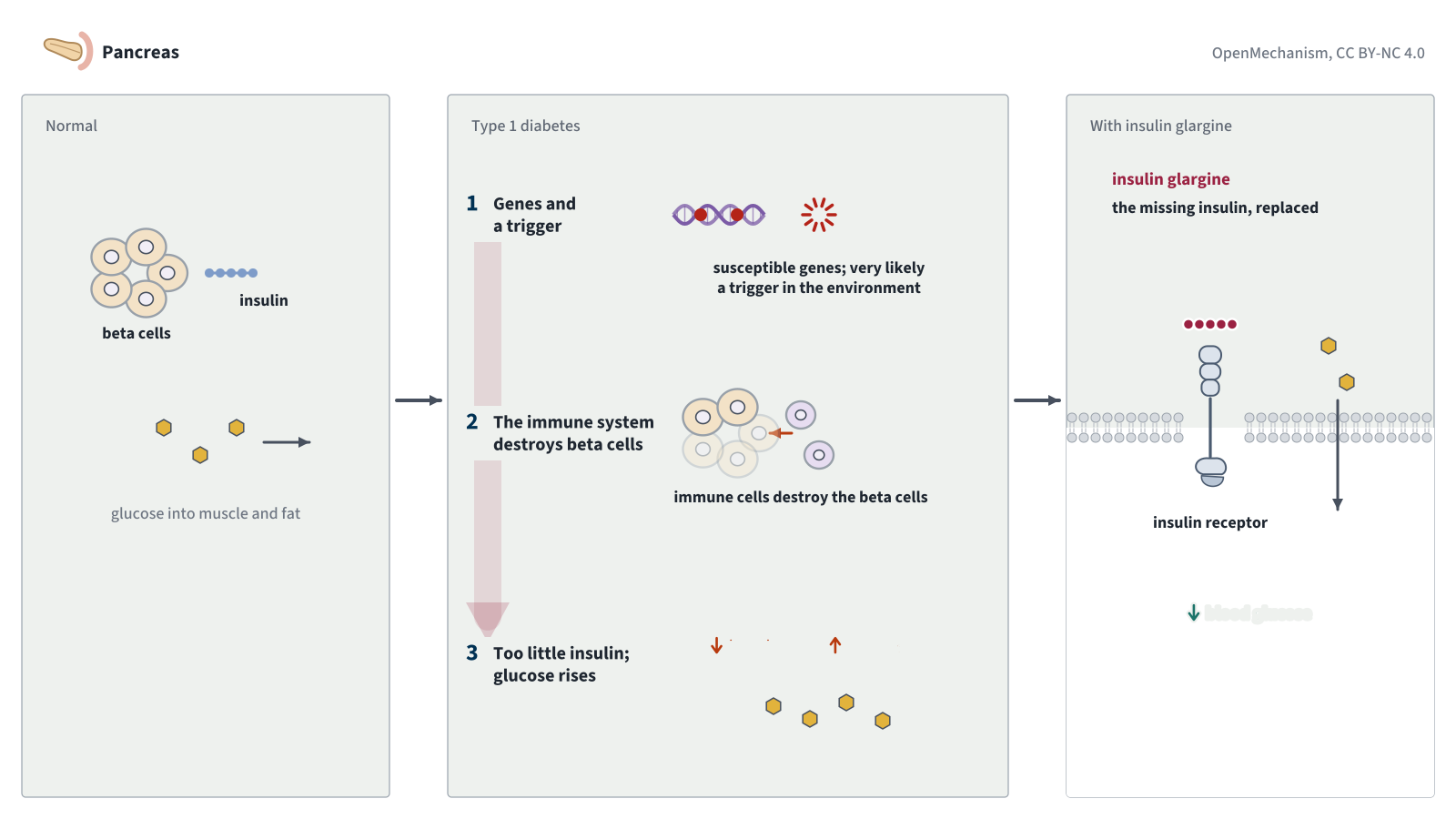
Type 1 diabetes is a long-lasting autoimmune disease: in people with susceptible genes, very likely after an environmental trigger, the immune system destroys or damages pancreatic beta cells, so too little insulin is made and blood glucose rises. Insulin normally moves glucose into muscle and fat and holds back the liver's glucose output; insulin glargine, a long-acting insulin, replaces it.
- Where
- Pancreas
- Body system
- Hormones & metabolism
- Medicines
- 1 medicine
For teachers: download this drawing.
What goes wrong
Genes and a trigger. Type 1 diabetes starts in people with susceptible genes, very likely after a trigger in the environment.1
What the source says
“T1D precipitates in genetically susceptible individuals, very likely as a result of an environmental trigger.”
Source 1The immune system destroys beta cells. It is a long-lasting autoimmune disease in which the beta cells of the pancreatic islets are destroyed or damaged.1
What the source says
“Type 1 diabetes (T1D) is a chronic autoimmune disease in which destruction or damaging of the beta-cells in the islets of Langerhans”
Source 1Too little insulin; glucose rises. Losing the beta cells leaves too little insulin and high blood glucose; insulin normally lowers glucose by moving it into muscle and fat and by holding back the liver's glucose output.1,2
Where medicines act
- A
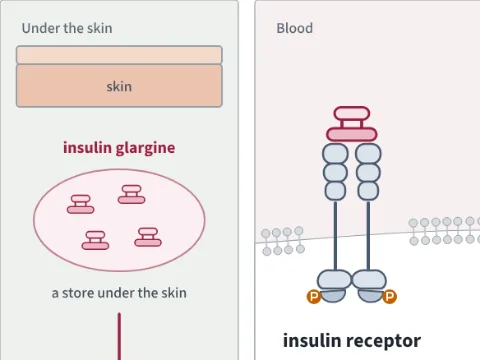
Insulin glargine: the missing insulin replaced
Insulin glargine is a long-acting insulin that lowers blood glucose like the body's own insulin; it improves glucose control in adults and children with diabetes.2
What the source says
“LANTUS is a long-acting human insulin analog indicated to improve glycemic control in adult and pediatric patients with diabetes mellitus.”
Source 2“Insulin and its analogs lower blood glucose by stimulating peripheral glucose uptake, especially by skeletal muscle and fat, and by inhibiting hepatic glucose production.”
Source 2
See also
Body system: hormones & metabolism.
Zoom in: insulin.
Also used for it: glucagon (for severe low blood sugar: “GVOKE is indicated for subcutaneous use for the treatment of severe hypoglycemia in adult and pediatric patients aged two and older with diabetes.”3).
Related medicines: insulin lispro and insulin aspart.
Other conditions: low blood sugar (hypoglycemia), type 2 diabetes and low blood potassium (hypokalemia).
Interactions: why beta-blockers can hide low blood sugar.
Sources
- 1Type 1 diabetes: etiology, immunology, and therapeutic strategiesvan Belle TL et al. Physiol Rev 2011 (abstract). Saved copy
- 2Lantus (insulin glargine): FDA label1 Indications and Usage; 12.1 Mechanism of Action. Saved copy
- 3Gvoke and Gvoke VialDx (glucagon): FDA label1 Indications and Usage. Saved copy
Notes and limits
- Autoimmunity is certainly how the beta cells are destroyed, but it may not be the first cause.1
- Which environmental trigger matters is not settled; studies suggest a part for enteroviruses.1
Notes that apply to every page are on How to read a page.
Spotted a mistake? Report an error (hello@openmechanism.com). Since launch, every published error we fix is listed on the corrections page.
Cite this page
Tran D. Type 1 diabetes [Internet]. OpenMechanism; 2026 [updated 2026 Oct 20; cited 2026 Oct 20]. Available from: https://openmechanism.com/conditions/type-1-diabetes