Absent periods (secondary amenorrhea)
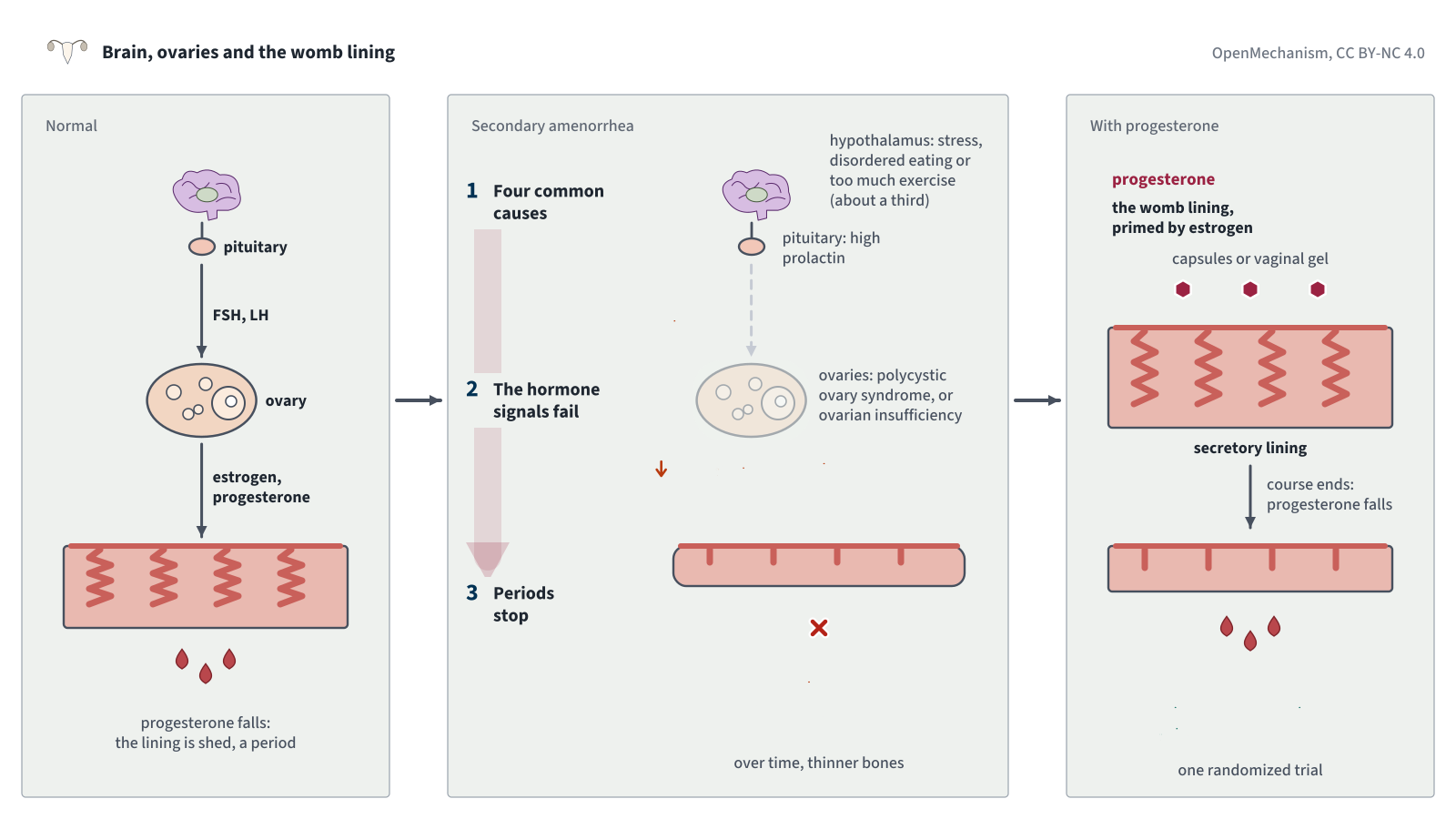
A period comes when progesterone falls and the womb's lining is shed. In secondary amenorrhea, periods stop for three months or more, most often from polycystic ovary syndrome, a hypothalamus upset by stress, disordered eating or exercise, high prolactin, or failing ovaries. Progesterone, given and then stopped, can bring on a bleed.
- Where
- Brain, ovaries and the womb lining
- Body systems
- Bladder & reproductive organs, Hormones & metabolism
- Medicines
- 1 medicine
For teachers: download this drawing.
Key terms in this drawing
- FSH
- Follicle-stimulating hormone. One of the gonadotropins, the pituitary hormones whose release estrogens hold back by negative feedback; large doses of added androgens may hold back FSH too. LH is the other.
- LH
- Luteinizing hormone. One of the gonadotropins, the pituitary hormones whose release estrogens hold back by negative feedback; added androgens hold back LH the same way. FSH is the other.
What goes wrong
Four common causes. Most cases of secondary amenorrhea come from polycystic ovary syndrome, hypothalamic amenorrhea, high prolactin (hyperprolactinemia) or primary ovarian insufficiency. Causes in the brain's hormone control, such as hypothalamic amenorrhea and high prolactin, make up the majority of cases of amenorrhea and infertility. Hypothalamic amenorrhea, about a third of cases, comes from stress, disordered eating or too much exercise. Prolactin is released by the pituitary; when it is high, it disrupts the hormone signals to the ovaries, and periods can stop.1,2,3,4,5
What the source says
“Most cases of secondary amenorrhea can be attributed to polycystic ovary syndrome, hypothalamic amenorrhea, hyperprolactinemia, or primary ovarian insufficiency.”
Source 1“Neuroendocrine causes of amenorrhea and infertility, including functional hypothalamic amenorrhea and hyperprolactinemia, constitute a majority of these cases.”
Source 2“Functional hypothalamic amenorrhea is responsible for approximately a third of the cases of secondary amenorrhea.”
Source 3“It is due to psychosocial stress, disordered eating, and/or excessive exercise.”
Source 3“Dopamine binds to type-2 dopamine receptors that are functionally linked to membrane channels and G proteins and suppresses the high intrinsic secretory activity of the pituitary lactotrophs. In addition to inhibiting PRL release by controlling calcium fluxes, dopamine activates several interacting intracellular signaling pathways and suppresses PRL gene expression and lactotroph proliferation.”
Source 4“Some symptoms of hyperprolactinaemia result from a direct effect of prolactin on target tissues but others result from hypogonadism caused by prolactin disrupting the normal functioning of the hypothalamic-pituitary-gonadal axis.”
Source 5“Symptoms of hyperprolactinaemia include gynaecomastia, galactorrhoea, sexual dysfunction, infertility, oligomenorrhoea and amenorrhoea.”
Source 5The hormone signals fail. Menstruation comes from the interplay of hormones from the hypothalamus, pituitary and ovaries: the ovarian follicle makes most of a woman's estrogen, and the ovary makes progesterone too. In hypothalamic amenorrhea, the hypothalamus releases GnRH in disturbed pulses, which disrupts the pituitary's release of and ; estrogen falls very low and ovulation stops.3,6,7,8,9
What the source says
“Menstruation is the cyclic, orderly sloughing of the uterine lining on account of the interactions of hormones produced by the hypothalamus, pituitary, and ovaries.”
Source 6“The primary source of estrogen in normally cycling adult women is the ovarian follicle, which secretes 70 to 500 mcg of estradiol daily, depending on the phase of the menstrual cycle.”
Source 7“Progesterone is a naturally occurring steroid that is secreted by the ovary, placenta, and adrenal gland.”
Source 8“FHA results from the aberrations in pulsatile gonadotropin-releasing hormone (GnRH) secretion, which in turn causes impairment of the gonadotropins (follicle-stimulating hormone and luteinizing hormone).”
Source 9“The condition is a result of disturbances in gonadotropin-releasing hormone pulsatile secretion at the level of the hypothalamus, which in turn disrupts gonadotropin secretion.”
Source 3“The final consequences are complex hormonal changes manifested by profound hypoestrogenism.”
Source 9“Functional hypothalamic amenorrhea is related to profound impairment of reproductive functions including anovulation and infertility.”
Source 9Periods stop. A fall in progesterone sets off each period; when the ovaries stop working, periods stop. In secondary amenorrhea, regular periods stop for three months, or irregular ones for six. It affects about 3 to 4% of women of reproductive age; a 2013 review says pregnancy should be ruled out in every case. Over time, hypothalamic amenorrhea affects the bones most of all, and also fertility, heart risk, thinking and mental health.1,2,3,9,10
What the source says
“Progesterone withdrawal is the trigger for menstruation.”
Source 10“The dysfunctional gonadotropin-releasing hormone release leads to the cessation of ovarian function, resulting in amenorrhea, infertility, and a long-term impact on affected women's bone health, cardiovascular risk, cognition, and mental health.”
Source 3“Secondary amenorrhea is defined as the cessation of regular menses for three months or the cessation of irregular menses for six months.”
Source 1“Secondary amenorrhea--the absence of menses for three consecutive cycles--affects approximately 3-4% of reproductive age women, and infertility--the failure to conceive after 12 months of regular intercourse--affects approximately 6-10%.”
Source 2“Pregnancy should be excluded in all cases.”
Source 1“Therefore, osteopenia and osteoporosis are the main long-term complications of FHA.”
Source 9
Where medicines act
The womb lining
- A
Progesterone targets The womb lining, primed by estrogen
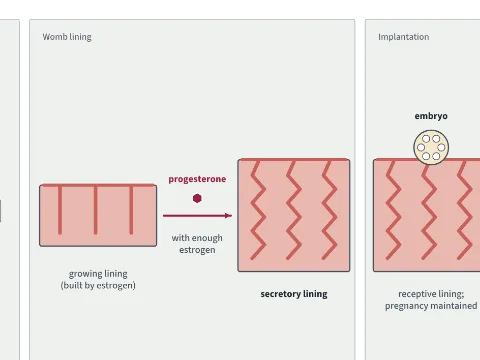
With enough estrogen, turns a growing lining secretory; its fall after the course ends sets off a withdrawal bleed.8,10,11,12,13
Used forSecondary amenorrhea: capsules or vaginal gel
What the label says
“They are also indicated for use in secondary amenorrhea.”
Source 11“Crinone 4% is indicated for the treatment of secondary amenorrhea.”
Source 8“In the presence of adequate estrogen, progesterone transforms a proliferative endometrium into a secretory endometrium.”
Source 8“Progesterone withdrawal is the trigger for menstruation.”
Source 10“In a single-center, randomized, double-blind clinical study that included premenopausal women with secondary amenorrhea for at least 90 days, administration of 10 days of PROMETRIUM ® (progesterone, USP) Capsules therapy resulted in 80 percent of women experiencing withdrawal bleeding within 7 days of the last dose of PROMETRIUM Capsules, 300 mg per day (n=20), compared to 10 percent of women experiencing withdrawal bleeding in the placebo group (n=21).”
Source 12“127 women (aged 18-44) with hypothalamic amenorrhea or premature ovarian failure were randomized to receive either Crinone 4% (n = 62) or Crinone 8% (n = 65).”
Source 13“All women were treated with either conjugated estrogens 0.625 mg daily (n = 100) or transdermal estradiol (delivering 50 mcg/day) twice weekly (n = 27).”
Source 13“In cycle 2, Crinone 4% induced bleeding in 79% of women and Crinone 8% induced bleeding in 77% of women.”
Source 13
See also
Body systems: bladder & reproductive organs and hormones & metabolism.
Also used for it: estradiol (for low estrogen from hypogonadism or failing ovaries: “Treatment of hypoestrogenism due to hypogonadism, castration or primary ovarian failure.”7).
Other conditions: heavy menstrual bleeding; acute pain and period pain; endometrial cancer; osteoporosis; low testosterone (male hypogonadism); and bulimia nervosa.
Side effects: why antipsychotics can raise prolactin.
Sources
- 1Amenorrhea: an approach to diagnosis and managementKlein DA, Poth MA. Am Fam Physician 2013 (abstract). Saved copy
- 2Neuroendocrine causes of amenorrhea: an updateFourman LT, Fazeli PK. J Clin Endocrinol Metab 2015 (abstract). Saved copy
- 3Functional hypothalamic amenorrhea: recognition and management of a challenging diagnosisSaadedine M et al. Mayo Clin Proc 2023 (abstract). Saved copy
- 4Dopamine as a prolactin (PRL) inhibitorBen-Jonathan N, Hnasko R. Endocr Rev 2001 (abstract). Saved copy
- 5Antipsychotic-induced hyperprolactinaemia: mechanisms, clinical features and managementHaddad PM, Wieck A. Drugs 2004 (abstract). Saved copy
- 6The menstrual cycle: a biological marker of general health in adolescentsPopat VB et al. Ann N Y Acad Sci 2008 (abstract). Saved copy
- 7Estradiol tablets: FDA labelIndications and Usage; Clinical Pharmacology. Saved copy
- 8Crinone (progesterone gel): FDA labelIndications and Usage; Clinical Pharmacology. Saved copy
- 9Functional hypothalamic amenorrhea and its influence on women's healthMeczekalski B et al. J Endocrinol Invest 2014 (abstract). Saved copy
- 10Physiology of the endometrium and regulation of menstruationCritchley HOD et al. Physiol Rev 2020 (abstract). Saved copy
- 11Prometrium (progesterone capsules): FDA labelIndications and Usage. Saved copy
- 12Prometrium (progesterone capsules): FDA labelClinical Studies; Warnings. Saved copy
- 13Crinone (progesterone gel): FDA labelClinical Studies. Saved copy
- 14Amenorrhea: a systematic approach to diagnosis and managementKlein DA et al. Am Fam Physician 2019 (abstract). Saved copy
Notes and limits
- A course of progesterone brings on a bleed in most women, given enough estrogen, but a 2019 review says treatment should address the underlying cause.8,12,14
- Primary ovarian insufficiency does not always mean infertility: the ovaries can keep working now and then.1
- The Prometrium label rules out progesterone capsules for women who have, or have had, clots in the veins or lungs, a stroke or a heart attack.12
Notes that apply to every page are on How to read a page.
Spotted a mistake? Report an error (hello@openmechanism.com). Since launch, every published error we fix is listed on the corrections page.
Cite this page
Tran D. Absent periods (secondary amenorrhea) [Internet]. OpenMechanism; 2026 [updated 2026 Nov 18; cited 2026 Nov 18]. Available from: https://openmechanism.com/conditions/secondary-amenorrhea