Hypothyroidism
Hypothyroidism means too little thyroid hormone. Its most common cause is long-lasting autoimmune inflammation of the thyroid (Hashimoto's thyroiditis); medicines, radioactive iodine and thyroid surgery are other frequent causes. Blood tests show high TSH with low free thyroxine (T4). It affects almost every body system, with tiredness, weight gain and feeling cold. Levothyroxine replaces the missing hormone.
- Where
- Thyroid gland
- Body system
- Hormones & metabolism
- Medicines
- 1 medicine
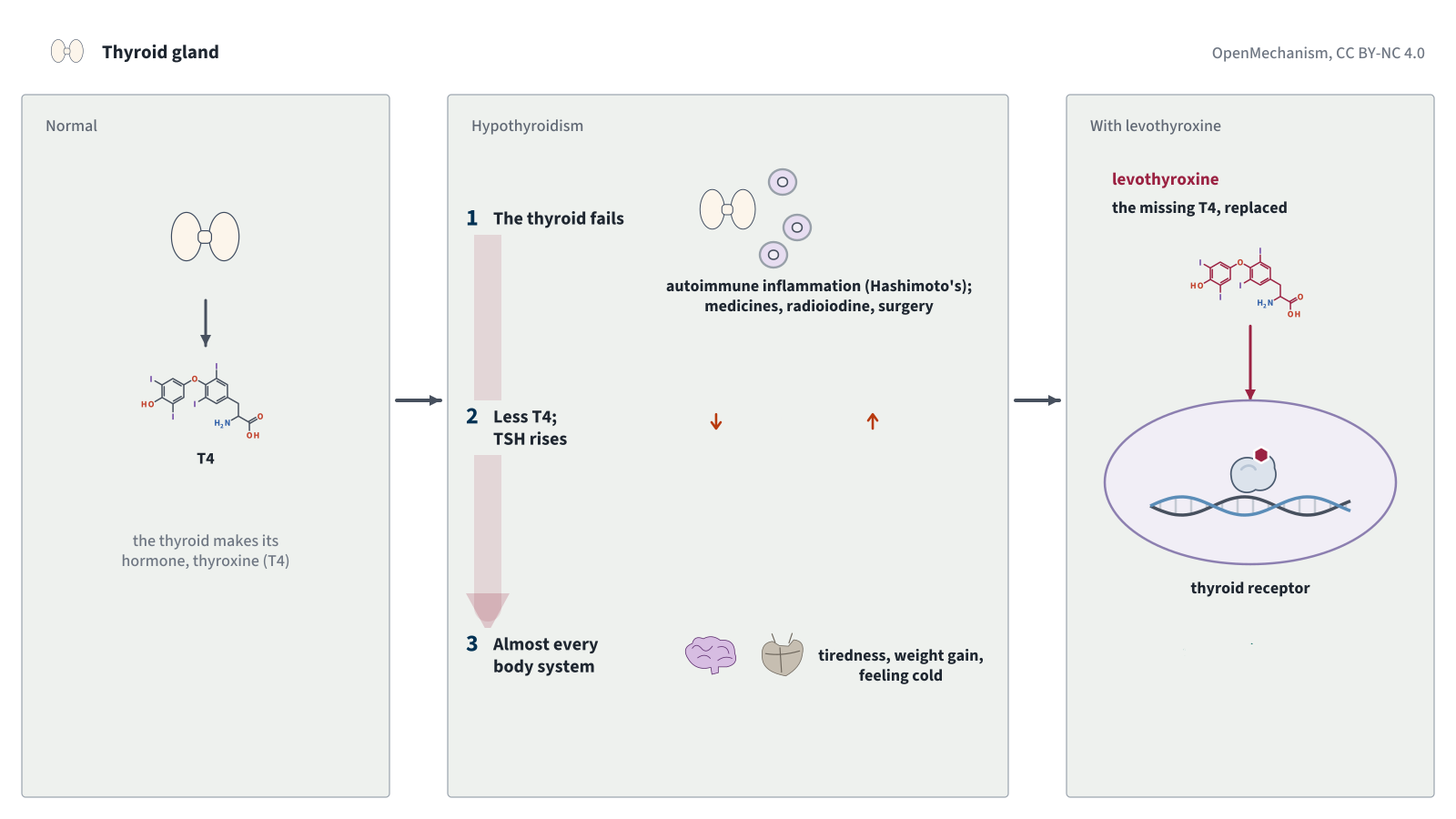
For teachers: download this drawing.
Key terms in this drawing
- T4
- Thyroxine. A hormone made in the thyroid gland; the body converts much of it to T3.
- TSH
- Thyroid-stimulating hormone. Thyroid-stimulating hormone; a high TSH with low free thyroxine (T4) defines overt primary hypothyroidism.
What goes wrong
The thyroid fails. The most common cause is long-lasting autoimmune inflammation of the thyroid (Hashimoto's thyroiditis); medicines, radioactive iodine and thyroid surgery are also frequent causes.1
What the source says
“The most common cause of hypothyroidism is chronic autoimmune thyroiditis (Hashimoto's thyroiditis), although other causes, including drugs (such as amiodarone, lithium, and immune checkpoint inhibitors), radioactive-iodine treatment, and thyroid surgery, are frequent.”
Source 1Less T4; TSH rises. In overt primary hypothyroidism, thyroid-stimulating hormone () is high and free thyroxine () is low.2
What the source says
“Overt primary hypothyroidism is defined as elevated thyroid-stimulating hormone (TSH) concentration in combination with free thyroxine (fT4) concentration below the reference range.”
Source 2Almost every body system. It affects almost all body systems; classic symptoms are tiredness, lethargy, weight gain and feeling cold.1
Where medicines act
- A
Levothyroxine: the missing hormone replaced
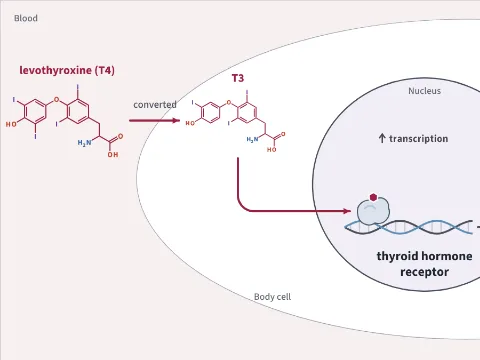
Levothyroxine is thyroxine (T4); thyroid hormones enter the cell nucleus, bind thyroid receptors on and switch genes on. It is replacement therapy for hypothyroidism.3
What the source says
“Thyroid hormones exert their physiologic actions through control of DNA transcription and protein synthesis.”
Source 3“Triiodothyronine (T3) and L-thyroxine (T4) diffuse into the cell nucleus and bind to thyroid receptor proteins attached to DNA.”
Source 3“SYNTHROID is indicated in adult and pediatric patients, including neonates, as a replacement therapy in primary (thyroidal), secondary (pituitary), and tertiary (hypothalamic) congenital or acquired hypothyroidism.”
Source 3
See also
Body system: hormones & metabolism.
Zoom in: thyroid hormone.
Side effects: why amiodarone can upset the thyroid and why checkpoint inhibitors can inflame healthy organs.
Interactions: levothyroxine and calcium, iron or acid reducers.
Sources
- 1HypothyroidismTaylor PN et al. Lancet 2024 (abstract). Saved copy
- 2HypothyroidismChaker L et al. Nat Rev Dis Primers 2022 (abstract). Saved copy
- 3Synthroid (levothyroxine): FDA label1 Indications and Usage; 12.1 Mechanism of Action. Saved copy
Notes and limits
- Symptoms are not specific, so the diagnosis rests on blood tests.1
- Some people still feel unwell after their blood tests return to normal on levothyroxine.1
Notes that apply to every page are on How to read a page.
Spotted a mistake? Report an error (hello@openmechanism.com). Since launch, every published error we fix is listed on the corrections page.
Cite this page
Tran D. Hypothyroidism [Internet]. OpenMechanism; 2026 [updated 2026 Oct 21; cited 2026 Oct 21]. Available from: https://openmechanism.com/conditions/hypothyroidism