Adrenal insufficiency
In adrenal insufficiency the adrenal glands make too little cortisol. In primary disease, Addison disease, the glands themselves are damaged and sometimes aldosterone runs short too; in other cases the glands get too little ACTH, most often because glucocorticoid medicines have turned the axis down. Hydrocortisone and other glucocorticoids replace cortisol; fludrocortisone replaces aldosterone.
- Where
- Brain, pituitary and adrenal glands
- Body system
- Hormones & metabolism
- Medicines
- 5 medicines
For teachers: download this drawing.
Key terms in this drawing
- aldosterone
- Aldosterone. Released by the adrenal glands, it helps the body keep sodium and fluid; angiotensin II stimulates its release.
- MR
- Mineralocorticoid receptor. A receptor that aldosterone and cortisol switch on; it controls which genes are read, and in the kidney it drives sodium reabsorption.
What goes wrong
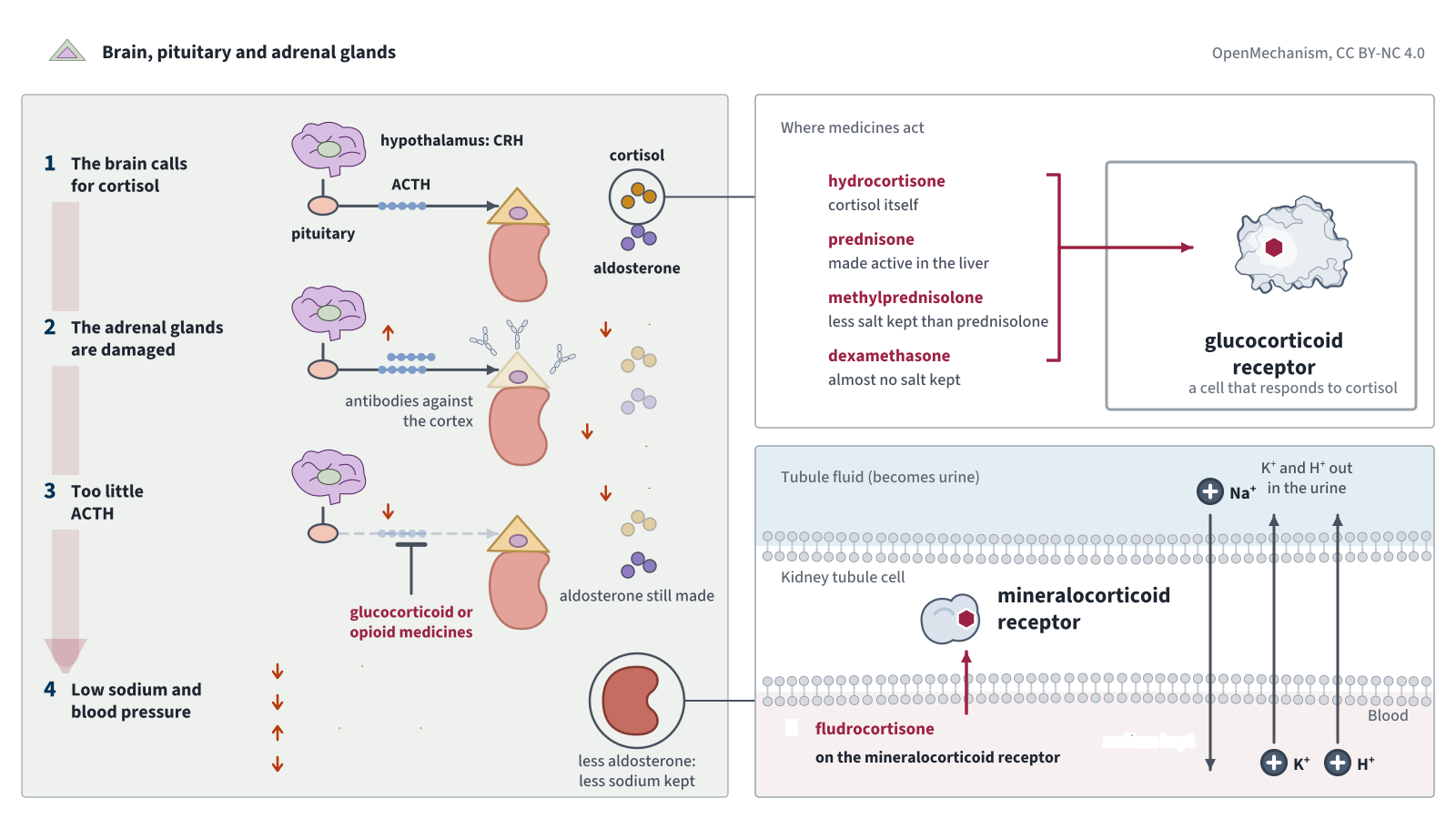
The brain calls for cortisol. The hypothalamus makes CRH, which tells the pituitary to make ACTH, and ACTH makes the adrenal cortex produce cortisol. In the cortex, the zona glomerulosa makes , a mineralocorticoid hormone.1,2,3
What the source says
“The hypothalamus makes corticotropin-releasing hormone (CRH), a hormone that tells the pituitary to make ACTH.”
Source 1“The pituitary makes adrenocorticotropin (ACTH), a hormone that tells the adrenal glands to make cortisol.”
Source 1“A hormone made by the adrenal cortex (the outer layer of the adrenal gland).”
Source 2“A mineralocorticoid hormone produced by aldosterone synthase (CYP11B2) in the zona glomerulosa of the adrenal cortex.”
Source 3The adrenal glands are damaged. In primary adrenal insufficiency the adrenal glands themselves are damaged. In autoimmune Addison disease, antibodies attack the adrenal glands; a major target is 21-hydroxylase, an enzyme that makes steroid hormones. The glands cannot make enough cortisol, and sometimes aldosterone, and ACTH is high: ACTH and already climb while the glands still keep up, before the failure shows.1,4,5,6
What the source says
“Primary adrenal insufficiency is often called Addison’s disease.”
Source 1“Addison’s disease occurs when the adrenal glands are damaged and can’t make enough of the hormone cortisol and sometimes the hormone aldosterone.”
Source 1“In autoimmune Addison’s disease, the antibodies mistakenly attack the adrenal glands.”
Source 1“These results indicate that 21-hydroxylase (P450c21), prominent in the zona glomerulosa of the adrenal cortex, is a major autoantigen in idiopathic Addison's disease.”
Source 4“serum autoantibodies to the key steroidogenic enzyme, 21-hydroxylase”
Source 5“The diagnostic process of primary adrenal insufficiency includes demonstration of low cortisol concentrations along with high plasma ACTH”
Source 6“patients have a period of compensated or preclinical disease, characterized by elevations in adrenocortocotropic hormone and renin, before overt, symptomatic adrenal failure develops.”
Source 5Too little ACTH. Adrenal insufficiency can also come from too little ACTH: when the pituitary makes too little, or when glucocorticoid or opioid medicines suppress it. Long-term glucocorticoid treatment does this through the axis's negative feedback, mainly on CRH. Then only cortisol and the other glucocorticoids run short.7,8,9,10
What the source says
“Adrenal insufficiency can arise from a primary adrenal disorder, secondary to adrenocorticotropic hormone deficiency, or by suppression of adrenocorticotropic hormone by exogenous glucocorticoid or opioid medications.”
Source 7“This effect is mediated by the negative feedback loop on the hypothalamus-pituitary-adrenal (HPA) axis, which mainly involves corticotropin-release hormone (CRH), which represents the most important driver of adrenocorticotropic hormone (ACTH) release.”
Source 8“Glucocorticoid-induced adrenal insufficiency is caused by exogenous glucocorticoid suppression of the hypothalamic-pituitary-adrenal axis and is the most prevalent form of adrenal insufficiency.”
Source 9“In secondary or tertiary adrenal insufficiency, the clinical picture results from glucocorticoid deficiency only”
Source 10Low sodium and blood pressure. In Addison disease, the lack of aldosterone, which helps the kidneys keep sodium in and release potassium, can sometimes lower blood sodium and raise blood potassium. Low blood pressure and low blood sugar are also typical of primary disease. Hallmark features are unintentional weight loss, poor appetite, low blood pressure on standing, deep tiredness, muscle and belly pain and low blood sodium; in primary disease people usually develop darker skin and crave salt.1,3,6,7
What the source says
“It helps control the balance of water and salts in the kidney by keeping sodium in and releasing potassium from the body.”
Source 3“Sometimes the lack of aldosterone in Addison’s disease can cause hyponatremia.”
Source 1“The lack of aldosterone can also cause hyperkalemia, or too much potassium.”
Source 1“Hallmark clinical features are unintentional weight loss, anorexia, postural hypotension, profound fatigue, muscle and abdominal pain, and hyponatraemia.”
Source 7“Additionally, patients with primary adrenal insufficiency usually develop skin hyperpigmentation and crave salt.”
Source 7“Typical manifestations of primary adrenal insufficiency include hyperpigmentation, hypotension, hypoglycaemia, hyponatremia with or without hyperkalemia that are generally preceded by nonspecific symptoms at the onset.”
Source 6
Where medicines act
Cells throughout the body
- A
Hydrocortisone targets Glucocorticoid receptor
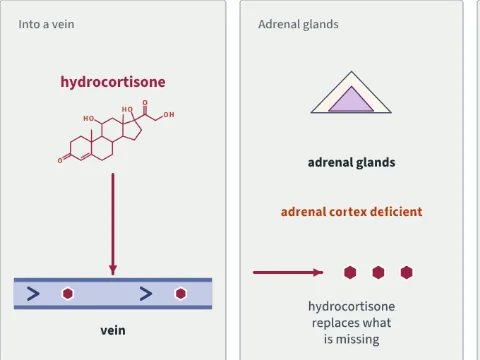
Is cortisol itself: it takes cortisol's place on the glucocorticoid receptor, and also holds on to some salt.11,12,13,14
Used forPrimary or secondary adrenal insufficiency: with cortisone, the drug of choiceAdrenal insufficiency in children: as replacement therapy (Alkindi Sprinkle)
What the label says
“ALKINDI SPRINKLE contains hydrocortisone, a corticosteroid, also known as cortisol.”
Source 11“ALKINDI SPRINKLE is a corticosteroid indicated as replacement therapy in pediatric patients with adrenocortical insufficiency”
Source 11“Primary or secondary adrenocortical insufficiency (hydrocortisone or cortisone is the drug of choice; synthetic analogs may be used in conjunction with mineralocorticoids where applicable; in infancy, mineralocorticoid supplementation is of particular importance)”
Source 12“we solved the X-ray structures of the glucocorticoid receptor (GR) ligand-binding domain (LBD) bound to its endogenous ligand, cortisol”
Source 13“The actions of glucocorticoids are predominantly mediated through the classic glucocorticoid receptor (GR).”
Source 14“GRs are expressed throughout the body”
Source 14“Naturally occurring glucocorticoids (hydrocortisone and cortisone), which also have salt-retaining properties, are used as replacement therapy in adrenocortical deficiency states.”
Source 12 - B
Prednisone targets Glucocorticoid receptor (as prednisolone)
Turned into prednisolone in the liver; acts as a glucocorticoid in cortisol's place.14,15,16,17
Used forPrimary or secondary adrenal insufficiency: a synthetic analog: may be used with a mineralocorticoid where applicable
What the label says
“A synthetic glucocorticoid with anti-inflammatory and immunomodulating properties.”
Source 15“Prednisone is converted in the liver to the active metabolite, prednisolone.”
Source 16“The actions of glucocorticoids are predominantly mediated through the classic glucocorticoid receptor (GR).”
Source 14“Primary or secondary adrenocortical insufficiency (hydrocortisone or cortisone is the first choice; synthetic analogs may be used in conjunction with mineralocorticoids where applicable; in infancy mineralocorticoid supplementation is of particular importance)”
Source 17 - C
Methylprednisolone targets Glucocorticoid receptor
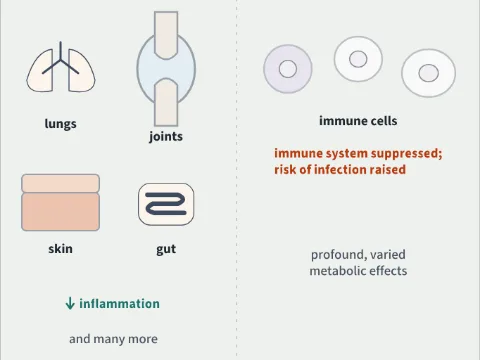
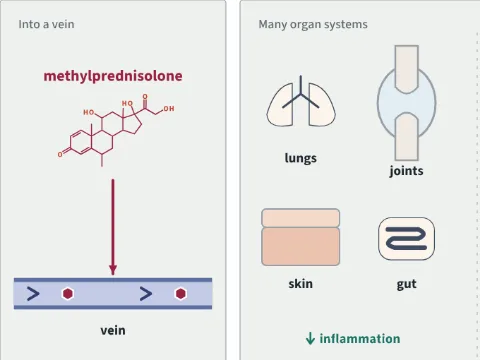
Acts mainly through the glucocorticoid receptor, like other glucocorticoids; holds on to even less salt and water than prednisolone.14,18,19
Used forPrimary or secondary adrenal insufficiency: a synthetic analog: may be used with a mineralocorticoid where applicable
What the label says
“A synthetic corticosteroid with anti-inflammatory and immunomodulating properties.”
Source 18“Methylprednisolone binds to and activates specific nuclear receptors, resulting in altered gene expression and inhibition of proinflammatory cytokine production.”
Source 18“SOLU-MEDROL Sterile Powder is an anti-inflammatory glucocorticoid, which contains methylprednisolone sodium succinate as the active ingredient.”
Source 19“The actions of glucocorticoids are predominantly mediated through the classic glucocorticoid receptor (GR).”
Source 14“GRs are expressed throughout the body”
Source 14“even less tendency than prednisolone to induce sodium and water retention.”
Source 19“Primary or secondary adrenocortical insufficiency (hydrocortisone or cortisone is the drug of choice; synthetic analogs may be used in conjunction with mineralocorticoids where applicable; in infancy, mineralocorticoid supplementation is of particular importance)”
Source 19 - D
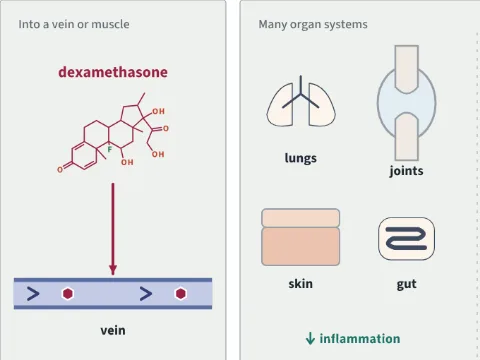
Dexamethasone targets Glucocorticoid receptor
Binds the glucocorticoid receptor and holds on to almost no salt.20,21
Used forPrimary or secondary adrenal insufficiency: a synthetic analog: may be used with a mineralocorticoid where applicableAcute adrenal insufficiency: hydrocortisone or cortisone first; a mineralocorticoid may be needed, particularly with synthetic analogs
What the label says
“Naturally occurring glucocorticoids (hydrocortisone and cortisone), which also have salt-retaining properties, are used as replacement therapy in adrenocortical deficiency states.”
Source 20“Their synthetic analogs, including dexamethasone, are primarily used for their potent anti-inflammatory effects in disorders of many organ systems.”
Source 20“Here, we report the crystal structure of the human GR ligand binding domain (LBD) bound to dexamethasone and a coactivator motif derived from the transcriptional intermediary factor 2.”
Source 21“At equipotent anti-inflammatory doses, dexamethasone almost completely lacks the sodium-retaining property of hydrocortisone and closely related derivatives of hydrocortisone.”
Source 20“Acute adrenocortical insufficiency (hydrocortisone or cortisone is the drug of choice; mineralocorticoid supplementation may be necessary, particularly when synthetic analogs are used)”
Source 20
The kidney's distal tubules
- E
Fludrocortisone acetate targets Mineralocorticoid receptor
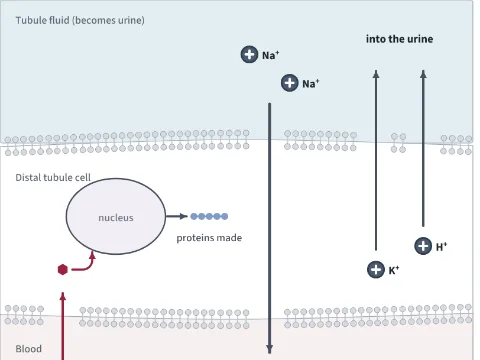
Binds the in kidney cells: sodium is kept and potassium leaves in the urine, as aldosterone would do.22,23
Used forPrimary and secondary adrenal insufficiency in Addison disease: partial replacement therapySalt-losing adrenogenital syndrome
What the label says
“Fludrocortisone acetate tablets USP, 0.1 mg contain fludrocortisone acetate, a synthetic adrenocortical steroid possessing very potent mineralocorticoid properties and high glucocorticoid activity; it is used only for its mineralocorticoid effects.”
Source 22“As a mineralocorticoid-receptor agonist, this agent stimulates Na+ reabsorption and water retention and K+ and H+ secretion in the distal tubules and collecting ducts of the kidney.”
Source 23“Mineralocorticoids act on the distal tubules of the kidney to enhance the reabsorption of sodium ions from the tubular fluid into the plasma; they increase the urinary excretion of both potassium and hydrogen ions.”
Source 22“Fludrocortisone acetate tablets, 0.1 mg are indicated as partial replacement therapy for primary and secondary adrenocortical insufficiency in Addison’s disease and for the treatment of salt-losing adrenogenital syndrome.”
Source 22
See also
Body system: hormones & metabolism.
Zoom in: cortisol and the adrenal glands.
Other conditions: low blood sodium, high blood potassium, primary aldosteronism, high calcium from cancer, ankylosing spondylitis and asthma.
Side effects: why steroid medicines can suppress the adrenal glands.
Sources
- 1Adrenal insufficiency and Addison's diseaseNIDDK, last reviewed September 2018 (Definition & Facts; Diagnosis). Saved copy
- 2Cortisol: NCI Thesaurus definitionNCI glossary definition, concept C2290. Saved copy
- 3Aldosterone: NCI Thesaurus definitionNCI definition; NCI glossary definition, concept C219. Saved copy
- 421-Hydroxylase, a major autoantigen in idiopathic Addison's diseaseWinqvist O et al. Lancet 1992 (abstract). Saved copy
- 5Autoimmune Addison disease: pathophysiology and genetic complexityMitchell AL, Pearce SH. Nat Rev Endocrinol 2012 (abstract). Saved copy
- 6Primary adrenal insufficiency in children: diagnosis and managementKirkgoz T, Guran T. Best Pract Res Clin Endocrinol Metab 2018 (abstract). Saved copy
- 7Adrenal insufficiencyHusebye ES et al. Lancet 2021 (abstract). Saved copy
- 8Treatment with synthetic glucocorticoids and the hypothalamus-pituitary-adrenal axisParagliola RM et al. Int J Mol Sci 2017 (abstract). Saved copy
- 9Approach to the patient with glucocorticoid-induced adrenal insufficiencyBorresen SW et al. J Clin Endocrinol Metab 2022 (abstract). Saved copy
- 10Adrenal insufficiencyCharmandari E et al. Lancet 2014 (abstract). Saved copy
- 11Alkindi Sprinkle (hydrocortisone): FDA label1 Indications and Usage; 11 Description. Saved copy
- 12Solu-Cortef (hydrocortisone sodium succinate): FDA labelIndications and Usage; Clinical Pharmacology. Saved copy
- 13Structures and mechanism for the design of highly potent glucocorticoidsHe Y et al. Cell Res 2014 (abstract). Saved copy
- 14Corticosteroids: mechanisms of action in health and diseaseRamamoorthy S, Cidlowski JA. Rheum Dis Clin North Am 2016 (abstract). Saved copy
- 15Prednisone: NCI Thesaurus definitionNCI definition, concept C770. Saved copy
- 16Drug choices in autoimmune hepatitis: part A, steroidsCzaja AJ. Expert Rev Gastroenterol Hepatol 2012 (abstract). Saved copy
- 17Prednisone tablets: FDA labelIndications and Usage. Saved copy
- 18Methylprednisolone: NCI Thesaurus definitionNCI definition, concept C647. Saved copy
- 19Solu-Medrol (methylprednisolone sodium succinate): FDA labelDescription; Indications and Usage; Clinical Pharmacology. Saved copy
- 20Dexamethasone sodium phosphate injection: FDA labelIndications and Usage; Clinical Pharmacology. Saved copy
- 21Crystal structure of the glucocorticoid receptor ligand binding domain reveals a novel mode of receptor dimerization and coactivator recognitionBledsoe RK et al. Cell 2002 (abstract). Saved copy
- 22Fludrocortisone acetate tablets: FDA labelDescription; Indications and Usage; Clinical Pharmacology. Saved copy
- 23Fludrocortisone acetate: NCI Thesaurus definitionNCI definition, concept C1103. Saved copy
- 24The hormone-binding part of the human glucocorticoid receptor, holding cortisol (hydrocortisone)PDB 4P6X; He, Y. et al. Cell Res. 2014;24:713-726. The glucocorticoid receptor outline in the drawing is traced from this structure. Saved copy
Notes and limits
- Diagnosis is usually late, because the first signs are often not specific.7
- Even with replacement, lower quality of life and work capacity and higher mortality are reported; an adrenal crisis, the most serious complication, which can cause death if not treated right away, occurs in about half of patients after diagnosis.1,7
Notes that apply to every page are on How to read a page.
Spotted a mistake? Report an error (hello@openmechanism.com). Since launch, every published error we fix is listed on the corrections page.
Cite this page
Tran D. Adrenal insufficiency [Internet]. OpenMechanism; 2026 [updated 2026 Nov 18; cited 2026 Nov 18]. Available from: https://openmechanism.com/conditions/adrenal-insufficiency