Semaglutide
Semaglutide activates receptors. When blood glucose is high, this increases insulin release and lowers glucagon, reducing blood glucose; a minor delay in stomach emptying early after meals also contributes.
- Acts on
- GLP-1 receptor
- Where
- Pancreas and blood
- Medicine type
- Protein
- Used for
- Hormones & metabolism
- Drug class
- GLP-1 receptor agonists
Also called Ozempic.
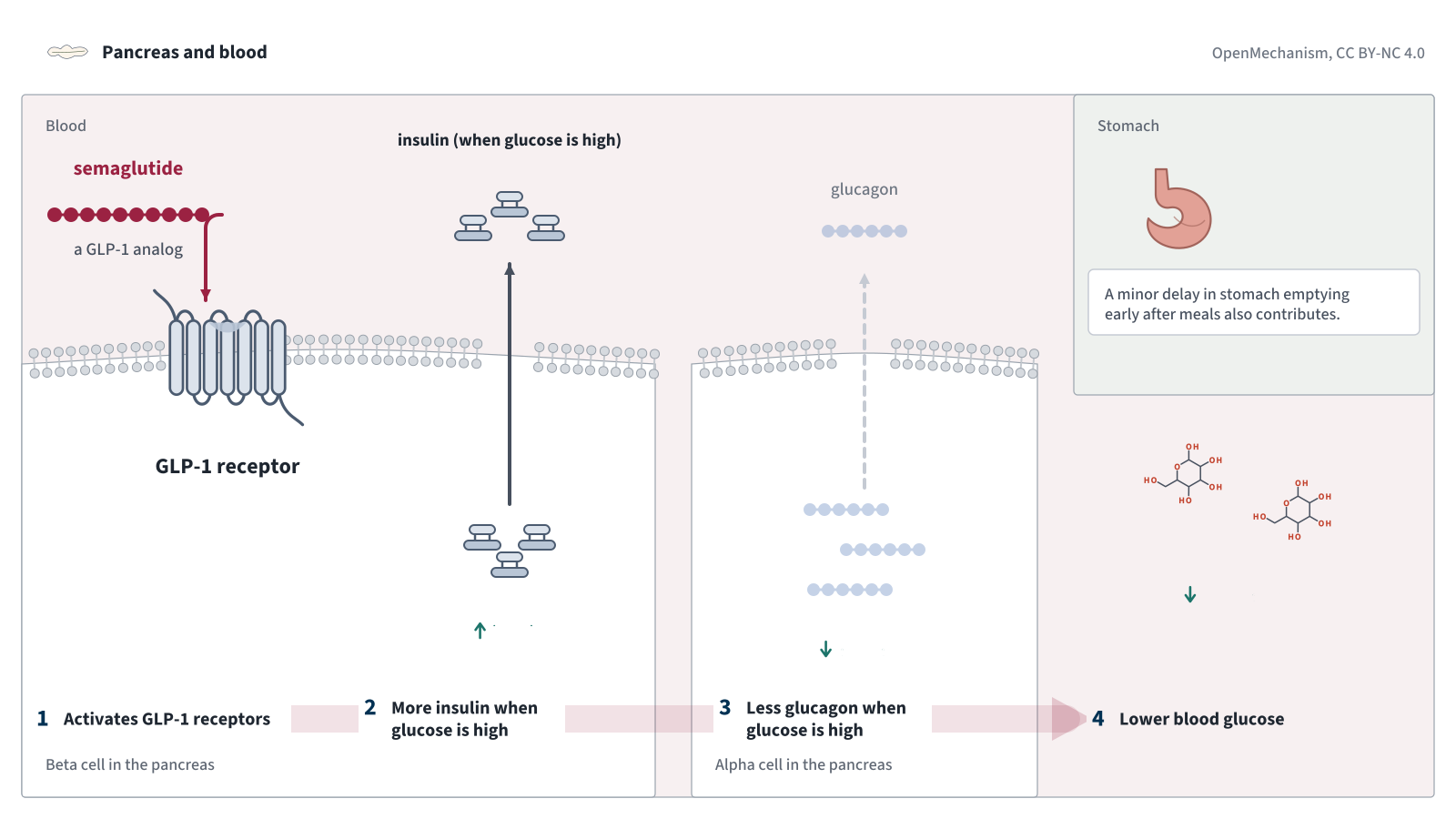
Key terms in this drawing
- GLP-1
- Glucagon-like peptide-1. A gut hormone that increases insulin release when blood glucose is normal or high.
How it works
Activates GLP-1 receptors. Semaglutide binds and activates the receptor used by native GLP-1.1
More insulin when glucose is high. When glucose is high, GLP-1 receptor action stimulates insulin secretion.1
Less glucagon when glucose is high. The medicine also lowers glucagon secretion in a glucose-dependent manner.1
Lower blood glucose. These insulin and glucagon changes lower blood glucose; the label says a minor delay in stomach emptying early after meals also contributes, by slowing how fast glucose reaches the blood after a meal.1
For teachers: download this drawing or build a slide deck.
See also
Condition pages: obesity and type 2 diabetes.
Other GLP-1 receptor agonists: dulaglutide and tirzepatide.
Explained: why GLP-1 medicines slow the stomach.
Body system: hormones & metabolism.
Sources
- 1Ozempic (semaglutide): FDA label1 Indications and Usage; 12.1 Mechanism of Action; 12.2 Pharmacodynamics
- 2ChEMBL CHEMBL2108724Target and action classification: Glucagon-like peptide 1 receptor agonist
Also used for the drawing
The drawing places insulin's release in the pancreas's beta cell and glucagon's in its alpha cell. This label section supports that part; the steps above come from the sources listed above.
- 3Januvia (sitagliptin): FDA label12.1 Mechanism of Action
Spotted a mistake? Report an error (hello@openmechanism.com). Since launch, every published error we fix is listed on the corrections page.
Notes and limits
- A schematic teaching drawing: not to scale, not exact structures, binding poses or a complete pathway, and not a guide to dosing, treatment or how a person will respond.
- The steps are in the order that explains them; one step is said to cause the next only where the source says so.
- This page shows only how semaglutide lowers blood glucose. The label also lists a use to reduce the risk of lasting loss of kidney function, kidney failure and cardiovascular death in adults with type 2 diabetes and chronic kidney disease, and says the mechanism of that kidney-related risk reduction has not been established.
All recorded limits are on the evidence page, and notes that apply to every page are on How to read a page. Version 1.0.2, medically reviewed by Daniel Tran, PharmD, on 30 October 2026.
Cite this page
Tran D. Semaglutide [Internet]. OpenMechanism; 2026 [updated 2026 Oct 30; cited 2026 Oct 30]. Available from: https://openmechanism.com/medicines/semaglutide