Vasopressin
Vasopressin, a hormone given into a vein, binds on blood-vessel muscle. A signal chain releases calcium in the muscle cells and the vessels narrow. In vasodilatory shock, resistance and blood pressure rise and less norepinephrine is needed. Through in the kidney it also makes less urine.
- Acts on
- Vasopressin V1 receptors (and V2 receptors in the kidney)
- Where
- Blood-vessel muscle and the kidney
- Medicine type
- Protein
- Used for
- Hormones & metabolism
- Drug class
- Inotropes and vasopressors
Also called Vasostrict.
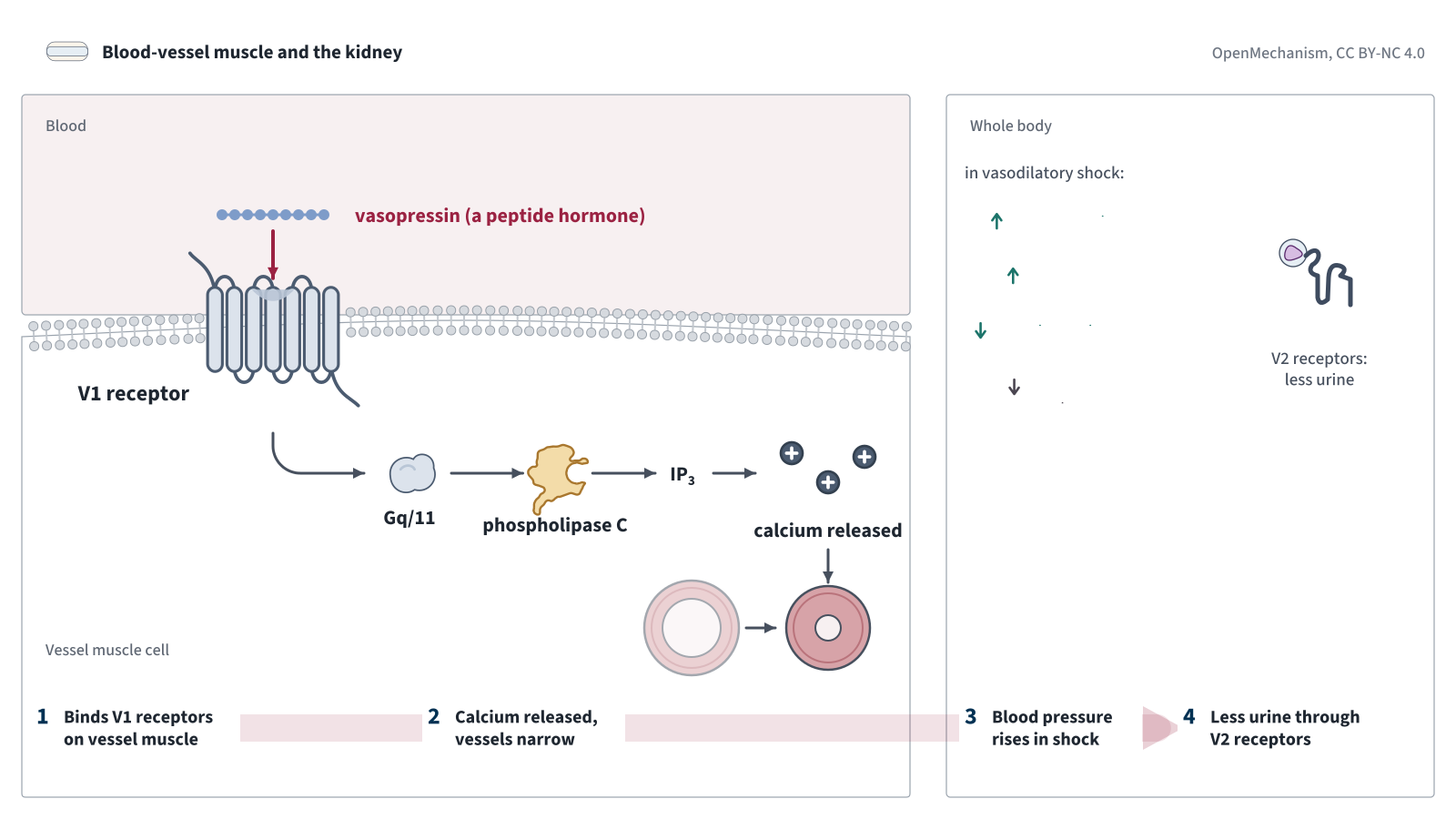
Key terms in this drawing
- Gq/11
- Gq/11 protein. A G protein that passes the V1 receptor's signal on inside the cell, through a chain that ends in calcium release.
- IP₃
- Inositol trisphosphate. A messenger inside the cell, made on the Gq/11 pathway, that leads to the release of calcium.
- V1 receptor
- Vasopressin V1 receptor. The vasopressin receptor on blood-vessel muscle; through it, vasopressin tightens the vessel.
- V2 receptor
- Vasopressin V2 receptor. The kidney receptor that antidiuretic hormone acts on to save water.
How it works
Binds V1 receptors on vessel muscle. Vasopressin, a polypeptide hormone given into a vein, binds V1 receptors on blood-vessel smooth muscle; these receptors are coupled to the –phospholipase C–inositol trisphosphate pathway.1
Calcium released, vessels narrow. This releases calcium inside the muscle cells and narrows the vessels (vasoconstriction) in most vascular beds, including the gut (splanchnic), kidney and skin circulations.1
Blood pressure rises in shock. In vasodilatory shock, vasopressin raises systemic vascular resistance and mean arterial blood pressure and lowers the dose of norepinephrine needed; it tends to decrease heart rate and cardiac output.1
Less urine through V2 receptors. Vasopressin also causes antidiuresis (less urine) by stimulating V2 receptors, which are coupled to adenylyl cyclase; at the lower concentrations of the body's own , it holds back water through the kidney's V2 receptors.1
For teachers: download this drawing.
See also
Condition pages: shock.
Other inotropes and vasopressors: dobutamine, epinephrine, milrinone and norepinephrine.
Body systems: hormones & metabolism; and heart, vessels & cholesterol.
Sources
- 1Vasostrict (vasopressin) injection: FDA label1 Indications and Usage; 11 Description; 12.1 Mechanism of Action; 12.2 Pharmacodynamics
- 2ChEMBL CHEMBL373742Target and action classification: Vasopressin receptor agonist
Also used for the drawing
The phospholipase C outline is traced from the crystal structure below.
- 3Human phospholipase C-beta 3 with the G protein Gq and its catalytic calciumPDB 7SQ2; Endo-Streeter, S.T. et al. Science 2010; 330:974-980
Spotted a mistake? Report an error (hello@openmechanism.com). Since launch, every published error we fix is listed on the corrections page.
Notes and limits
- A schematic teaching drawing: not to scale, not exact structures, binding poses or a complete pathway, and not a guide to dosing, treatment or how a person will respond.
All recorded limits are on the evidence page, and notes that apply to every page are on How to read a page. Version 1.0.0, not yet medically reviewed.
Cite this page
Tran D. Vasopressin [Internet]. OpenMechanism; 2026 [updated 2026 Oct 10; cited 2026 Oct 10]. Available from: https://openmechanism.com/medicines/vasopressin