Pompe disease
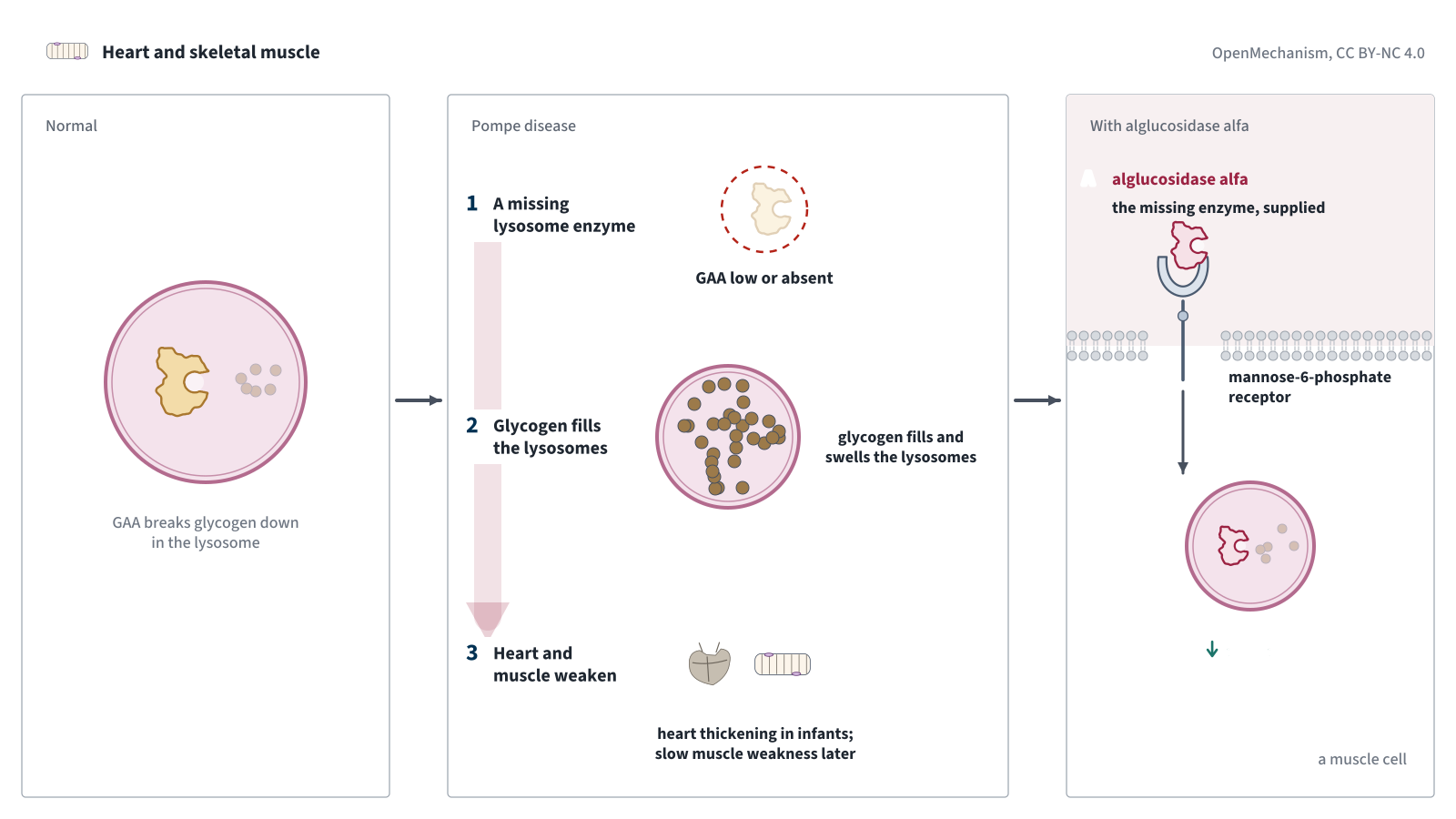
Pompe disease is an inherited lysosomal storage disorder: the enzyme acid alpha-glucosidase (GAA), which breaks down glycogen in lysosomes, is missing or very low. Glycogen-filled lysosomes swell in many tissues, worst in heart and skeletal muscle; infants can have fatal heart muscle thickening, and later forms bring slowly worsening muscle weakness. Alglucosidase alfa, a replacement enzyme, is taken into lysosomes.
- Where
- Heart and skeletal muscle
- Body systems
- Hormones & metabolism; Muscles, bones & joints
- Medicines
- 1 medicine
For teachers: download this drawing.
Key terms in this drawing
- GAA
- Acid alpha-glucosidase. The lysosome enzyme that breaks down glycogen; missing in Pompe disease.
- M6P receptor
- Mannose-6-phosphate receptor. A receptor that takes up enzymes carrying mannose-6-phosphate sugar tags and sends them to lysosomes.
What goes wrong
A missing lysosome enzyme. Pompe disease is a lysosomal storage disorder in which the enzyme acid alpha-glucosidase () is low or absent; it is inherited.1,2
Glycogen fills the lysosomes. Without the enzyme, lysosomes fill with glycogen and swell in many tissues, worst in heart and skeletal muscle.1
What the source says
“Deficiency of this lysosomal enzyme results in progressive expansion of glycogen-filled lysosomes in multiple tissues, with cardiac and skeletal muscle being the most severely affected.”
Source 1Heart and muscle weaken. It ranges from fatal heart muscle thickening and muscle disease in infants to milder forms with slowly worsening muscle weakness and no heart disease.1
What the source says
“The clinical spectrum ranges from fatal hypertrophic cardiomyopathy and skeletal muscle myopathy in infants to relatively attenuated forms, which manifest as a progressive myopathy without cardiac involvement.”
Source 1
Where medicines act
- A
Alglucosidase alfa: the enzyme replaced
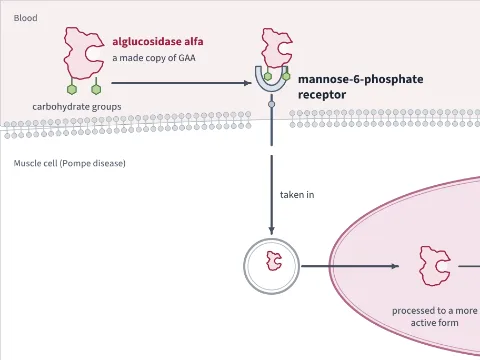
Alglucosidase alfa supplies the missing enzyme: it binds , is carried into lysosomes and breaks down glycogen there. It treats Pompe disease.2
What the source says
“Alglucosidase alfa provides an exogenous source of GAA.”
Source 2“after which it is internalized and transported into lysosomes, where it undergoes proteolytic cleavage that results in increased enzymatic activity. It then exerts enzymatic activity in cleaving glycogen.”
Source 2“indicated for patients with Pompe disease (acid α-glucosidase [GAA] deficiency).”
Source 2
See also
Body systems: hormones & metabolism; and muscles, bones & joints.
Other conditions: growth hormone deficiency, hypoparathyroidism and primary hyperparathyroidism.
Sources
- 1Pompe disease: from pathophysiology to therapy and back againLim JA et al. Front Aging Neurosci 2014 (abstract). Saved copy
- 2Lumizyme (alglucosidase alfa): FDA label1 Indications and Usage; 12.1 Mechanism of Action. Saved copy
- 3Human lysosomal acid alpha-glucosidase (GAA)PDB 5NN3; Roig-Zamboni, V. et al. Nat Commun 2017;8:1111. The acid alpha-glucosidase outline in the drawing is traced from this structure. Saved copy
Notes and limits
- Enzyme replacement has reversed the heart changes but not the skeletal muscle ones.1
- How the muscle is damaged is still poorly understood; faulty autophagy plays a part, not only swollen lysosomes.1
Notes that apply to every page are on How to read a page.
Spotted a mistake? Report an error (hello@openmechanism.com). Since launch, every published error we fix is listed on the corrections page.
Cite this page
Tran D. Pompe disease [Internet]. OpenMechanism; 2026 [updated 2026 Oct 16; cited 2026 Oct 16]. Available from: https://openmechanism.com/conditions/pompe-disease