Glimepiride
Glimepiride binds the sulfonylurea receptor on the pancreas's beta cells, which closes their and stimulates insulin release. The enzyme starts its breakdown: the first product, M1, has about a third of its activity in animals, and the second, M2, is inactive.
- Acts on
- Sulfonylurea receptor (ATP-sensitive potassium channel)
- Where
- Beta cells of the pancreas
- Medicine type
- Small molecule
- Used for
- Hormones & metabolism
- Drug class
- Sulfonylureas
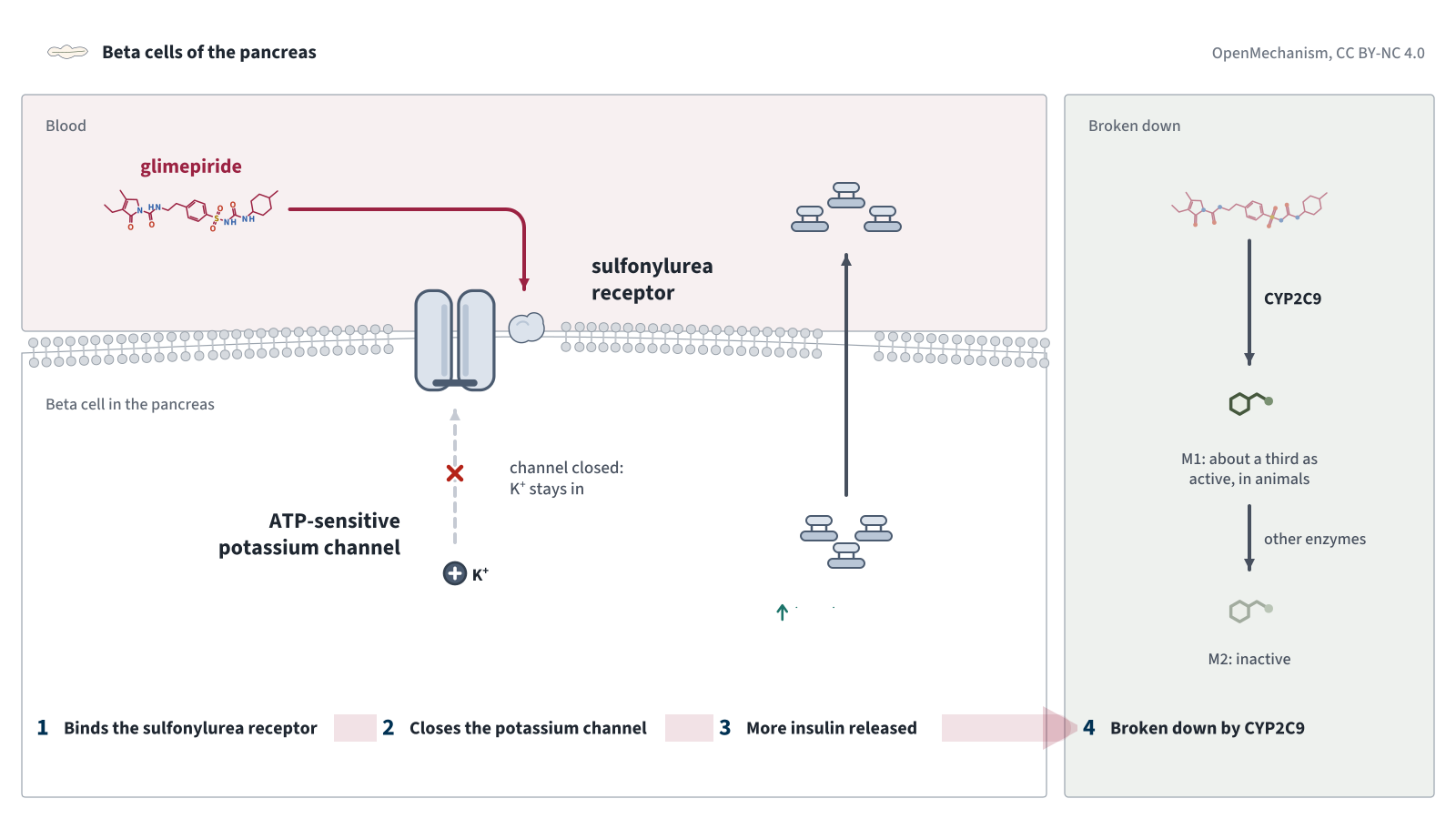
Key terms in this drawing
- ATP-sensitive potassium channel
- ATP-sensitive potassium channel. A potassium channel in the beta cells of the pancreas; sulfonylureas close it, which stimulates insulin release.
- CYP2C9
- Cytochrome P450 2C9. One of the cytochrome P450 enzymes that break down medicines; it breaks down some rimegepant (most goes by CYP3A4).
How it works
Binds the sulfonylurea receptor. Sulfonylureas such as glimepiride bind the sulfonylurea receptor in the membrane of the pancreas's beta cells.1
Closes the potassium channel. This closes the cell's ATP-sensitive potassium channel.1
More insulin released. Closing the channel stimulates the release of insulin from the beta cells; this is mainly how glimepiride lowers blood glucose.1
Broken down by CYP2C9. Glimepiride is completely broken down. CYP2C9 turns it into M1, which other enzymes turn into M2; M2 is inactive. In animals M1 has about a third of glimepiride's activity, but it is unclear whether M1 has a meaningful effect on blood glucose in people.1
For teachers: download this drawing.
See also
Condition pages: type 2 diabetes.
Side effects: low blood sugar (hypoglycemia).
Other sulfonylureas: glipizide.
Explained: why sulfonylureas can cause low blood sugar.
Body system: hormones & metabolism.
Sources
- 1Glimepiride tablets (Aurobindo): FDA label12.1 Mechanism of Action; 12.3 Pharmacokinetics
- 2ChEMBL CHEMBL1481Target and action classification: Sulfonylurea receptor 1, Kir6.2 blocker
Spotted a mistake? Report an error (hello@openmechanism.com). Since launch, every published error we fix is listed on the corrections page.
Notes and limits
- A schematic teaching drawing: not to scale, not exact structures, binding poses or a complete pathway, and not a guide to dosing, treatment or how a person will respond.
All recorded limits are on the evidence page, and notes that apply to every page are on How to read a page. Version 1.0.0, not yet medically reviewed.
Cite this page
Tran D. Glimepiride [Internet]. OpenMechanism; 2026 [updated 2026 Oct 11; cited 2026 Oct 11]. Available from: https://openmechanism.com/medicines/glimepiride