Acromegaly
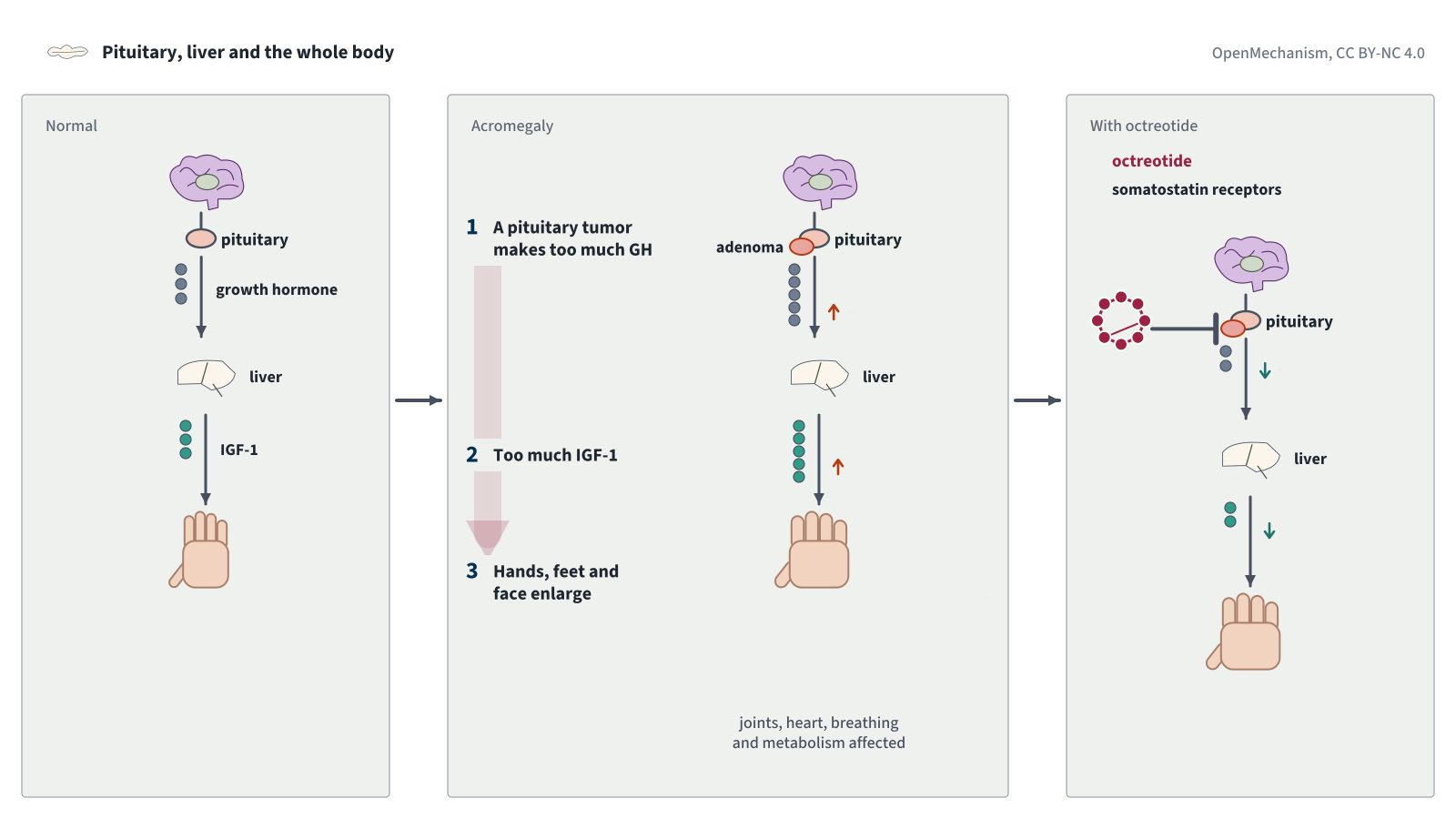
Acromegaly is too much growth hormone, and so too much IGF-1, most often from a pituitary adenoma. Over years the hands, feet and face enlarge, and the joints, heart, breathing and metabolism are affected. Octreotide, which acts like the body's somatostatin, lowers growth hormone, IGF-1 or both.
- Where
- Pituitary, liver and the whole body
- Body system
- Hormones & metabolism
- Medicines
- 1 medicine
For teachers: download this drawing.
What goes wrong
A pituitary tumor makes too much GH. Acromegaly is an increased release of growth hormone (GH), and so of IGF-1, most often by a pituitary adenoma, a tumor of the pituitary gland; 60% of them are purely GH-secreting. It is rare, about 1 in 140,000 to 250,000 people, and is usually diagnosed in middle age, often 4 to more than 10 years after it began.1,2
What the source says
“Acromegaly is characterized by increased release of growth hormone and, consequently, insulin-like growth factor I (IGF1), most often by a pituitary adenoma.”
Source 1“In the majority of cases, acromegaly is related to a pituitary adenoma, either purely GH-secreting (60%) or mixed.”
Source 2“The prevalence is estimated at 1:140,000-250,000.”
Source 2“It is most often diagnosed in middle-aged adults (average age 40 years, men and women equally affected).”
Source 2“Due to insidious onset and slow progression, acromegaly is often diagnosed four to more than ten years after its onset.”
Source 2Too much IGF-1. The extra GH raises IGF-1, which is made in many tissues, most of all in the liver, and carries most of GH's effects on bone. In acromegaly bone turnover is high, which can lead to bone loss and spine fractures, especially when sex hormones are also low (hypogonadism).1,3,4
What the source says
“Acromegaly is characterized by increased release of growth hormone and, consequently, insulin-like growth factor I (IGF1), most often by a pituitary adenoma.”
Source 1“IGF-I is expressed in virtually every tissue of the body, but with much higher expression in the liver than in any other tissue.”
Source 3“Although GH may act directly on skeletal cells, most of its effects are mediated by IGF-I, which is present in the systemic circulation and is synthesized by peripheral tissues.”
Source 4“Acromegaly is characterized by high bone turnover, which can lead to bone loss and vertebral fractures, particularly in patients with coexistent hypogonadism.”
Source 4Hands, feet and face enlarge. Over years the hands and feet broaden and the fingers and soft tissues thicken; the nose widens, the cheekbones and forehead stand out, the lips thicken and the jaw can overgrow. Acromegaly also affects the joints, heart, breathing and metabolism, which shape its outlook, and is linked to higher mortality.1,2
What the source says
“The main clinical features are broadened extremities (hands and feet), widened thickened and stubby fingers, and thickened soft tissue.”
Source 2“The facial aspect is characteristic and includes a widened and thickened nose, prominent cheekbones, forehead bulges, thick lips and marked facial lines.”
Source 2“There is a tendency towards mandibular overgrowth with prognathism, maxillary widening, tooth separation and jaw malocclusion.”
Source 2“The disease also has rheumatologic, cardiovascular, respiratory and metabolic consequences which determine its prognosis.”
Source 2“Prolonged exposure to excess hormone leads to progressive somatic disfigurement and a wide range of systemic manifestations that are associated with increased mortality.”
Source 1
Where medicines act
The pituitary
- A
Octreotide targets Somatostatin receptors
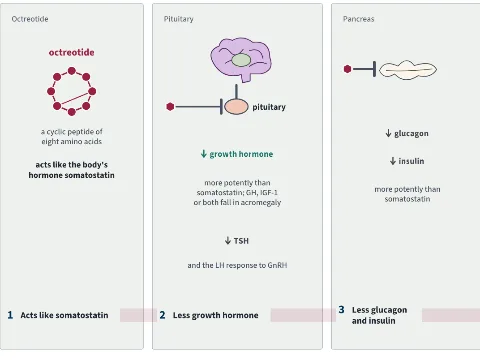
Acts like somatostatin to hold back growth hormone release, lowering growth hormone, IGF-1 or both.5,6
Used forAcromegaly: when surgery, radiation and bromocriptine have not worked well enough or cannot be used
What the label says
“Acromegaly : To reduce blood levels of growth hormone (GH) and insulin growth factor-1 (IGF-1; somatomedin C) in acromegaly patients who have had inadequate response to or cannot be treated with surgical resection, pituitary irradiation, and bromocriptine mesylate at maximally tolerated doses.”
Source 5“Sandostatin Injection exerts pharmacologic actions similar to the natural hormone, somatostatin.”
Source 5“It is an even more potent inhibitor of GH, glucagon, and insulin than somatostatin.”
Source 5“Octreotide substantially reduces GH and/or IGF-1 (somatomedin C) levels in patients with acromegaly.”
Source 5“Somatostatin, also known as somatotropin-release inhibitory factor, is a cyclopeptide that exerts potent inhibitory actions on hormone secretion and neuronal excitability.”
Source 6“Its physiologic functions are mediated by five G protein-coupled receptors (GPCRs) called somatostatin receptor (SST)1-5.”
Source 6
See also
Body system: hormones & metabolism.
Other conditions: growth hormone deficiency and diabetes insipidus.
Sources
- 1AcromegalyColao A et al. Nat Rev Dis Primers 2019 (abstract). Saved copy
- 2AcromegalyChanson P, Salenave S. Orphanet J Rare Dis 2008 (abstract). Saved copy
- 3The role of liver-derived insulin-like growth factor-IOhlsson C et al. Endocr Rev 2009 (abstract). Saved copy
- 4Growth hormone, insulin-like growth factors, and the skeletonGiustina A et al. Endocr Rev 2008 (abstract). Saved copy
- 5Sandostatin (octreotide) injection: FDA label1 Indications and Usage; 12.1 Mechanism of Action; 12.2 Pharmacodynamics. Saved copy
- 6Somatostatin receptors: structure, function, ligands, and new nomenclatureGünther T et al. Pharmacol Rev 2018 (abstract). Saved copy
Notes and limits
- Pituitary surgery (transsphenoidal surgery) is often the first treatment. When it does not correct GH and IGF-1, somatostatin analogs or radiotherapy can be used, and the GH blocker pegvisomant when somatostatin analogs do not work.2
- In trials, octreotide was not shown to improve symptoms or to shrink the tumor or slow its growth, though the trials were not designed to detect such effects.5
- In controlled trials, octreotide markedly increased gallstones and biliary sludge.5
- With good control, life expectancy can match that of the general population, but joint pain, deformities and a lower quality of life often remain.2
- Octreotide is also used for the severe diarrhea and flushing of metastatic carcinoid tumors and the watery diarrhea of VIPomas.5
Notes that apply to every page are on How to read a page.
Spotted a mistake? Report an error (hello@openmechanism.com). Since launch, every published error we fix is listed on the corrections page.
Cite this page
Tran D. Acromegaly [Internet]. OpenMechanism; 2026 [updated 2026 Oct 20; cited 2026 Oct 20]. Available from: https://openmechanism.com/conditions/acromegaly