Prednisone
Prednisone is a synthetic glucocorticoid, readily absorbed from the gut. It is used mainly for its strong anti-inflammatory effects in many organ systems; it also has profound metabolic effects and changes the body's immune responses. It can suppress the body's own hypothalamic-pituitary-adrenal axis, and after large doses taken for long periods the resulting shortfall may last up to 12 months after stopping.
- Acts on
- Glucocorticoid receptor (as prednisolone)
- Where
- Many organs, the immune system and the adrenal axis
- Medicine type
- Small molecule
- Used for
- Hormones & metabolism
- Drug class
- Corticosteroids
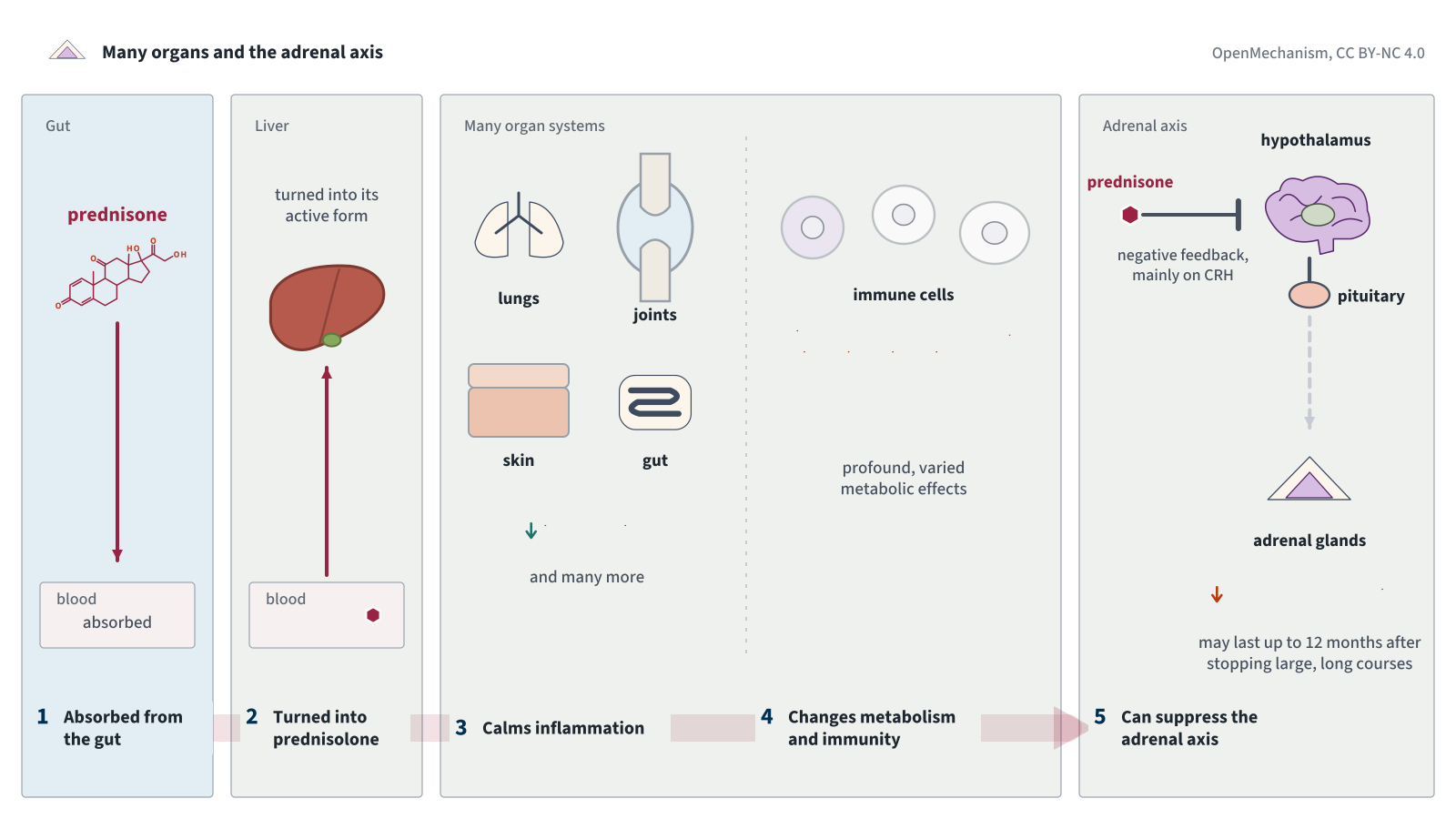
How it works
Absorbed from the gut. Prednisone is a glucocorticoid, a synthetic adrenocortical steroid; glucocorticoids are readily absorbed from the gastrointestinal tract.1
Turned into prednisolone. The liver turns prednisone into its active form, prednisolone; glucocorticoids act mainly through the glucocorticoid receptor.2,3
Calms inflammation. Synthetic glucocorticoids such as prednisone are used mainly for their potent anti-inflammatory effects in disorders of many organ systems.1
Changes metabolism and immunity. Glucocorticoids cause profound and varied metabolic effects, and they modify the body's immune responses to diverse stimuli; corticosteroids, including prednisone, suppress the immune system and increase the risk of infection.1
Can suppress the adrenal axis. Corticosteroids can produce reversible suppression of the hypothalamic-pituitary-adrenal (HPA) axis, with possible corticosteroid insufficiency after treatment is withdrawn, which may result from withdrawing it too quickly; after large doses taken for long periods, this relative insufficiency may persist for up to 12 months after stopping.1
For teachers: download this drawing.
See also
Condition pages: acute lymphoblastic leukemia, adrenal insufficiency, ankylosing spondylitis, asthma, B-cell lymphomas, chronic lymphocytic leukemia, Crohn disease, gout, Hodgkin lymphoma, high calcium from cancer, juvenile idiopathic arthritis, lupus nephritis, osteoarthritis, pemphigus, psoriasis, psoriatic arthritis, rheumatoid arthritis, tuberculosis and ulcerative colitis.
Other corticosteroids: budesonide, clobetasol, dexamethasone, fluticasone propionate, hydrocortisone, methylprednisolone and triamcinolone.
Explained: why steroid medicines can suppress the adrenal glands, why steroid medicines can weaken bones and why steroid medicines can raise blood sugar.
Body system: hormones & metabolism.
Sources
- 1Prednisone tablets: FDA labelIndications; Description; Clinical Pharmacology; Warnings (Immunosuppression and Increased Risk of Infection); Warnings (Endocrine); Precautions (Endocrine)
- 2Drug choices in autoimmune hepatitis: part A, steroidsCzaja AJ, Expert Rev Gastroenterol Hepatol 2012 (abstract)
- 3Corticosteroids: mechanisms of action in health and diseaseRamamoorthy S, Cidlowski JA, Rheum Dis Clin North Am 2016 (abstract)
- 4ChEMBL CHEMBL635Target and action classification: Glucocorticoid receptor agonist
Also used for the drawing
The drawing ends prednisone's negative feedback on the hypothalamus, where it mainly acts on CRH, as the page on steroids and adrenal suppression does. This paper supports that part; the steps above come from the sources listed above.
- 5Treatment with synthetic glucocorticoids and the hypothalamus-pituitary-adrenal axisParagliola RM et al. Int J Mol Sci 2017 (abstract)
Spotted a mistake? Report an error (hello@openmechanism.com). Since launch, every published error we fix is listed on the corrections page.
Notes and limits
- A schematic teaching drawing: not to scale, not exact structures, binding poses or a complete pathway, and not a guide to dosing, treatment or how a person will respond.
- The steps are in the order that explains them; one step is said to cause the next only where the source says so.
All recorded limits are on the evidence page, and notes that apply to every page are on How to read a page. Version 1.0.1, medically reviewed by Daniel Tran, PharmD, on 30 October 2026.
Cite this page
Tran D. Prednisone [Internet]. OpenMechanism; 2026 [updated 2026 Oct 30; cited 2026 Oct 30]. Available from: https://openmechanism.com/medicines/prednisone