Low blood sugar (hypoglycemia)
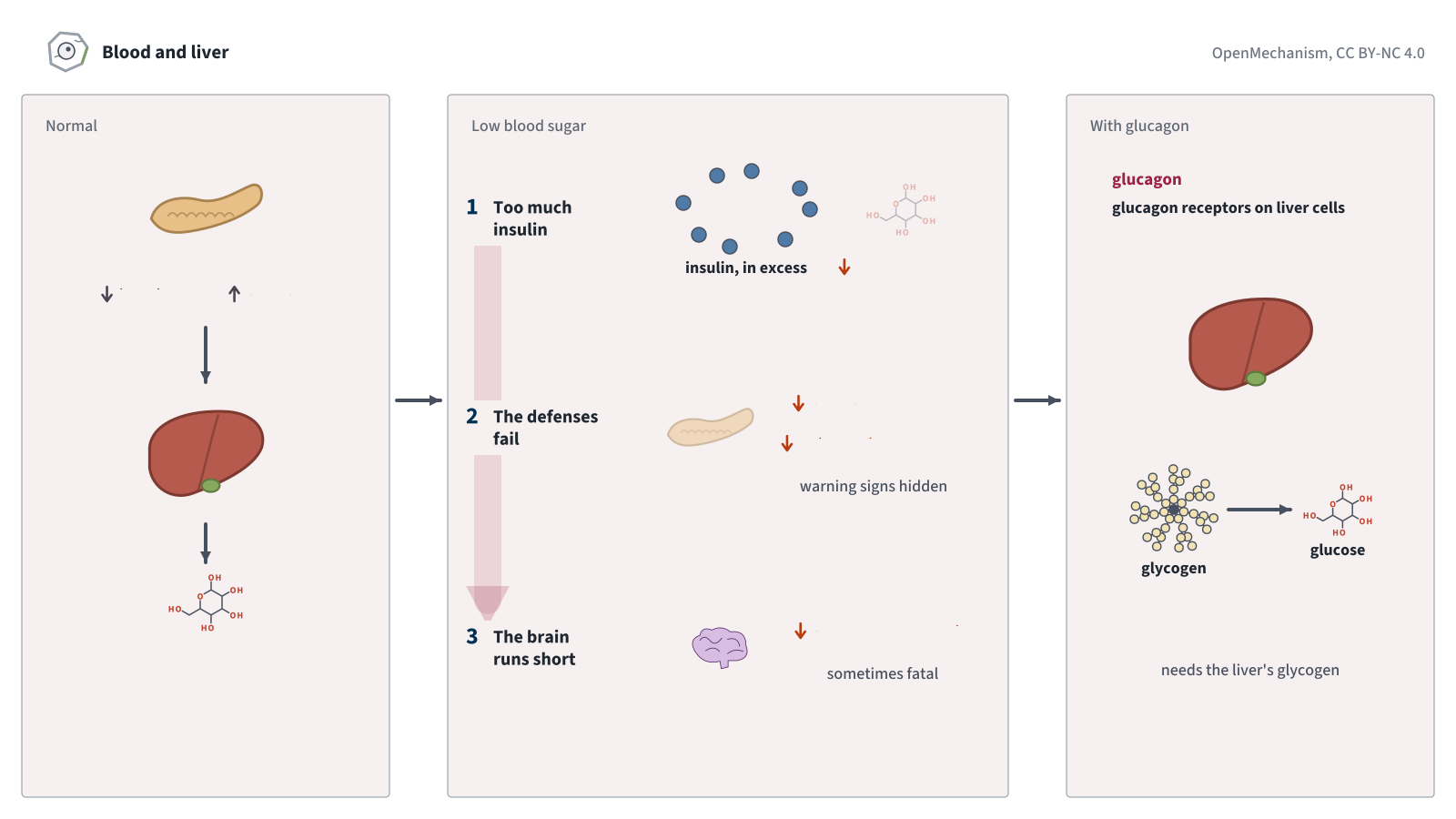
Low blood sugar from diabetes treatment typically comes from insulin in excess while the body's defenses against a falling glucose (less insulin, more glucagon and epinephrine) fail. It harms most people with type 1 diabetes at times and is sometimes fatal. Glucagon makes the liver release glucose.
- Where
- Blood and liver
- Body system
- Hormones & metabolism
- Medicines
- 1 medicine
For teachers: download this drawing.
What goes wrong
Too much insulin. Less insulin, more glucagon and, failing that, more epinephrine normally stop or quickly correct a low blood sugar. Low blood sugar from diabetes treatment typically comes from insulin in excess, absolutely or relatively, while these defenses are weakened, in type 1 and advanced type 2 diabetes.1
What the source says
“Decrements in insulin, increments in glucagon, and, absent the latter, increments in epinephrine stand high in the hierarchy of redundant glucose counterregulatory factors that normally prevent or rapidly correct hypoglycemia.”
Source 1“Hypoglycemia can result from exogenous or endogenous insulin excess alone.”
Source 1“However, iatrogenic hypoglycemia is typically the result of the interplay of absolute or relative insulin excess and compromised glucose counterregulation in type 1 and advanced type 2 diabetes.”
Source 1The defenses fail. In diabetes with too little insulin of its own, injected insulin does not fall as glucose falls, and weak glucagon and epinephrine responses leave the defense faulty. Weaker nerve-and-adrenal responses also hide the warning signs (hypoglycemia unawareness).1
What the source says
“In insulin-deficient diabetes (exogenous) insulin levels do not decrease as glucose levels fall, and the combination of deficient glucagon and epinephrine responses causes defective glucose counterregulation.”
Source 1“Reduced sympathoadrenal responses cause hypoglycemia unawareness.”
Source 1The brain runs short. The symptoms come from the nerves and from the brain running short of glucose; they are often not specific, so many episodes go unrecognized. Low blood sugar from treatment repeatedly harms most people with type 1 diabetes and many with type 2, and is sometimes fatal.1
What the source says
“the neurogenic and neuroglycopenic symptoms of hypoglycemia are nonspecific and relatively insensitive; therefore, many episodes are not recognized.”
Source 1“Iatrogenic hypoglycemia causes recurrent morbidity in most people with type 1 diabetes and many with type 2 diabetes, and it is sometimes fatal.”
Source 1
Where medicines act
In the liver
- A
Glucagon targets Glucagon receptors on liver cells
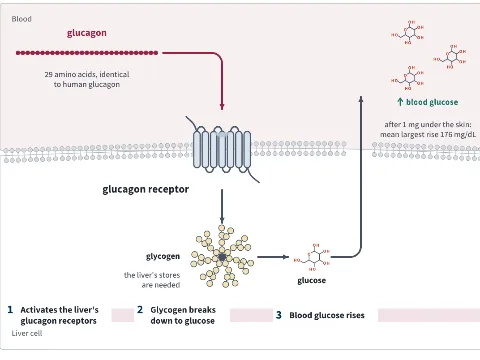
Activates liver glucagon receptors, so glycogen is broken down and glucose released.2
Used forSevere low blood sugar in diabetes: age 2 and older
What the label says
“GVOKE is indicated for subcutaneous use for the treatment of severe hypoglycemia in adult and pediatric patients aged two and older with diabetes.”
Source 2“Glucagon increases blood glucose concentration by activating hepatic glucagon receptors, thereby stimulating glycogen breakdown and release of glucose from the liver.”
Source 2“Hepatic stores of glycogen are necessary for glucagon to produce an antihypoglycemic effect.”
Source 2
See also
Body system: hormones & metabolism.
Can raise or cause it: insulin glargine (“Hypoglycemia is the most common adverse reaction associated with insulins, including LANTUS.”3); and glimepiride (“All sulfonylureas, including glimepiride, can cause severe hypoglycemia”4).
Other conditions: type 1 diabetes, type 2 diabetes and low blood potassium (hypokalemia).
Interactions: why beta-blockers can hide low blood sugar.
Side effects: why sulfonylureas can cause low blood sugar.
Sources
- 1Hypoglycemia in diabetesCryer PE, Davis SN, Shamoon H. Diabetes Care 2003 (abstract). Saved copy
- 2Gvoke (glucagon): FDA label1.1 Severe Hypoglycemia; 12.1 Mechanism of Action. Saved copy
- 3Lantus (insulin glargine): FDA label5.3 Hypoglycemia. Saved copy
- 4Glimepiride: FDA label5.1 Hypoglycemia. Saved copy
Notes and limits
- A concept called hypoglycemia-associated autonomic failure holds that a recent low blood sugar both weakens the defenses and hides the warning signs; avoiding low blood sugar for a short time brings the warning signs back in most people.1
Notes that apply to every page are on How to read a page.
Spotted a mistake? Report an error (hello@openmechanism.com). Since launch, every published error we fix is listed on the corrections page.
Cite this page
Tran D. Low blood sugar (hypoglycemia) [Internet]. OpenMechanism; 2026 [updated 2026 Oct 20; cited 2026 Oct 20]. Available from: https://openmechanism.com/conditions/low-blood-sugar