Dapagliflozin
Dapagliflozin blocks , the kidney transporter that takes back most filtered glucose, so more glucose leaves in the urine. It also lets more sodium pass on down the tubule, which may lower the heart's load and the pressure inside the .
- Acts on
- SGLT2 in the kidney's proximal tubule
- Where
- Kidney tubule cells
- Medicine type
- Small molecule
- Used for
- Hormones & metabolism
- Drug class
- SGLT2 inhibitors
Also called Farxiga.
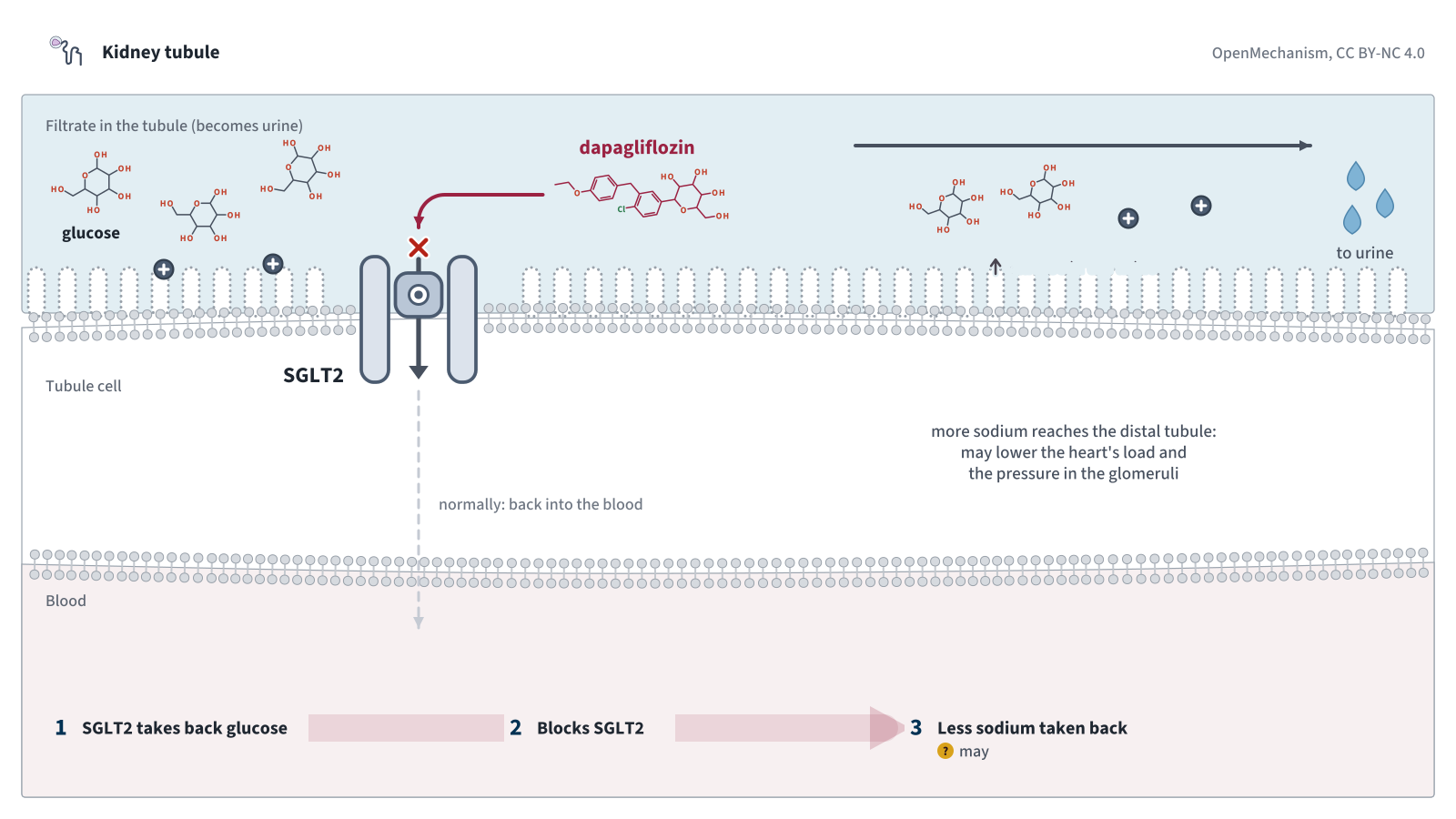
Step 3: may
The Farxiga label says: Dapagliflozin also reduces sodium reabsorption and increases the delivery of sodium to the distal tubule. … This may influence several physiological functions including, but not restricted to, lowering both pre- and afterload of the heart and downregulation of sympathetic activity, and decreased intraglomerular pressure which is believed to be mediated by increased tubuloglomerular feedback.
Source 1: Farxiga (dapagliflozin): FDA label, 12.1 Mechanism of Action
Clinical study: In a randomized trial against placebo (DAPA-HF) in 4744 people with heart failure and a reduced ejection fraction, with or without diabetes; the trial measured worsening heart failure or death from cardiovascular causes, not these effects: Among patients with heart failure and a reduced ejection fraction, the risk of worsening heart failure or death from cardiovascular causes was lower among those who received dapagliflozin than among those who received placebo, regardless of the presence or absence of diabetes.
McMurray JJV et al., N Engl J Med 2019 (PMID 31535829)
This study was picked with a literature search and is not yet checked by our reviewer.
Key terms in this drawing
- glomerulus
- Glomerulus. The filter at the start of each nephron: it passes water and small solutes from the blood into the nephron's tubule.
- SGLT2
- Sodium-glucose cotransporter 2. The kidney's main transporter for taking glucose back from the filtrate into the blood.
How it works
SGLT2 takes back glucose. SGLT2, in the kidney's proximal tubules, reabsorbs most of the glucose filtered from the blood.1
Blocks SGLT2. Dapagliflozin blocks SGLT2, so less filtered glucose is reabsorbed and more leaves in the urine.1
Less sodium taken back. It also reduces sodium reabsorption, so more sodium reaches the distal tubule. This may influence several functions, including lowering the heart's preload and afterload, damping sympathetic activity and lowering the pressure inside the glomeruli, which is believed to come from stronger tubuloglomerular feedback.1
For teachers: download this drawing.
See also
Condition pages: chronic kidney disease, heart failure and type 2 diabetes.
Other SGLT2 inhibitors: empagliflozin.
Body system: hormones & metabolism.
Sources
- 1Farxiga (dapagliflozin): FDA label12.1 Mechanism of Action
- 2ChEMBL CHEMBL429910Target and action classification: Sodium/glucose cotransporter 2 inhibitor
- 3Dapagliflozin in Patients with Heart Failure and Reduced Ejection FractionMcMurray JJV et al. N Engl J Med 2019 (abstract)
Spotted a mistake? Report an error (hello@openmechanism.com). Since launch, every published error we fix is listed on the corrections page.
Notes and limits
- A schematic teaching drawing: not to scale, not exact structures, binding poses or a complete pathway, and not a guide to dosing, treatment or how a person will respond.
- The label says the increased sodium delivery may influence several physiological functions, including lowering pre- and afterload of the heart, and that lower intraglomerular pressure is believed to be mediated by increased tubuloglomerular feedback.
All recorded limits are on the evidence page, and notes that apply to every page are on How to read a page. Version 1.0.0, not yet medically reviewed.
Cite this page
Tran D. Dapagliflozin [Internet]. OpenMechanism; 2026 [updated 2026 Oct 13; cited 2026 Oct 13]. Available from: https://openmechanism.com/medicines/dapagliflozin