Low testosterone (male hypogonadism)
In male hypogonadism the body fails to make enough testosterone, sperm or both, from disease of the testes (primary) or of the hypothalamus and pituitary (secondary), whose luteinizing hormone drives the testes. Testosterone shapes the male sex organs, hair, voice, muscle and fat. Testosterone cypionate replaces it.
- Where
- Brain and testes
- Body systems
- Hormones & metabolism, Bladder & reproductive organs
- Medicines
- 1 medicine
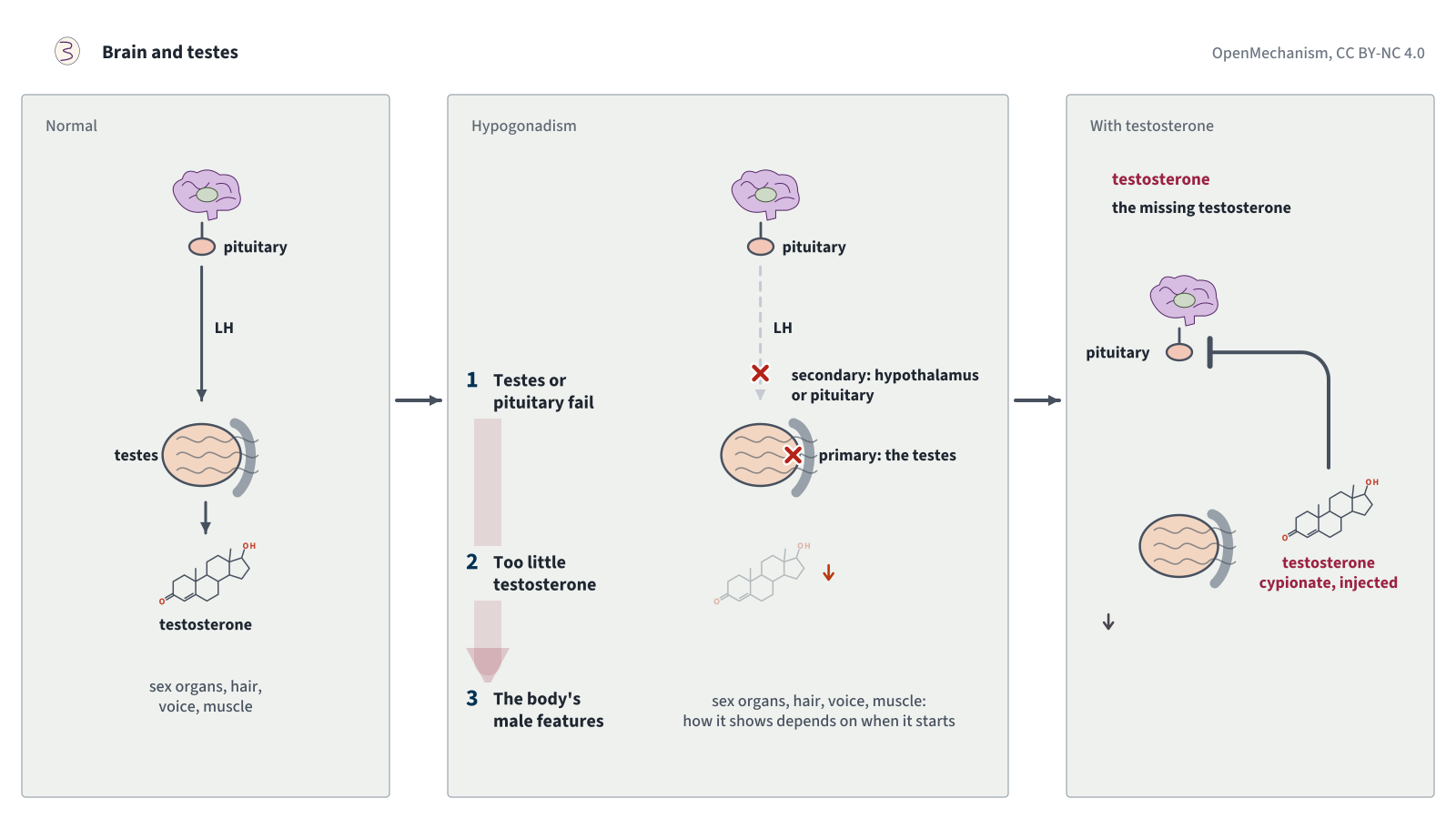
For teachers: download this drawing.
Key terms in this drawing
- LH
- Luteinizing hormone. One of the gonadotropins, the pituitary hormones whose release estrogens hold back by negative feedback; added androgens hold back LH the same way. FSH is the other.
What goes wrong
Testes or pituitary fail. Male hypogonadism is a failure to make normal amounts of testosterone, sperm, or both. It arises from disease of the testes (primary), such as undescended testes, torsion, inflammation or removal, or from a faulty hypothalamus and pituitary (secondary), such as too little gonadotropin or LHRH, or injury from tumors, trauma or radiation.1,2
What the source says
“Male hypogonadism is a clinical syndrome that results from failure to produce physiological concentrations of testosterone, normal amounts of sperm, or both.”
Source 1“Hypogonadism may arise from testicular disease (primary hypogonadism) or dysfunction of the hypothalamic-pituitary unit (secondary hypogonadism).”
Source 1“1. Primary hypogonadism (congenital or acquired)-testicular failure due to cryptorchidism, bilateral torsion, orchitis, vanishing testis syndrome; or orchidectomy.”
Source 2“2. Hypogonadotropic hypogonadism (congenital or acquired) - gonadotropin or LHRH deficiency, or pituitary-hypothalamic injury from tumors, trauma, or radiation.”
Source 2Too little testosterone. Leydig cells in the testes make testosterone in response to luteinizing hormone () from the pituitary; when the testes fail, or the hypothalamus and pituitary send too little LH, testosterone falls short.1,2,3,4
What the source says
“In this rat model, the ability of aged Leydig cells, the terminally differentiated T-producing cells of the testis, to produce T in response to LH stimulation is significantly diminished.”
Source 3“this age-related decline in testosterone appears to occur, in part, due to a significant decline in the ability of aged Leydig cells to produce testosterone maximally in response to luteinizing hormone (LH).”
Source 4“During exogenous administration of androgens, endogenous testosterone release is inhibited through feedback inhibition of pituitary luteinizing hormone (LH).”
Source 2“Hypogonadism may arise from testicular disease (primary hypogonadism) or dysfunction of the hypothalamic-pituitary unit (secondary hypogonadism).”
Source 1“2. Hypogonadotropic hypogonadism (congenital or acquired) - gonadotropin or LHRH deficiency, or pituitary-hypothalamic injury from tumors, trauma, or radiation.”
Source 2The body's male features. Testosterone and other androgens are responsible for the growth of the male sex organs and for keeping male features: body and facial hair, a deeper voice, and the build of muscle and fat. How low testosterone shows depends on when it starts.1,2
What the source says
“Endogenous androgens are responsible for normal growth and development of the male sex organs and for maintenance of secondary sex characteristics.”
Source 2“These effects include growth and maturation of the prostate, seminal vesicles, penis, and scrotum; development of male hair distribution, such as beard, pubic, chest, and axillary hair; laryngeal enlargement, vocal cord thickening, and alterations in body musculature and fat distribution.”
Source 2“Clinical presentations vary dependent on the time of onset of androgen deficiency, whether the defect is in testosterone production or spermatogenesis, associated genetic factors, or history of androgen therapy.”
Source 1
Where medicines act
In the blood, to the whole body
- A
Testosterone targets The missing testosterone
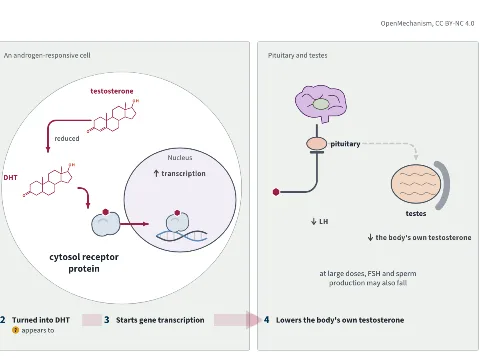
Replaces testosterone; it also holds down the pituitary's LH.2
Used forTestosterone replacement in men: primary hypogonadism or hypogonadotropic hypogonadism
What the label says
“DEPO-Testosterone Injection is indicated for replacement therapy in the male in conditions associated with symptoms of deficiency or absence of endogenous testosterone.”
Source 2“1.”
Source 2“2.”
Source 2“During exogenous administration of androgens, endogenous testosterone release is inhibited through feedback inhibition of pituitary luteinizing hormone (LH).”
Source 2“At large doses of exogenous androgens, spermatogenesis may also be suppressed through feedback inhibition of pituitary follicle stimulating hormone (FSH).”
Source 2
See also
Body systems: hormones & metabolism and bladder & reproductive organs.
Other conditions: erectile dysfunction, enlarged prostate (BPH) and absent periods (secondary amenorrhea).
Sources
- 1Male hypogonadismBasaria S. Lancet 2014 (abstract). Saved copy
- 2Depo-Testosterone (testosterone cypionate): FDA labelIndications and Usage; Clinical Pharmacology. Saved copy
- 3Aging and declining testosterone: past, present, and hopes for the futureZirkin BR, Tenover JL. J Androl 2012 (abstract). Saved copy
- 4Leydig cell aging and the mechanisms of reduced testosterone synthesisMidzak AS et al. Mol Cell Endocrinol 2009 (abstract). Saved copy
Notes and limits
- Its safety and benefit in age-related (late-onset) low testosterone have not been established.2
- A 2014 review names prostate and breast cancer, uncontrolled heart failure, severe urinary symptoms and a high red cell count among the reasons not to use testosterone replacement.1
- Lower testosterone with age may be linked to changes in body composition, energy, muscle strength, sexual and thinking functions, and mood.3
Notes that apply to every page are on How to read a page.
Spotted a mistake? Report an error (hello@openmechanism.com). Since launch, every published error we fix is listed on the corrections page.
Cite this page
Tran D. Low testosterone (male hypogonadism) [Internet]. OpenMechanism; 2026 [updated 2026 Nov 18; cited 2026 Nov 18]. Available from: https://openmechanism.com/conditions/low-testosterone