Homocystinuria
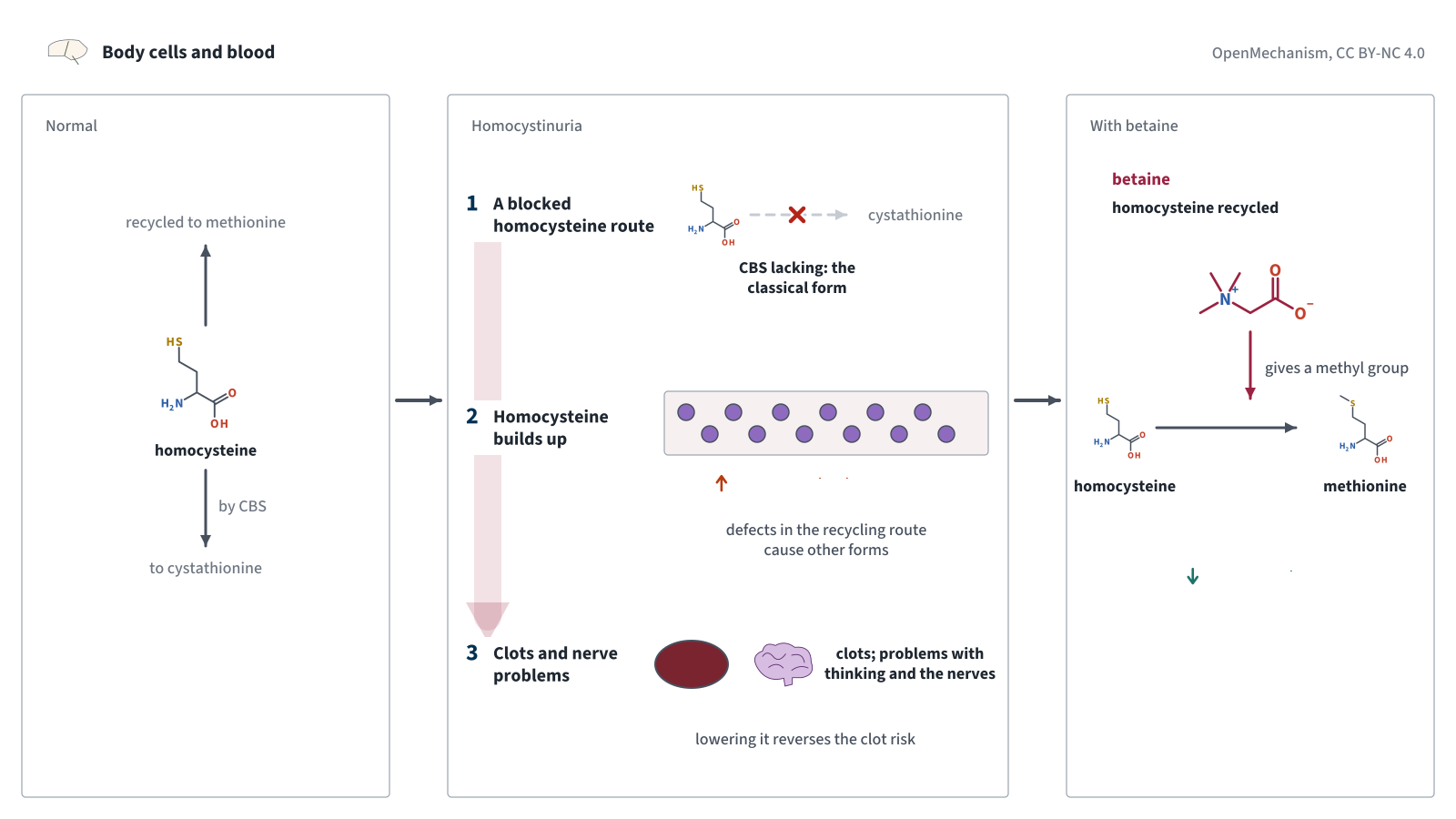
Homocystinuria is a group of inherited disorders with high blood homocysteine, a tendency to blood clots, and problems with thinking and the nervous system. The most common form, classical homocystinuria, lacks cystathionine beta-synthase, which turns homocysteine into cystathionine; homocysteine can also be recycled to methionine. Betaine donates methyl groups for that recycling and lowers homocysteine.
- Where
- Body cells and blood
- Body system
- Hormones & metabolism
- Medicines
- 1 medicine
For teachers: download this drawing.
Key terms in this drawing
- CBS
- Cystathionine beta-synthase. The enzyme that turns homocysteine into cystathionine; lacking it causes classical homocystinuria.
What goes wrong
A blocked homocysteine route. The most common inherited form, classical homocystinuria, lacks cystathionine beta-synthase, the enzyme that turns homocysteine into cystathionine.1
What the source says
“The most prevalent inherited disorder of homocysteine metabolism is classical HCU caused by deficiency of the pyridoxine-dependent enzyme, cystathione beta-synthase, which converts homocysteine to cystathionine in the transsulphuration pathway.”
Source 1Homocysteine builds up. Homocystinuria is a group of inherited disorders with high homocysteine in the blood; homocysteine can also be recycled to methionine, and defects in that route cause other forms.1
What the source says
“Homocystinuria (HCU) refers to a group of inherited disorders of homocysteine metabolism associated with high blood homocysteine concentration”
Source 1“An alternative route for homocysteine metabolism is its remethylation to methionine by the cobalamin-dependent enzyme, methionine synthase”
Source 1Clots and nerve problems. High homocysteine goes with a tendency to blood clots and problems with thinking and the nervous system; lowering it reverses the clot risk.1
Where medicines act
- A
Betaine: homocysteine recycled
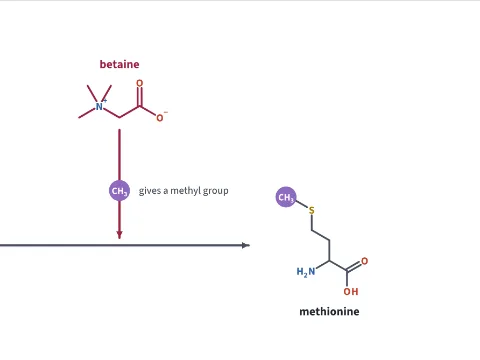
Betaine donates a methyl group so homocysteine is turned back into methionine; it lowers high homocysteine in several kinds of homocystinuria.2
What the source says
“CYSTADANE acts as a methyl group donor in the remethylation of homocysteine to methionine in patients with homocystinuria.”
Source 2“CYSTADANE ® is indicated for the treatment of homocystinuria to decrease elevated homocysteine blood concentrations in pediatric and adult patients.”
Source 2
See also
Body system: hormones & metabolism.
Sources
- 1Homocystinuria diagnosis and management: it is not all classicalGerrard A, Dawson C. J Clin Pathol 2022 (abstract). Saved copy
- 2Cystadane (betaine): FDA label1 Indications and Usage; 12.1 Mechanism of Action. Saved copy
Notes and limits
- High homocysteine is most often due to a lack of vitamin B12 or folate, which is ruled out first.1
- In classical homocystinuria, pyridoxine alone may be enough; betaine is an alternative methyl donor, and some people also follow a low-methionine diet.1
Notes that apply to every page are on How to read a page.
Spotted a mistake? Report an error (hello@openmechanism.com). Since launch, every published error we fix is listed on the corrections page.
Cite this page
Tran D. Homocystinuria [Internet]. OpenMechanism; 2026 [updated 2026 Oct 16; cited 2026 Oct 16]. Available from: https://openmechanism.com/conditions/homocystinuria