Blood & clotting
How a damaged vessel is sealed by a clot, and how the clot is cleared.
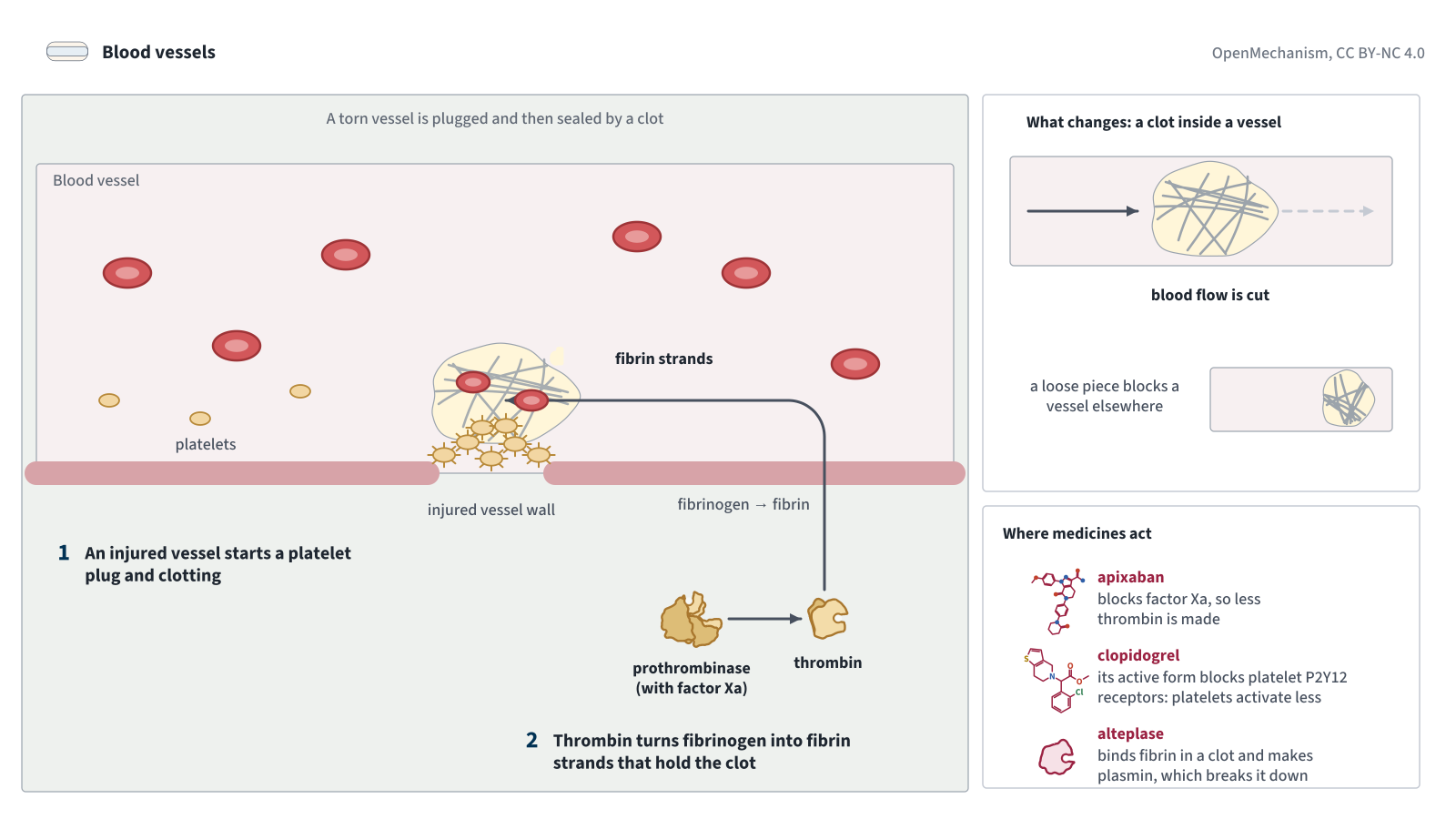
For teachers: download this drawing.
Key terms in this drawing
- factor Xa
- Activated coagulation factor X. A clotting enzyme that turns prothrombin into thrombin.
- P2Y12 receptor
- P2Y12 receptor. A receptor on platelets for ADP (adenosine diphosphate), a signal that helps switch them on.
How it works
An injured vessel starts a platelet plug and clotting. Stopping bleeding takes three steps: the damaged vessel tightens, platelets form a plug, and the blood clots. Platelets that meet the torn vessel's exposed collagen clump together, turn sticky and bind to it.1
What the source says
“There are three steps to the process: vascular spasm, the formation of a platelet plug, and coagulation (blood clotting).”
Source 1“When a vessel is severed or punctured, or when the wall of a vessel is damaged, vascular spasm occurs.”
Source 1“In vascular spasm, the smooth muscle in the walls of the vessel contracts dramatically.”
Source 1“The platelets begin to clump together, become spiked and sticky, and bind to the exposed collagen and endothelial lining.”
Source 1Thrombin turns fibrinogen into fibrin strands that hold the clot. Clotting ends with thrombin turning soluble fibrinogen into strands of fibrin. The fibrin forms a mesh that traps platelets and blood cells, and factor XIII then stabilizes the clot.1
What the source says
“Then, thrombin converts factor I, the soluble fibrinogen, into the insoluble fibrin protein strands.”
Source 1“The result is the production of a gelatinous but robust clot made up of a mesh of fibrin—an insoluble filamentous protein derived from fibrinogen, the plasma protein introduced earlier—in which platelets and blood cells are trapped.”
Source 1“Factor XIII then stabilizes the fibrin clot.”
Source 1
What changes in disease
A clot inside a vessel. A clot can also form inside an intact or only slightly damaged vessel, a thrombus. In a large vessel it slows the blood; in a small one it may block the flow completely. A piece that breaks free, an embolus, can block a vessel of a major organ: in the heart, brain or lungs it may cause a heart attack, a stroke or a pulmonary embolism.1
What the source says
“While the formation of a clot is normal following the hemostatic mechanism just described, thrombi can form within an intact or only slightly damaged blood vessel.”
Source 1“In a large vessel, a thrombus will adhere to the vessel wall and decrease the flow of blood, and is referred to as a mural thrombus. In a small vessel, it may actually totally block the flow of blood and is termed an occlusive thrombus.”
Source 1“When a portion of a thrombus breaks free from the vessel wall and enters the circulation, it is referred to as an embolus. An embolus that is carried through the bloodstream can be large enough to block a vessel critical to a major organ.”
Source 1“In the heart, brain, or lungs, an embolism may accordingly cause a heart attack, a stroke, or a pulmonary embolism.”
Source 1
Where medicines act
- b
Apixaban
Blocks factor Xa, so less thrombin is made.
- c
Clopidogrel
Its active form blocks platelet P2Y12 receptors, so platelets activate less.
- d
Alteplase
Binds fibrin in a clot and makes plasmin, which breaks the clot down.
See also
Zoom in: clotting in a blood vessel and making red cells.
Conditions
- Acute lymphoblastic leukemia
- Acute myeloid leukemia
- Anemia from cancer treatment
- Atypical hemolytic uremic syndrome (aHUS)
- Beta-thalassemia
- Bleeding on blood thinners
- Blood clots in the veins
- Blood clots on artificial heart valves
- Bloodstream infections and endocarditis
- Chronic lymphocytic leukemia
- Chronic myeloid leukemia
- Heart attack
- Heavy menstrual bleeding
- Hemophilia A
- Hodgkin lymphoma
- Iron overload
- Iron-deficiency anemia
- Ischemic stroke
- Malaria
- Methemoglobinemia
- Multiple myeloma
- Myelodysplastic syndromes (MDS)
- Paroxysmal nocturnal hemoglobinuria
- Pyruvate kinase deficiency
- Sickle cell disease
- Tumor lysis syndrome
- Vitamin B12 and folate deficiency
- Von Willebrand disease
More medicines for this area
- Antihemophilic factor (factor VIII)
- Aspirin
- Cyanocobalamin (vitamin B12)
- Dabigatran etexilate
- Daprodustat
- Dipyridamole
- Emicizumab
- Enoxaparin
- Epoetin alfa
- Epoprostenol
- Eptifibatide
- Exagamglogene autotemcel
- Ferric carboxymaltose
- Folic acid
- Heparin
- Mitapivat
- Phytonadione (vitamin K1)
- Prasugrel
- Rivaroxaban
- Selexipag
- Tenecteplase
- Ticagrelor
- Tranexamic acid
- Voxelotor (withdrawn)
- Warfarin
Sources
- 1HemostasisOpenStax Anatomy and Physiology 2e, section 18.5 (CC BY-NC-SA 4.0). Saved copy
- 2Eliquis (apixaban): FDA label12.1 Mechanism of Action. Saved copy
- 3Plavix (clopidogrel): FDA label12.1 Mechanism of Action. Saved copy
- 4Activase (alteplase): FDA label12.1 Mechanism of Action. Saved copy
- 5Human prothrombinase (factor Xa with factor Va), from its complex with prothrombinPDB 7TPP; Ruben, E.A. et al. Blood 2022;139:3463-3473. The prothrombinase outline in the drawing is traced from this structure. Saved copy
- 6Human alpha-thrombin with an active-site inhibitor (PPACK)PDB 1PPB; Bode, W. et al. EMBO J. 1989;8:3467-3475. The thrombin outline in the drawing is traced from this structure. Saved copy
- 7The catalytic domain of human tissue plasminogen activator (tPA) with an inhibitorPDB 1A5H; Renatus, M. et al. J.Biol.Chem. 1997;272:21713-21719. The alteplase outline in the drawing is traced from this structure. Saved copy
Notes and limits
- Thrombi are most often caused by damage to a vessel's lining, which sets off clotting; blood that stays still in the leg veins for long periods can also lead to one.1
- The drawing is schematic and not to scale; it shows only what the statements above say.
Spotted a mistake? Report an error (hello@openmechanism.com). Since launch, every published error we fix is listed on the corrections page.
Cite this page
Tran D. Blood & clotting [Internet]. OpenMechanism; 2026 [updated 2026 Nov 13; cited 2026 Nov 13]. Available from: https://openmechanism.com/body/blood