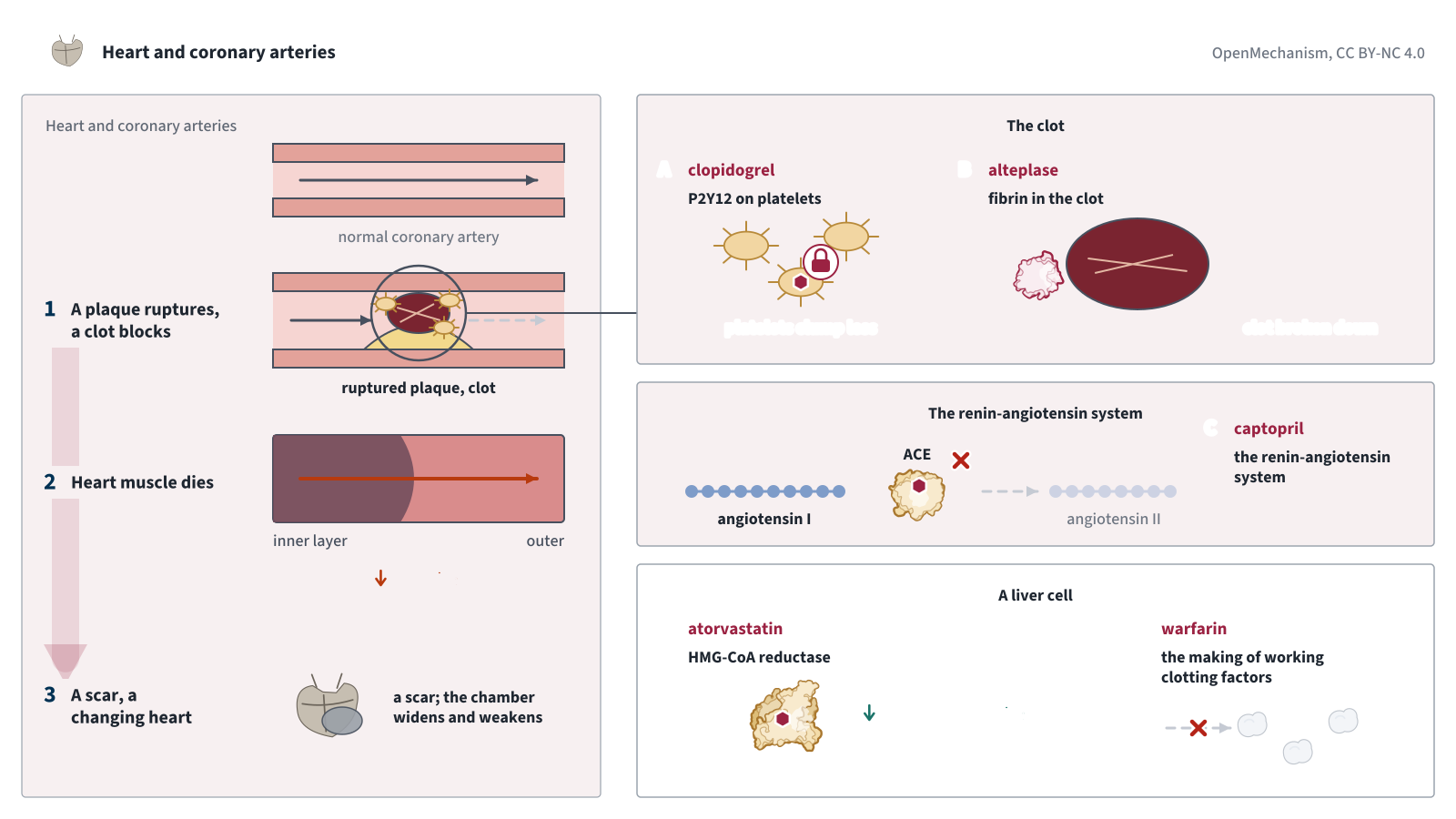
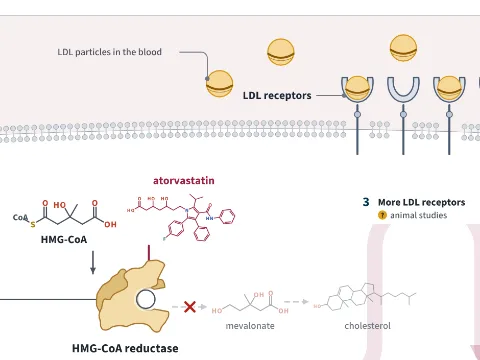
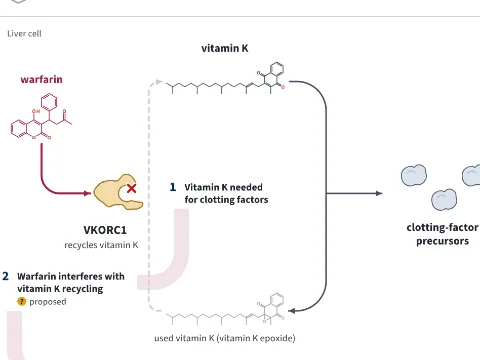
A heart attack is the sudden death of heart muscle starved of blood, usually because a clot blocks a coronary artery at a ruptured plaque. It remains a leading cause of illness and death. Clopidogrel makes platelets clump less, alteplase breaks down the clot, atorvastatin slows cholesterol making, captopril damps the renin-angiotensin system and warfarin slows the making of working clotting factors.
What goes wrong in heart attack, and where medicines act. Schematic, not to scale. Alteplase outline from the catalytic domain of tPA. ACE outline from the structure with lisinopril. License CC BY-NC 4.0.
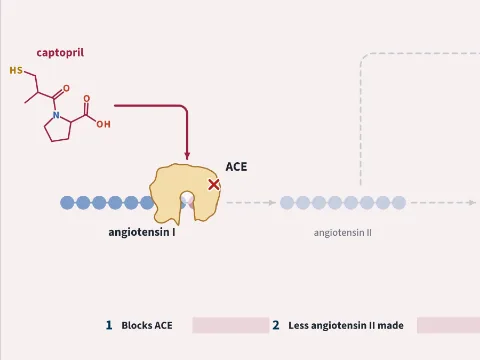
Angiotensin-converting enzyme. The enzyme that makes angiotensin II from angiotensin I.
angiotensin II
Angiotensin II. A hormone that strongly tightens blood vessels; ACE makes it from angiotensin I.
HMG-CoA
3-hydroxy-3-methylglutaryl coenzyme A. A building block the liver turns into mevalonate on the way to making cholesterol.
HMG-CoA reductase
3-hydroxy-3-methylglutaryl-coenzyme A reductase. The enzyme that turns HMG-CoA into mevalonate, an early step in making cholesterol.
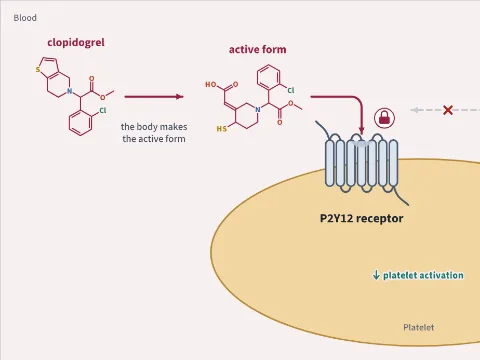
P2Y12 receptor
P2Y12 receptor. A receptor on platelets for ADP (adenosine diphosphate), a signal that helps switch them on.
What goes wrong
A plaque ruptures, a clot blocks. A heart attack is the sudden death of heart muscle that has lost its blood supply. It is usually caused by a clot blocking a coronary artery where a fragile plaque has ruptured.1
What the source says
“Myocardial infarction is defined as sudden ischemic death of myocardial tissue.”
Heart muscle dies. Without blood the muscle quickly pumps less; if the blood stays cut off, its cells die in a wave from the inner to the outer layer of the wall.1
What the source says
“Ischemia induces profound metabolic and ionic perturbations in the affected myocardium and causes rapid depression of systolic function.”
A scar, a changing heart. The adult heart can barely regrow muscle, so it heals with a scar; as it heals, the chamber widens and its pumping can get worse.1
What the source says
“The adult mammalian heart has negligible regenerative capacity, thus the infarcted myocardium heals through formation of a scar.”
“Infarct healing is intertwined with geometric remodeling of the chamber, characterized by dilation, hypertrophy of viable segments, and progressive dysfunction.”
Clopidogrel's active form binds the platelet's for good, so platelets activate and clump less. Given with aspirin, it lowers the rate of further heart attacks and stroke in heart attacks without ST elevation, and in those with ST elevation treated with medicines rather than a procedure to restore blood flow.2
What the source says
“Clopidogrel is an inhibitor of platelet activation and aggregation through the irreversible binding of its active metabolite to the P2Y 12 class of ADP receptors on platelets.”
“Plavix is indicated to reduce the rate of myocardial infarction (MI) and stroke in patients with non–ST-segment elevation ACS (unstable angina [UA]/non–ST-elevation myocardial infarction [NSTEMI]), including patients who are to be managed medically and those who are to be managed with coronary revascularization. Plavix should be administered in conjunction with aspirin. Plavix is indicated to reduce the rate of myocardial infarction and stroke in patients with acute ST-elevation myocardial infarction (STEMI) who are to be managed medically. Plavix should be administered in conjunction with aspirin.”
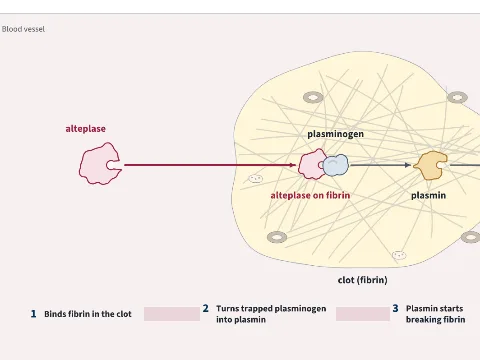
Alteplase binds the fibrin in a clot and turns the plasminogen trapped there into plasmin, which breaks the clot down. In a heart attack it lowers deaths and heart failure; in people at low risk of dying from heart causes, the stroke risk may outweigh the benefit.3
What the source says
“alteplase binds to fibrin in a thrombus and converts the entrapped plasminogen to plasmin.”
Captopril blocks , the enzyme that makes from angiotensin I. Captopril's benefits in high blood pressure and heart failure seem to come mainly from damping the renin-angiotensin-aldosterone system. After a heart attack it improves survival in stable people whose heart pumps weakly.4
What the source says
“Captopril tablets prevent the conversion of angiotensin I to angiotensin II by inhibition of ACE, a peptidyldipeptide carboxy hydrolase.”
Atorvastatin blocks , the enzyme for the slowest step in making cholesterol. In adults who already have coronary heart disease, it lowers the risk of a non-fatal heart attack, stroke, hospital stays for heart failure and angina.5
What the source says
“LIPITOR is a selective, competitive inhibitor of HMG-CoA reductase, the rate-limiting enzyme that converts 3-hydroxy-3-methylglutaryl-coenzyme A to mevalonate, a precursor of sterols, including cholesterol.”
“Non-fatal MI, fatal and non-fatal stroke, revascularization procedures, hospitalization for congestive heart failure, and angina in adults with clinically evident CHD”
Warfarin slows the making of working vitamin K-dependent clotting factors in the liver. After a heart attack, it lowers the risk of death, another heart attack, and events caused by clots, such as a stroke. Warfarin has no direct effect on a clot already formed, nor does it reverse damage to tissue that has lost its blood supply.6,7
What the source says
“Warfarin acts by inhibiting the synthesis of vitamin K-dependent clotting factors, which include Factors II, VII, IX, and X, and the anticoagulant proteins C and S.”
“Reduction in the risk of death, recurrent myocardial infarction (MI), and thromboembolic events such as stroke or systemic embolization after myocardial infarction.”
“vitamin K, which is necessary for the production via the liver of active prothrombin (factor II), proconvertin (factor VII), plasma thromboplastin component (factor IX), and Stuart factor (factor X)”
Also used for it: prasugrel (for lowering the rate of clot-caused heart and blood vessel events, including clots in a stent, in people treated with PCI: “Patients with ST-elevation myocardial infarction (STEMI) when managed with either primary or delayed PCI”9); tenecteplase (“to reduce the risk of death associated with acute ST elevation myocardial infarction (STEMI) in adults”10); enoxaparin (given with aspirin, it “has been shown to reduce the rate of the combined endpoint of recurrent myocardial infarction or death in patients with acute ST-segment elevation myocardial infarction (STEMI) receiving thrombolysis and being managed medically or with percutaneous coronary intervention (PCI)”11); and eptifibatide (for lowering the rate of death or a new heart attack in people having a heart attack without ST elevation (NSTEMI): “Eptifibatide injection is indicated to decrease the rate of a combined endpoint of death or new myocardial infarction (MI) in patients with ACS (unstable angina [UA]/non-ST-elevation myocardial infarction [NSTEMI]), including patients who are to be managed medically and those undergoing percutaneous coronary intervention (PCI).”12).
Claude Opus 5.5 (AI source check), 29 October 2026: 43 statements compared with their sources, 10 flagged for the reviewer. An automated check, not a medical review.
Conflict of interest
Atorvastatin: Pfizer, the reviewer's former employer, used to market this medicine as Lipitor. The label this site cites is from Viatris. Details
Next review due
29 April 2028
Cite this page
Tran D. Heart attack [Internet]. OpenMechanism; 2026 [updated 2026 Oct 29; cited 2026 Oct 29]. Available from: https://openmechanism.com/conditions/heart-attack