Aspirin
In platelets, aspirin blocks the cyclooxygenase () enzyme for good, so they stop making and clump less. Aspirin also lowers the body's production of prostaglandins, including those involved in inflammation, and acts on the brain's heat-regulating center to reduce fever, though other mechanisms may be involved.
- Acts on
- Cyclooxygenase (COX), blocked irreversibly in platelets
- Where
- Platelets, tissues and the brain
- Medicine type
- Small molecule
- Used for
- Blood & clotting
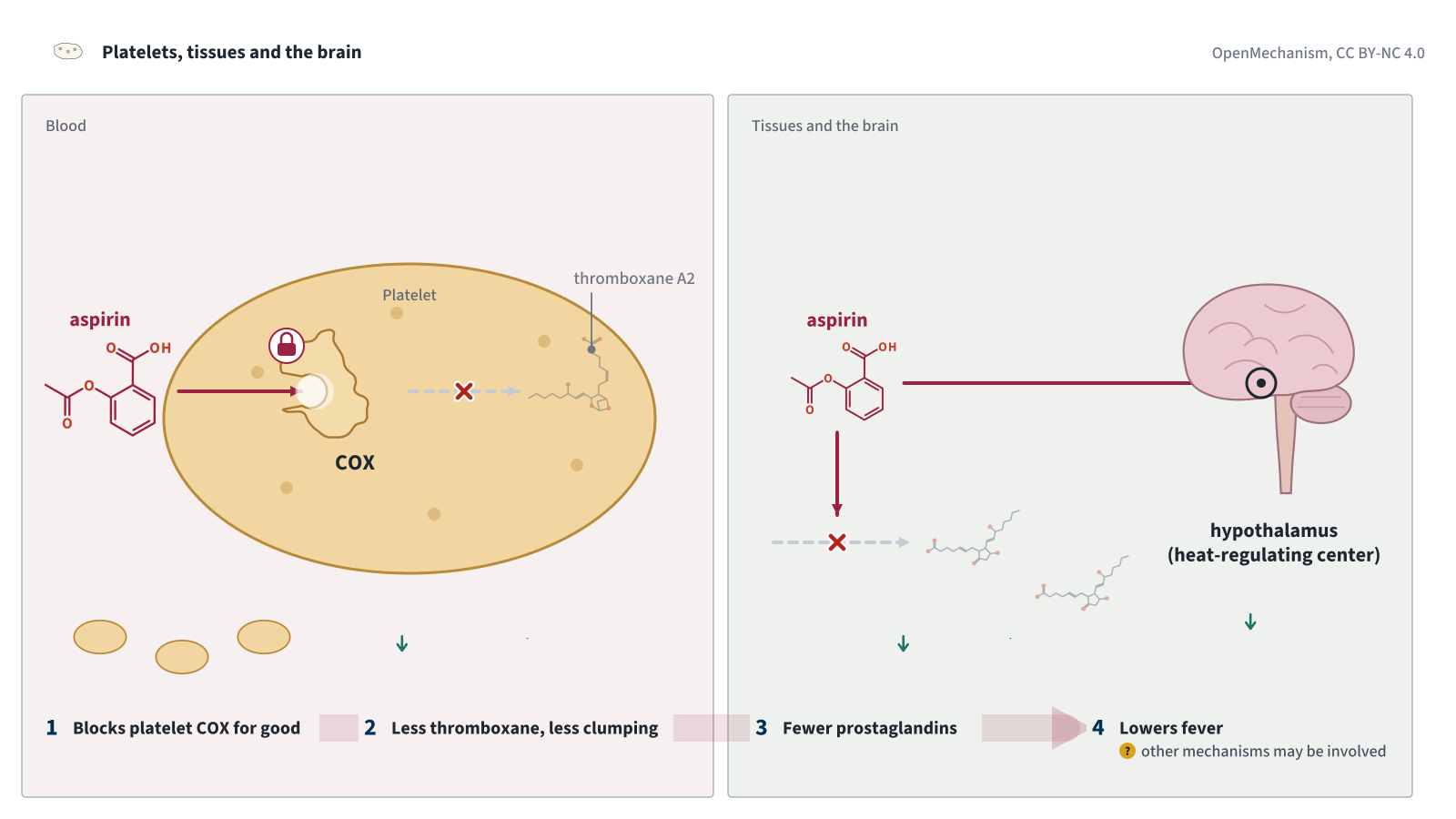
Step 4: other mechanisms may be involved
The oxycodone and aspirin label says: In the CNS, aspirin works on the hypothalamus heat-regulating center to reduce fever, however, other mechanisms may be involved.
Clinical study: In a 2005 randomized trial of single doses of aspirin 500 or 1000 mg, acetaminophen 500 or 1000 mg, or placebo in 392 adults with fever from an upper respiratory tract infection, where the main measure was the fall in body temperature over the 4 hours after the dose, not how aspirin brings it down: In terms of the primary efficacy variable, all active treatments were significantly superior to placebo
Bachert C et al., Clin Ther 2005 (PMID 16154478)
Key terms in this drawing
- COX
- Cyclooxygenase. The enzymes, COX-1 and COX-2, that make prostaglandins.
- thromboxane A2
- Thromboxane A2. A signal that platelets make; it strongly drives platelet clumping and tightens blood vessels. Aspirin stops it being made.
How it works
Blocks platelet COX for good. Aspirin blocks the cyclooxygenase (COX) enzyme in platelets irreversibly; the effect lasts for the life of the platelet.1,2
Less thromboxane, less clumping. Blocking platelet cyclooxygenase stops the making of thromboxane A2, a powerful trigger of platelet clumping (aggregation) and of vessel narrowing (vasoconstriction), so aspirin inhibits platelet aggregation.1,2
Fewer prostaglandins. Aspirin lowers the body's production of prostaglandins, including those involved in inflammation. The label says prostaglandins cause pain sensations by stimulating muscle contractions and widening blood vessels throughout the body.2
Lowers fever. In the central nervous system, aspirin acts on the hypothalamus, the brain's heat-regulating center, to reduce fever, though other mechanisms may be involved.2
For teachers: download this drawing.
See also
Condition pages: ischemic stroke.
Other NSAIDs and other COX inhibitors: celecoxib, diclofenac, ibuprofen, meloxicam and naproxen.
Other antiplatelet medicines: clopidogrel, dipyridamole, eptifibatide, prasugrel and ticagrelor.
Explained: why NSAIDs can cause stomach ulcers and bleeding; why SSRIs can raise the risk of bleeding; and warfarin and NSAIDs or aspirin.
Body system: blood & clotting.
Sources
- 1Aspirin and extended-release dipyridamole capsules: FDA label12.1 Mechanism of Action (Aspirin)
- 2Oxycodone and aspirin tablets: FDA labelClinical Pharmacology: Mechanism of Action (aspirin); Pharmacodynamics: Platelet Aggregation
- 3ChEMBL CHEMBL25Target and action classification: Cyclooxygenase inhibitor
- 4Aspirin compared with acetaminophen in the treatment of fever and other symptoms of upper respiratory tract infection in adults: a multicenter, randomized, double-blind, double-dummy, placebo-controlled, parallel-group, single-dose, 6-hour dose-ranging studyBachert C et al. Clin Ther 2005 (abstract)
Also used for the drawing
The COX-1 outline is traced from the crystal structure below.
- 5Ovine cyclooxygenase-1 (COX-1) with ibuprofenPDB 1EQG; Selinsky, B.S. et al. Biochemistry 2001; 40:5172-5180
Spotted a mistake? Report an error (hello@openmechanism.com). Since launch, every published error we fix is listed on the corrections page.
Notes and limits
- A schematic teaching drawing: not to scale, not exact structures, binding poses or a complete pathway, and not a guide to dosing, treatment or how a person will respond.
- The label says aspirin works on the hypothalamus heat-regulating center to reduce fever, but that other mechanisms may be involved.
All recorded limits are on the evidence page, and notes that apply to every page are on How to read a page. Version 1.0.1, medically reviewed by Daniel Tran, PharmD, on 29 October 2026.
Cite this page
Tran D. Aspirin [Internet]. OpenMechanism; 2026 [updated 2026 Oct 29; cited 2026 Oct 29]. Available from: https://openmechanism.com/medicines/aspirin