Iron overload
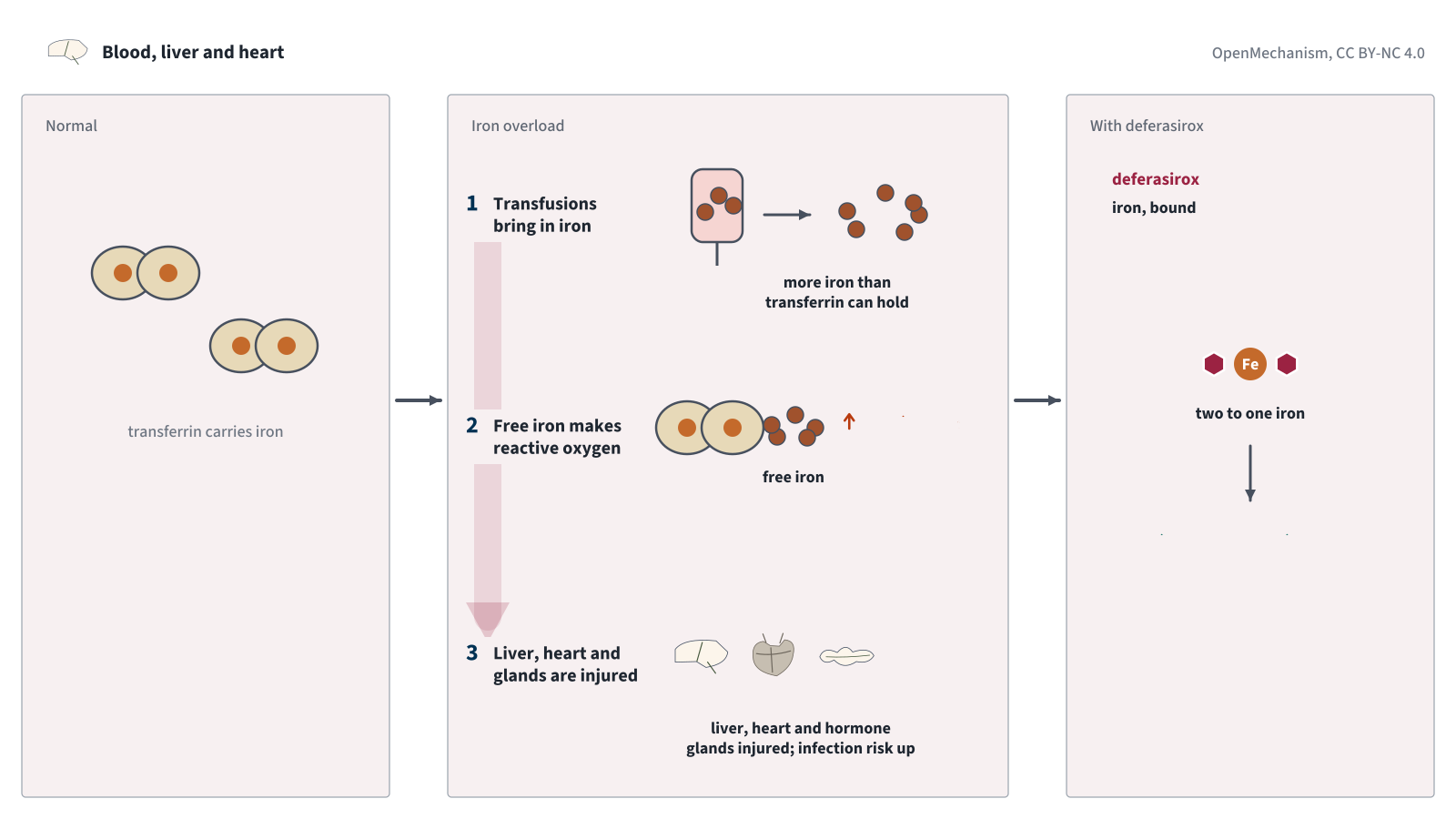
Repeated blood transfusions bring in more iron than transferrin, the blood's iron carrier, can hold. The free iron (non-transferrin-bound iron) makes highly reactive oxygen species that injure the liver, heart and hormone glands and raise the risk of infection. Deferasirox binds iron so the body can pass it out.
- Where
- Blood, liver and heart
- Body system
- Blood & clotting
- Medicines
- 1 medicine
For teachers: download this drawing.
What goes wrong
Transfusions bring in iron. Repeated transfusions bring in more iron than transferrin, the main iron carrier in the blood, can bind.1
What the source says
“Chronic transfusion results in accumulation of excess iron that surpasses the binding capacity of the major iron transport protein, transferrin.”
Source 1Free iron makes reactive oxygen. The iron not bound to transferrin drives the making of highly reactive oxygen species.1
What the source says
“The resulting non-transferrin bound iron (NTBI) can catalyze the production of highly reactive oxygen species (ROS)”
Source 1Liver, heart and glands are injured. These injure the liver, heart and hormone glands, and raise the risk of infection.1
What the source says
“leading to significant and wide spread injury to the liver, heart, and endocrine organs as well as increases in infection.”
Source 1
Where medicines act
- A
Deferasirox: iron bound
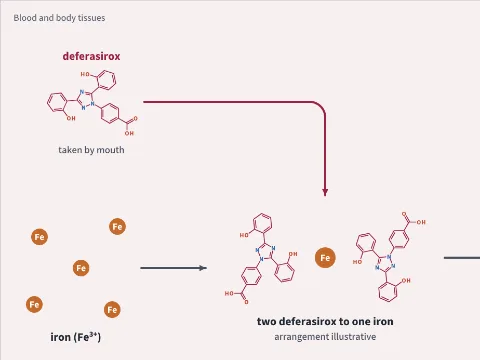
Deferasirox, taken by mouth, binds iron tightly (two molecules to one iron), and the body then passes the iron out, mostly in the stool; it treats chronic iron overload from blood transfusions.2
What the source says
“Exjade (deferasirox) is an orally active chelator that is selective for iron (as Fe 3+ ). It is a tridentate ligand that binds iron with high affinity in a 2:1 ratio.”
Source 2“deferasirox (10, 20, and 40 mg per kg per day) was able to induce a mean net iron excretion”
Source 2“Iron excretion was predominantly fecal.”
Source 2“Exjade is an iron chelator indicated for the treatment of chronic iron overload due to blood transfusions in patients 2 years of age and older.”
Source 2
See also
Body system: blood & clotting.
Other conditions: beta-thalassemia.
Sources
- 1Iron overload following red blood cell transfusion and its impact on disease severityOzment CP, Turi JL. Biochim Biophys Acta 2009 (abstract). Saved copy
- 2Exjade (deferasirox): FDA label1 Indications and Usage; 12.1 Mechanism of Action. Saved copy
Notes and limits
- Transfusion is often necessary; its benefits and the risk of iron overload have to be weighed.1
Notes that apply to every page are on How to read a page.
Spotted a mistake? Report an error (hello@openmechanism.com). Since launch, every published error we fix is listed on the corrections page.
Cite this page
Tran D. Iron overload [Internet]. OpenMechanism; 2026 [updated 2026 Oct 16; cited 2026 Oct 16]. Available from: https://openmechanism.com/conditions/iron-overload