Sickle cell disease
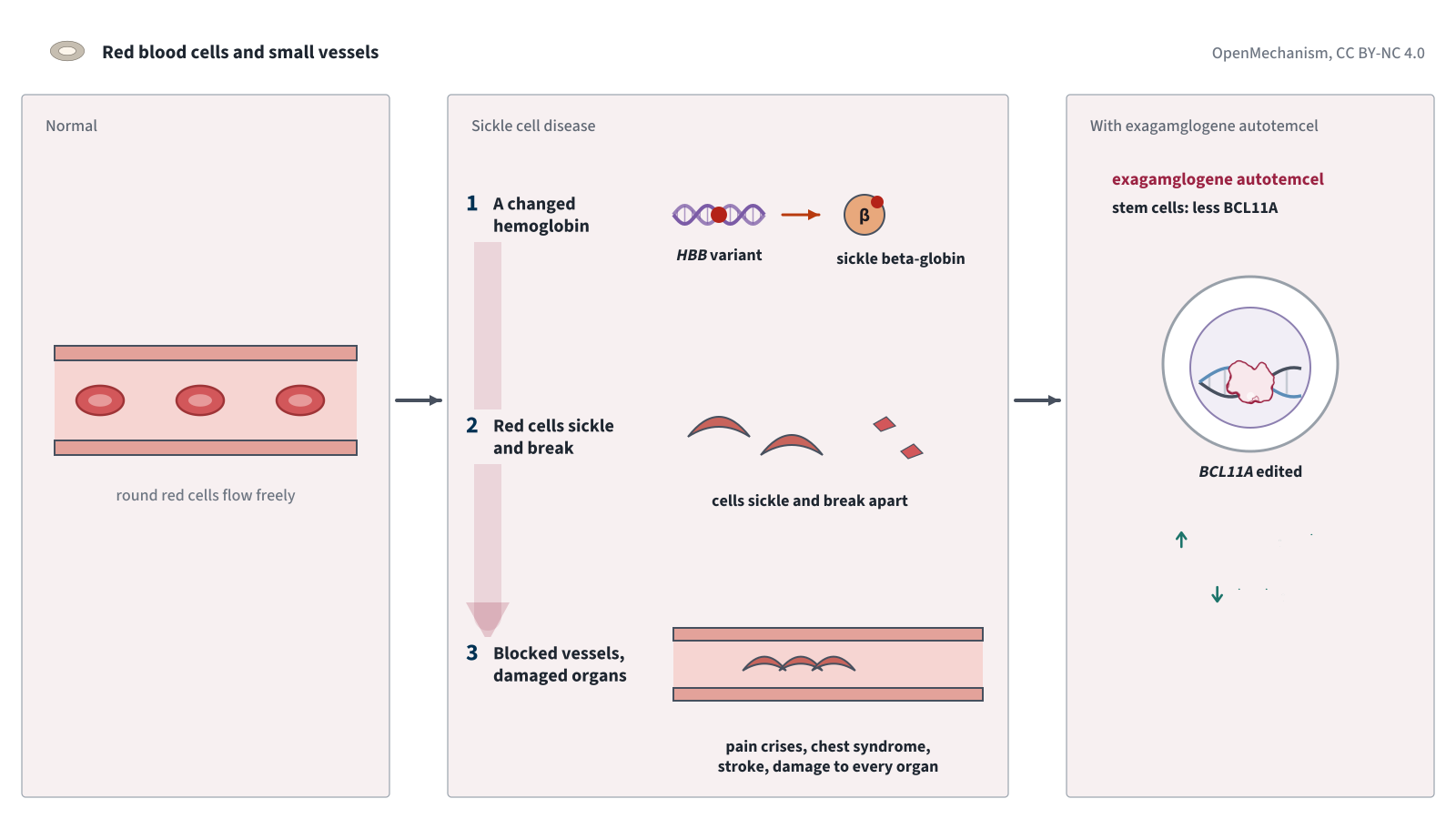
Sickle cell disease is inherited: variants in the HBB gene change hemoglobin's beta subunit. Sickle hemoglobin can polymerize, and red cells full of polymer sickle and break apart easily. Blocked vessels and immune activation bring pain crises, acute chest syndrome, stroke and damage to every organ. Exagamglogene autotemcel switches fetal hemoglobin back on, which keeps red cells from sickling.
- Where
- Red blood cells and small vessels
- Body system
- Blood & clotting
- Medicines
- 1 medicine
For teachers: download this drawing.
Key terms in this drawing
- BCL11A
- B-cell lymphoma/leukemia 11A. A protein that turns down fetal hemoglobin in red-cell precursors.
- HBB
- HBB gene. The gene for the β part of hemoglobin; mutations in it cause sickle cell disease.
What goes wrong
A changed hemoglobin. Sickle cell disease is a group of inherited disorders caused by variants in , the gene for hemoglobin's beta subunit.1
What the source says
“Sickle cell disease (SCD) is a group of inherited disorders caused by mutations in HBB, which encodes haemoglobin subunit β.”
Source 1Red cells sickle and break. Hemoglobin with sickle beta-globin can polymerize; red cells full of the polymer take a sickle shape and break apart easily (hemolysis).1
What the source says
“Haemoglobin molecules that include mutant sickle β-globin subunits can polymerize; erythrocytes that contain mostly haemoglobin polymers assume a sickled form and are prone to haemolysis.”
Source 1Blocked vessels, damaged organs. Blocked small vessels and immune activation add to it: pain crises, acute chest syndrome and stroke, and long-term damage to every organ.1
What the source says
“Other pathophysiological mechanisms that contribute to the SCD phenotype are vaso-occlusion and activation of the immune system.”
Source 1“Common acute complications are acute pain events, acute chest syndrome and stroke; chronic complications (including chronic kidney disease) can damage all organs.”
Source 1
Where medicines act
- A
Exagamglogene autotemcel: fetal hemoglobin back on
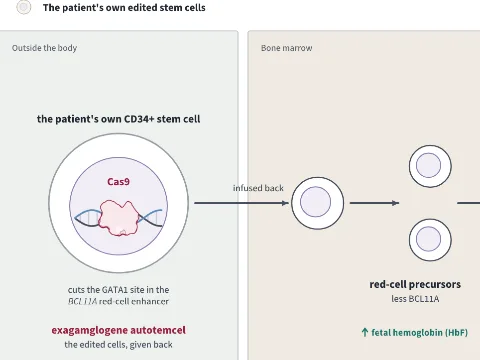
In this gene-edited stem cell therapy, the edited cells make red cells with less , so they make more fetal hemoglobin (); HbF lowers the sickle hemoglobin inside and keeps the cells from sickling.2
What the source says
“Reduced BCL11A expression results in an increase in γ-globin expression and HbF protein production in erythroid cells.”
Source 2“HbF expression reduces intracellular hemoglobin S (HbS) concentration, preventing the red blood cells from sickling”
Source 2“sickle cell disease (SCD) with recurrent vaso-occlusive crises”
Source 2
See also
Body system: blood & clotting.
Also used for it: hydroxyurea (for fewer painful crises and transfusions in sickle cell anemia with repeated crises: “DROXIA is indicated to reduce the frequency of painful crises and to reduce the need for blood transfusions in patients with sickle cell anemia with recurrent moderate to severe painful crises.”3).
Other conditions: beta-thalassemia; chronic myeloid leukemia; and head and neck cancer.
Sources
- 1Sickle cell diseaseKato GJ et al. Nat Rev Dis Primers 2018 (abstract). Saved copy
- 2Casgevy (exagamglogene autotemcel): FDA label1 Indications and Usage; 12.1 Mechanism of Action. Saved copy
- 3Droxia (hydroxyurea): FDA labelIndications and Usage. Saved copy
- 4Streptococcus pyogenes Cas9 (made inactive for the study) with its guide RNA and target DNAPDB 4OO8; Nishimasu, H. et al. Cell(Cambridge,Mass.) 2014;156:935-949. The Cas9 outline in the drawing is traced from this structure. Saved copy
Notes and limits
- Other treatments that reduce severity (hydroxycarbamide, blood transfusions, stem cell transplants) do not have pages here yet.1
Notes that apply to every page are on How to read a page.
Spotted a mistake? Report an error (hello@openmechanism.com). Since launch, every published error we fix is listed on the corrections page.
Cite this page
Tran D. Sickle cell disease [Internet]. OpenMechanism; 2026 [updated 2026 Oct 18; cited 2026 Oct 18]. Available from: https://openmechanism.com/conditions/sickle-cell-disease