Pyruvate kinase deficiency
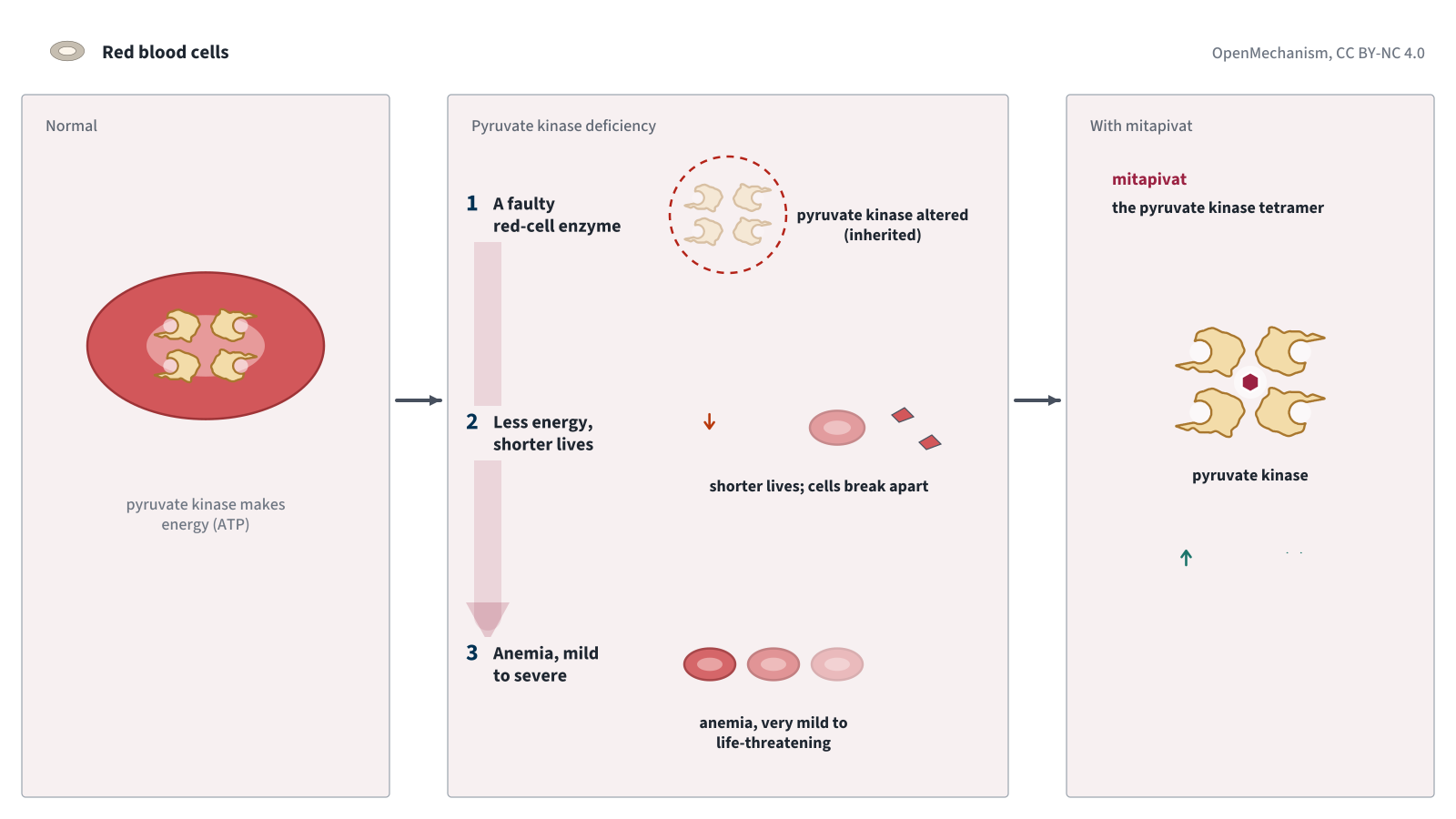
Pyruvate kinase deficiency is the most common glycolysis enzyme defect that causes long-term hemolytic anemia; it is inherited in a recessive way. Red cells with the faulty enzyme make less ATP, live shorter lives and break apart, and the anemia ranges from mild to life-threatening. Mitapivat activates pyruvate kinase.
- Where
- Red blood cells
- Body system
- Blood & clotting
- Medicines
- 1 medicine
For teachers: download this drawing.
Key terms in this drawing
- ATP
- Adenosine triphosphate. The molecule cells use to carry energy.
What goes wrong
A faulty red-cell enzyme. Pyruvate kinase deficiency is the most common glycolysis enzyme defect causing long-term hemolytic anemia; it is inherited in a recessive way.1
Less energy, shorter lives. The red-cell form of pyruvate kinase is altered, so red cells make less , live shorter lives and break apart.2
What the source says
“The red blood cell (RBC) form of pyruvate kinase (PK-R) is mutated in PK deficiency, which leads to reduced adenosine triphosphate (ATP), shortened RBC lifespan, and chronic hemolysis.”
Source 2Anemia, mild to severe. How severe the hemolysis is varies widely, from very mild to life-threatening anemia in newborns.1
What the source says
“The severity of haemolysis is highly variable, ranging from very mild or fully compensated forms to life-threatening neonatal anaemia necessitating exchange transfusions.”
Source 1
Where medicines act
- A
Mitapivat: pyruvate kinase switched on
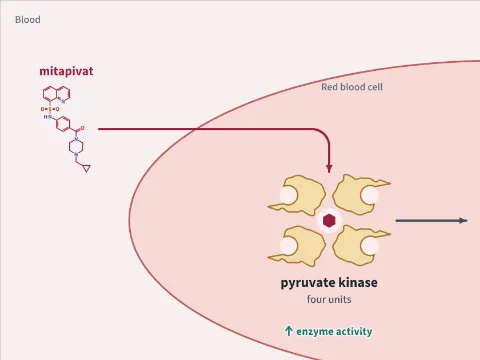
Mitapivat binds the pyruvate kinase tetramer and raises its activity; it treats hemolytic anemia in adults with pyruvate kinase deficiency.2
What the source says
“Mitapivat is a pyruvate kinase activator that acts by allosterically binding to the pyruvate kinase tetramer and increasing pyruvate kinase (PK) activity.”
Source 2“PYRUKYND is indicated for the treatment of hemolytic anemia in adults with pyruvate kinase (PK) deficiency.”
Source 2
See also
Body system: blood & clotting.
Sources
- 1Pyruvate kinase deficiency: the genotype-phenotype associationZanella A et al. Blood Rev 2007 (abstract). Saved copy
- 2Pyrukynd (mitapivat): FDA label1 Indications and Usage; 12.1 Mechanism of Action. Saved copy
- 3Human red-cell pyruvate kinase with a substrate analoguePDB 2VGB; Valentini, G. et al. J.Biol.Chem. 2002;277:23807. The red-cell pyruvate kinase outline in the drawing is traced from this structure. Saved copy
Notes and limits
- How severe it is depends on more than the enzyme change: other genes, other enzymes and the spleen play a part.1
Notes that apply to every page are on How to read a page.
Spotted a mistake? Report an error (hello@openmechanism.com). Since launch, every published error we fix is listed on the corrections page.
Cite this page
Tran D. Pyruvate kinase deficiency [Internet]. OpenMechanism; 2026 [updated 2026 Oct 16; cited 2026 Oct 16]. Available from: https://openmechanism.com/conditions/pyruvate-kinase-deficiency