Alteplase
Alteplase binds fibrin inside a blood clot and turns the plasminogen trapped there into plasmin. Plasmin breaks down the clot's fibrin; the label describes this as directed at the clot, with limited breakdown of proteins in the rest of the circulation.
- Acts on
- Fibrin, plasminogen
- Where
- A blood clot
- Medicine type
- Enzyme
- Used for
- Blood & clotting
- Drug class
- Clot-dissolving medicines
Also called Activase.
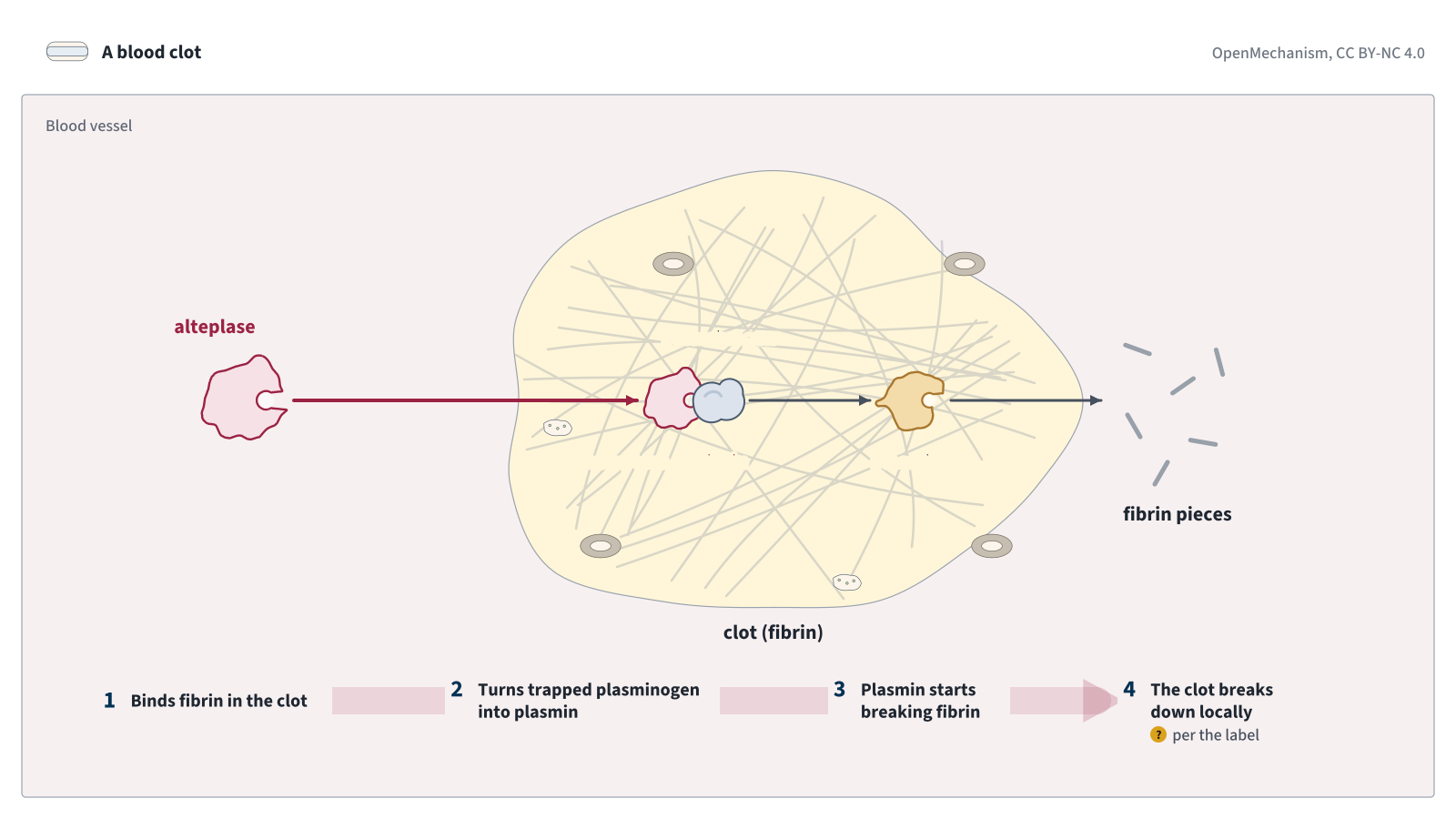
Step 4: per the label
The alteplase label says: This initiates local fibrinolysis with limited systemic proteolysis.
Source 1: Activase (alteplase): FDA label, 1 Indications and Usage; 12.1 Mechanism of Action
Clinical study: In a 1987 double-blind randomized trial in 290 people having a heart attack, who entered within 7 hours of symptom onset and were followed to hospital discharge, 80 mg of alteplase (recombinant tissue plasminogen activator, rt-PA) given into a vein over 3 hours was compared with 1.5 million units of streptokinase (SK) over 1 hour: The reduction in circulating fibrinogen and plasminogen and the increase in circulating fibrin split products at 3 and 24 hr were significantly less in patients treated with rt-PA than in those treated with SK (p less than .001). The occurrence of bleeding events, administration of blood transfusions, and reocclusion of the infarct-related artery was comparable in the two groups.
Chesebro JH et al., Circulation 1987 (PMID 3109764)
How it works
Binds fibrin in the clot. Given into the bloodstream at the concentrations used as a medicine, alteplase binds fibrin within a thrombus.1
Turns trapped plasminogen into plasmin. Alteplase converts the entrapped plasminogen into plasmin; fibrin enhances this conversion, and without fibrin it is limited.1
Plasmin starts breaking fibrin. The generated plasmin initiates local fibrinolysis.1
The clot breaks down locally. The label describes this breakdown as local, with limited breakdown of proteins in the rest of the circulation.1
For teachers: download this drawing or build a slide deck.
See also
Condition pages: heart attack, ischemic stroke and blood clots in the veins.
Other clot-dissolving medicines: tenecteplase.
Body system: blood & clotting.
Sources
- 1Activase (alteplase): FDA label1 Indications and Usage; 12.1 Mechanism of Action
- 2ChEMBL CHEMBL1201593Target and action classification: Tissue-type plasminogen activator exogenous protein
- 3
Also used for the drawing
The alteplase and plasmin outlines are traced from the crystal structures below.
- 4The catalytic domain of human tissue plasminogen activator (tPA) with an inhibitorPDB 1A5H; Renatus, M. et al. J.Biol.Chem. 1997; 272:21713-21719
- 5Microplasmin, the catalytic part of plasmin, in a complex with staphylokinasePDB 1BUI; Parry, M.A. et al. Nat.Struct.Biol. 1998; 5:917-923
Spotted a mistake? Report an error (hello@openmechanism.com). Since launch, every published error we fix is listed on the corrections page.
Notes and limits
- A schematic teaching drawing: not to scale, not exact structures, binding poses or a complete pathway, and not a guide to dosing, treatment or how a person will respond.
- The steps are in the order that explains them; one step is said to cause the next only where the source says so.
- No absolute clot specificity, clot-clearance speed or vascular reopening guarantee is implied.
All recorded limits are on the evidence page, and notes that apply to every page are on How to read a page. Version 1.0.1, medically reviewed by Daniel Tran, PharmD, on 29 October 2026.
Cite this page
Tran D. Alteplase [Internet]. OpenMechanism; 2026 [updated 2026 Oct 29; cited 2026 Oct 29]. Available from: https://openmechanism.com/medicines/alteplase