Warfarin
Some clotting factors need vitamin K to become active. Warfarin is proposed to block , which recycles vitamin K, so fewer active clotting factors are made, including factors II, VII, IX and X and the proteins C and S. Blood then clots less easily, but warfarin has no direct effect on a clot that has already formed.
- Acts on
- VKORC1, and so the making of vitamin-K-dependent clotting factors
- Where
- The liver, where clotting factors are made
- Medicine type
- Small molecule
- Used for
- Blood & clotting
- Drug class
- Anticoagulants
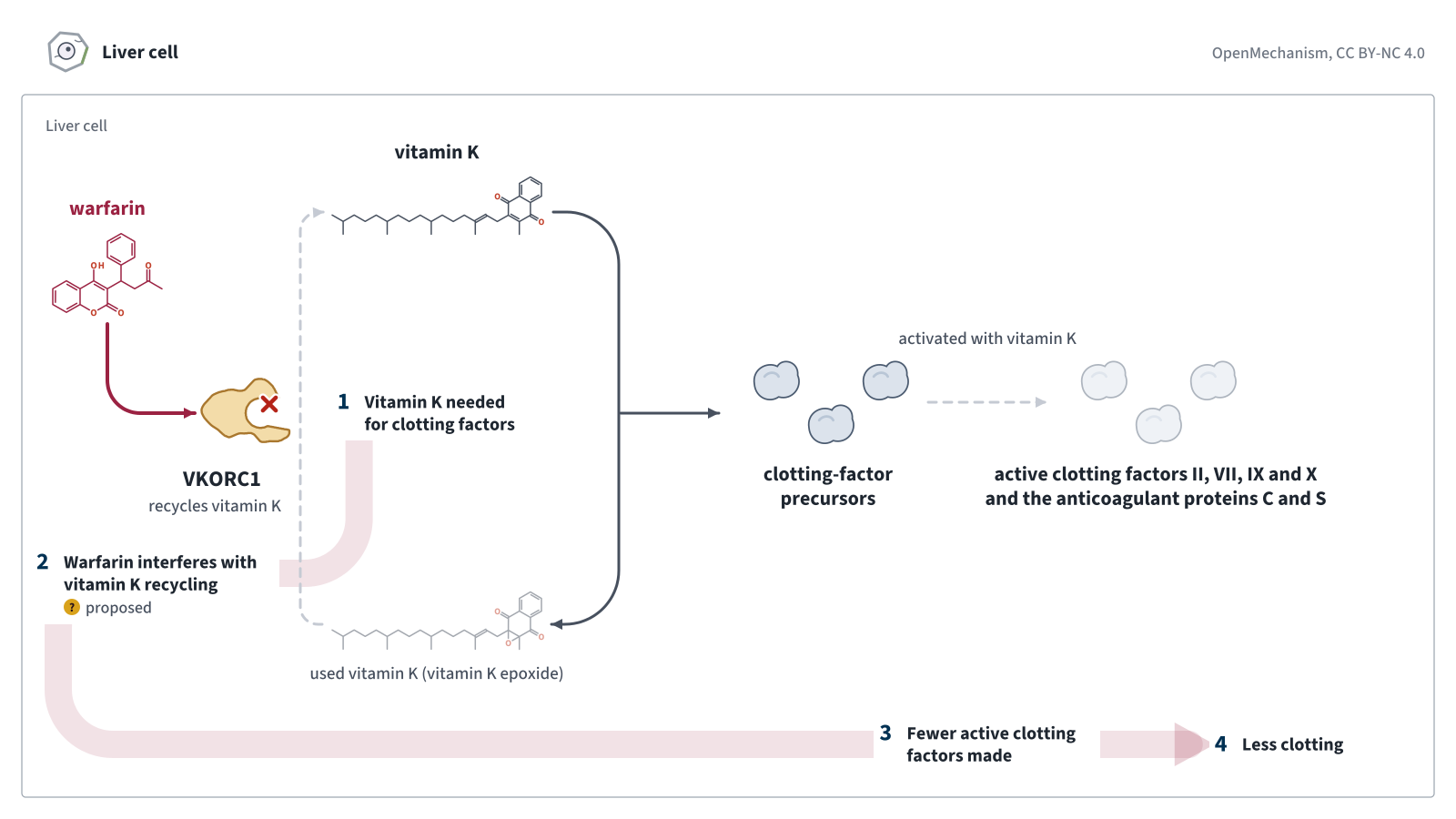
Step 2: proposed
The warfarin label says: Warfarin is thought to interfere with clotting factor synthesis by inhibition of the C1 subunit of vitamin K epoxide reductase (VKORC1) enzyme complex
Source 1: Warfarin sodium: FDA label, 12.1 Mechanism of Action; 12.2 Pharmacodynamics; 12.5 Pharmacogenomics
Clinical study: In a 2005 retrospective study of European-American patients on long-term warfarin, versions of the VKORC1 gene (grouped as A and B) went with different warfarin doses: VKORC1 haplotype groups A and B explained approximately 25 percent of the variance in dose.
Rieder MJ et al., N Engl J Med 2005 (PMID 15930419)
Key terms in this drawing
- anticoagulant
- Anticoagulant. A blood thinner, such as warfarin.
- VKORC1
- Vitamin K epoxide reductase complex subunit 1. Part of the enzyme complex that recycles used vitamin K so it can be used again.
How it works
Vitamin K needed for clotting factors. Vitamin K supports post-ribosomal gamma-carboxylation required for clotting-factor biological activity.1
Warfarin interferes with vitamin K recycling. The label says warfarin reduces the regeneration of vitamin K from vitamin K epoxide by inhibiting VKOR, a multiprotein enzyme complex, and that it is thought to act on the complex's C1 subunit, VKORC1.1
Fewer active clotting factors made. Vitamin-K-dependent clotting-factor synthesis is inhibited.1
Less clotting. Factors II, VII, IX and X are among the affected factors; the anticoagulant proteins C and S are also affected. The label calls the result an anticoagulation effect.1
For teachers: download this drawing or build a slide deck.
See also
Condition pages: atrial fibrillation, heart attack, blood clots on artificial heart valves, ischemic stroke and blood clots in the veins.
Side effects: bleeding on blood thinners.
Other anticoagulants: apixaban, dabigatran etexilate, enoxaparin, heparin and rivaroxaban.
More medicines for blood & clotting: alteplase, antihemophilic factor (factor VIII), aspirin, clopidogrel, cyanocobalamin (vitamin B12), daprodustat, deferasirox, dipyridamole and 13 more.
Explained: amiodarone and warfarin; why SSRIs can raise the risk of bleeding; vitamin K and warfarin; warfarin and NSAIDs or aspirin; and warfarin and the CYP2C9 and VKORC1 genes.
Related drawings: phytonadione (vitamin K1), which treats prothrombin deficiency caused by coumarin anticoagulants.
Body system: blood & clotting.
Sources
- 1Warfarin sodium: FDA label1 Indications and Usage; 12.1 Mechanism of Action; 12.2 Pharmacodynamics; 12.5 Pharmacogenomics
- 2ChEMBL CHEMBL1464Target and action classification: Vitamin k epoxide reductase complex subunit 1 isoform 1 inhibitor
- 3Effect of VKORC1 haplotypes on transcriptional regulation and warfarin doseRieder MJ et al. N Engl J Med 2005 (abstract)
Also used for the drawing
Saved copies of label sections the page's plain text rests on, beyond the record's own sources. The VKORC1 outline is traced from the crystal structure below.
- 4Phytonadione injectable emulsion (vitamin K1): FDA label1 Indications and Usage; 12.1 Mechanism of Action
- 5Human vitamin K epoxide reductase (VKORC1) with warfarinPDB 6WV3; Liu, S. et al. Science 2021; 371
Spotted a mistake? Report an error (hello@openmechanism.com). Since launch, every published error we fix is listed on the corrections page.
Notes and limits
- A schematic teaching drawing: not to scale, not exact structures, binding poses or a complete pathway, and not a guide to dosing, treatment or how a person will respond.
- The steps are in the order that explains them; one step is said to cause the next only where the source says so.
- The selected label uses thought-to language for VKORC1.
- Warfarin acts on the making of clotting factors, not on thrombin itself, and has no direct effect on a clot already formed; it also affects the anticoagulant proteins C and S.
All recorded limits are on the evidence page, and notes that apply to every page are on How to read a page. Version 1.0.1, medically reviewed by Daniel Tran, PharmD, on 29 October 2026.
Cite this page
Tran D. Warfarin [Internet]. OpenMechanism; 2026 [updated 2026 Oct 29; cited 2026 Oct 29]. Available from: https://openmechanism.com/medicines/warfarin