Bleeding on blood thinners
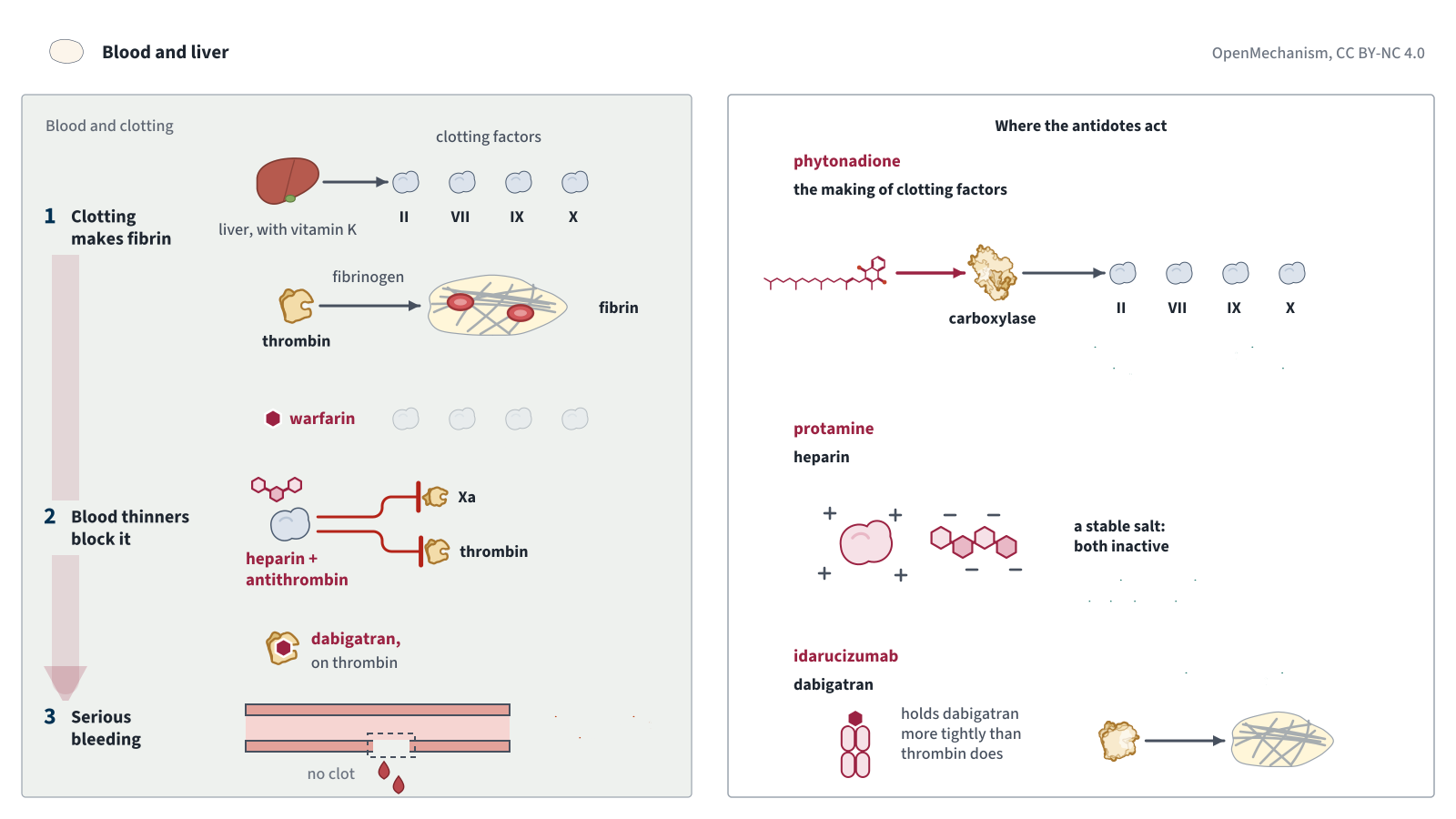
Blood thinners block clotting at different points: warfarin cuts the clotting factors the liver makes with vitamin K, heparin strengthens antithrombin against and thrombin, and dabigatran blocks thrombin. All three can cause serious, sometimes fatal bleeding. Each has an antidote of its own: vitamin K, protamine and idarucizumab.
- Where
- Blood and liver
- Body system
- Blood & clotting
- Medicines
- 3 medicines
For teachers: download this drawing.
What goes wrong
Clotting makes fibrin. The liver needs vitamin K to make the active clotting factors II, VII, IX and X. During clotting, thrombin turns fibrinogen into fibrin; blocking it prevents a clot from forming.1,2
What the source says
“naturally-occurring vitamin K, which is necessary for the production via the liver of active prothrombin (factor II), proconvertin (factor VII), plasma thromboplastin component (factor IX), and Stuart factor (factor X).”
Source 1“Because thrombin (serine protease) enables the conversion of fibrinogen into fibrin during the coagulation cascade, its inhibition prevents the development of a thrombus.”
Source 2Blood thinners block it. Warfarin blocks the making of the vitamin K-dependent clotting factors. Heparin makes antithrombin III far more active against activated clotting factors, particularly Xa and thrombin (IIa). Dabigatran blocks thrombin directly.2,3,4
What the source says
“Warfarin acts by inhibiting the synthesis of vitamin K-dependent clotting factors, which include Factors II, VII, IX, and X, and the anticoagulant proteins C and S.”
Source 3“Heparin interacts with the naturally occurring plasma protein, Antithrombin III, to induce a conformational change, which markedly enhances the serine protease activity of Antithrombin III, thereby inhibiting the activated coagulation factors involved in the clotting sequence, particularly Xa and IIa.”
Source 4“Dabigatran and its acyl glucuronides are competitive, direct thrombin inhibitors.”
Source 2Serious bleeding. All three can cause serious bleeding: warfarin major or fatal bleeding, dabigatran significant and sometimes fatal bleeding, and heparin bleeding at virtually any site, fatal at times.2,3,4
What the source says
“Warfarin sodium can cause major or fatal bleeding”
Source 3“PRADAXA increases the risk of bleeding and can cause significant and, sometimes, fatal bleeding.”
Source 2“Hemorrhage can occur at virtually any site in patients receiving heparin. Fatal hemorrhages have occurred.”
Source 4
Where medicines act
In the liver
- A
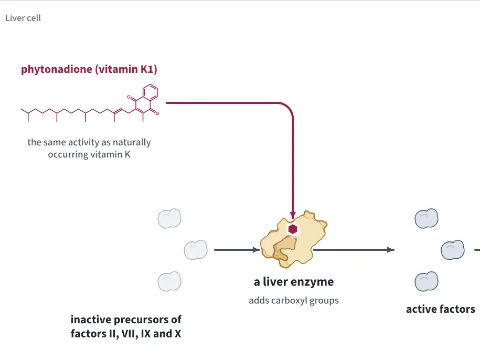
Phytonadione (vitamin K1) targets The making of clotting factors II, VII, IX and X
Supplies vitamin K, which the liver needs to turn the precursors of factors II, VII, IX and X into active clotting factors.1,3
Used forLow clotting factors caused by anticoagulants: coumarins, such as warfarin, or indanediones
What the label says
“Phytonadione Injectable Emulsion is a vitamin K replacement indicated for the treatment of the following coagulation disorders which are due to faulty formation of factors II, VII, IX and X when caused by vitamin K deficiency or interference with vitamin K activity.”
Source 1“Anticoagulant-induced hypoprothrombinemia deficiency caused by coumarin or indanedione derivatives;”
Source 1“The chemical name of warfarin sodium is 3-(α-acetonylbenzyl)-4-hydroxycoumarin sodium salt”
Source 3“Vitamin K is an essential cofactor for a microsomal enzyme that catalyzes the post-translational carboxylation of multiple, specific, peptide-bound glutamic acid residues in inactive hepatic precursors of factors II, VII, IX, and X. The resulting gamma-carboxy-glutamic acid residues convert the precursors into active coagulation factors that are subsequently secreted by liver cells into the blood.”
Source 1“The action of the aqueous dispersion, when administered intravenously, is generally detectable within an hour or two and hemorrhage is usually controlled within 3 to 6 hours.”
Source 1
In the blood
- B
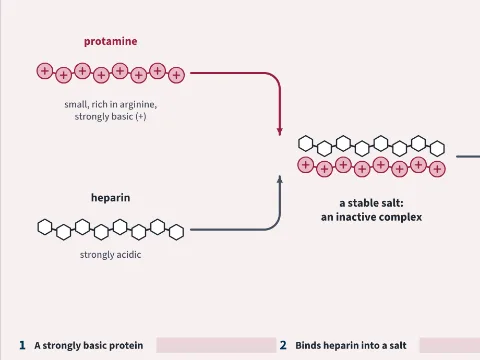
Protamine targets Heparin
Binds heparin into a stable salt, so that neither stays active as an .5
Used forHeparin overdose
What the label says
“Protamine Sulfate Injection, USP is indicated in the treatment of heparin overdosage.”
Source 5“Protamines are simple proteins of low molecular weight that are rich in arginine and strongly basic.”
Source 5“However, when it is given in the presence of heparin (which is strongly acidic), a stable salt is formed and the anticoagulant activity of both drugs is lost.”
Source 5“Neutralization of heparin occurs within five minutes after intravenous administration of an appropriate dose of protamine sulfate.”
Source 5 - C
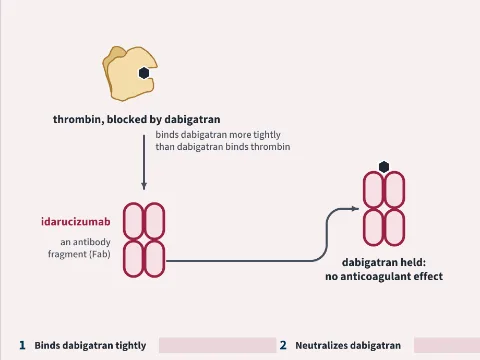
Idarucizumab targets Dabigatran
Binds dabigatran more tightly than thrombin does, neutralizing it.6
Used forReversing dabigatran: for emergency surgery or urgent procedures, or life-threatening or uncontrolled bleeding
What the label says
“PRAXBIND is indicated in patients treated with Pradaxa when reversal of the anticoagulant effects of dabigatran is needed: For emergency surgery/urgent procedures In life-threatening or uncontrolled bleeding”
Source 6“Idarucizumab is a specific reversal agent for dabigatran.”
Source 6“It is a humanized monoclonal antibody fragment (Fab) that binds to dabigatran and its acylglucuronide metabolites with higher affinity than the binding affinity of dabigatran to thrombin, neutralizing their anticoagulant effect.”
Source 6
See also
Body system: blood & clotting.
Can raise or cause it: warfarin (“Warfarin sodium can cause major or fatal bleeding”3); heparin (“Hemorrhage, including fatal events, has occurred in patients receiving heparin.”4); and apixaban (“ELIQUIS can cause serious, potentially fatal, bleeding.”7).
Other conditions: blood clots in the veins, atrial fibrillation, blood clots on artificial heart valves, ischemic stroke and heart attack.
Interactions: vitamin K and warfarin; protamine and heparin; idarucizumab and dabigatran; and warfarin and NSAIDs or aspirin.
Sources
- 1Phytonadione injectable emulsion: FDA label1.1 Indications; 12.1 Mechanism of Action; 12.2 Pharmacodynamics. Saved copy
- 2Pradaxa (dabigatran etexilate) capsules: FDA label5.1 Premature Discontinuation; 5.2 Risk of Bleeding; 12.1 Mechanism of Action. Saved copy
- 3Warfarin sodium tablets: FDA labelBoxed Warning; 11 Description; 12.1 Mechanism of Action. Saved copy
- 4Heparin sodium injection (Fresenius Kabi): FDA label5.2 Hemorrhage; 12.1 Mechanism of Action. Saved copy
- 5Protamine sulfate injection: FDA labelIndications and Usage; Description; Clinical Pharmacology. Saved copy
- 6Praxbind (idarucizumab): FDA label1 Indications and Usage; 12.1 Mechanism of Action. Saved copy
- 7Eliquis (apixaban): FDA label5.2 Bleeding. Saved copy
- 8Human alpha-thrombin with an active-site inhibitor (PPACK)PDB 1PPB; Bode, W. et al. EMBO J. 1989;8:3467-3475. The thrombin outline in the drawing is traced from this structure. Saved copy
- 9Factor Xa with apixabanPDB 2P16; Pinto, D.J. et al. J.Med.Chem. 2007;50:5339-5356. The factor Xa outline in the drawing is traced from this structure. Saved copy
- 10Human vitamin K-dependent gamma-carboxylase with a factor IX precursor peptide and vitamin K1 hydroquinonePDB 9BVK; Cao, Q. et al. Nature 2025;639:816-824. The vitamin K-dependent carboxylase outline in the drawing is traced from this structure. Saved copy
Notes and limits
- Protamine and vitamin K are not expected to affect dabigatran; idarucizumab is a reversal agent specific to dabigatran.2,6
- For adults, apixaban has a reversal agent of its own, andexanet alfa, which has no page here.7
- Given alone, protamine has an anticoagulant effect of its own.5
- Stopping an oral anticoagulant early, with nothing in its place, raises the risk of clots.2
Notes that apply to every page are on How to read a page.
Spotted a mistake? Report an error (hello@openmechanism.com). Since launch, every published error we fix is listed on the corrections page.
Cite this page
Tran D. Bleeding on blood thinners [Internet]. OpenMechanism; 2026 [updated 2026 Oct 20; cited 2026 Oct 20]. Available from: https://openmechanism.com/conditions/bleeding-on-blood-thinners