Epoprostenol
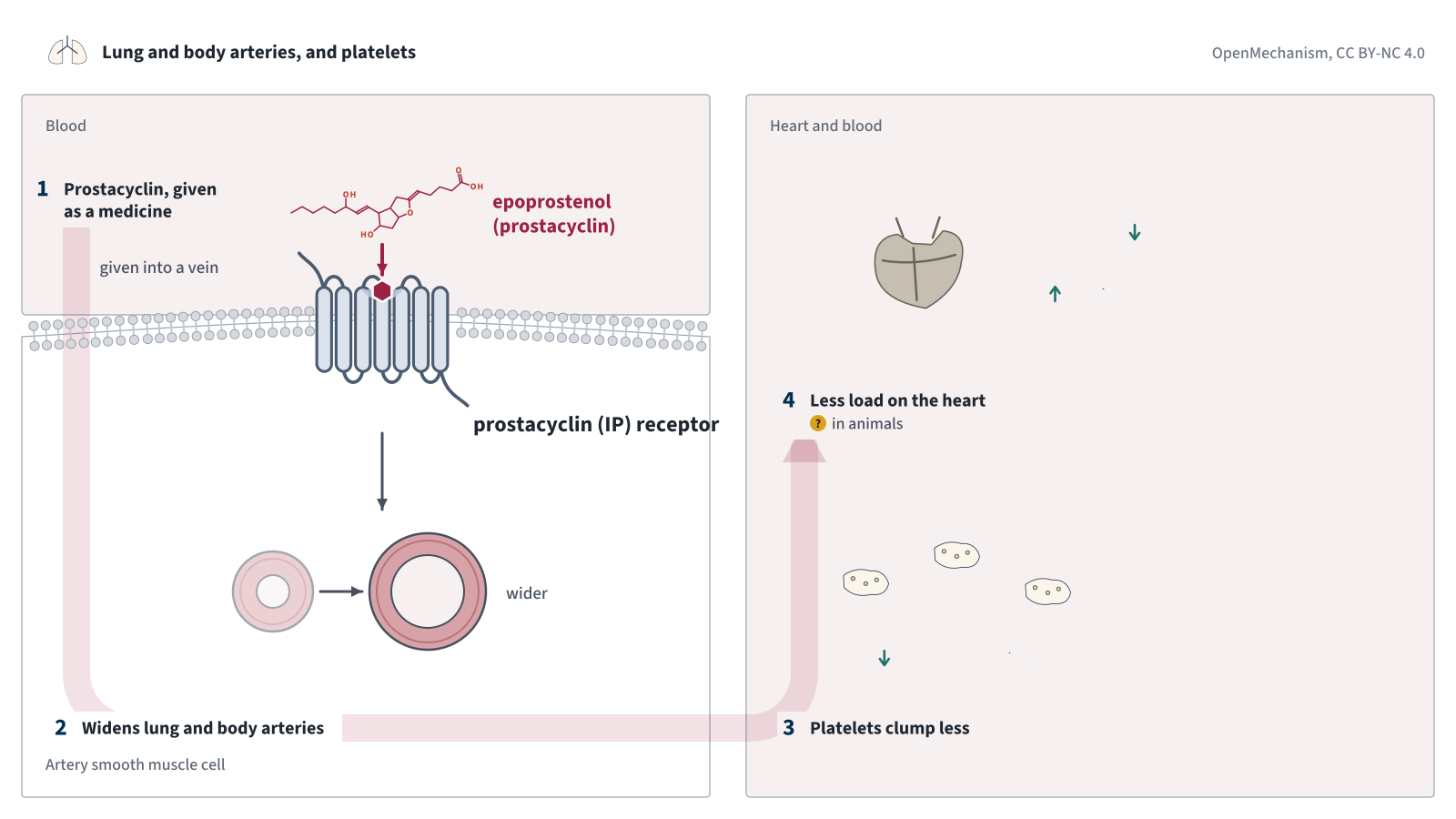
Epoprostenol is prostacyclin, a prostaglandin the body makes itself, given into a vein. It widens the arteries of the lungs and of the rest of the body, and it stops platelets clumping. In animals, the widening lightens the load on both sides of the heart and raises its output.
- Acts on
- Arteries and platelets, as the body's own prostacyclin does
- Where
- Lung and body arteries, and platelets
- Medicine type
- Small molecule
- Used for
- Heart & circulation
- Drug class
- Prostacyclin receptor agonists
Also called Veletri.
Step 4: in animals
The Veletri (epoprostenol) label says: In animals, the vasodilatory effects reduce right- and left-ventricular afterload and increase cardiac output and stroke volume.
Clinical study: In an open, randomized 12-week trial in 81 people with severe primary pulmonary hypertension, comparing epoprostenol plus conventional therapy with conventional therapy alone: the mean changes in pulmonary vascular resistance for the epoprostenol and control groups were -21 percent and +9 percent, respectively
Barst RJ et al., N Engl J Med 1996 (PMID 8532025)
This study was picked with a literature search and is not yet checked by our reviewer.
Key terms in this drawing
- IP receptor
- Prostacyclin receptor. The receptor that prostacyclin and its look-alike medicines are thought to act on; it is linked to making cAMP inside the cell.
How it works
Prostacyclin, given as a medicine. Epoprostenol is prostacyclin (PGI2), a prostaglandin the body makes naturally from arachidonic acid, with strong vessel-widening and anti-platelet activity; the medicine is given into a vein.1
Widens lung and body arteries. Epoprostenol directly widens (dilates) the arteries of the lungs and of the rest of the body.1
Platelets clump less. Epoprostenol inhibits platelet aggregation (platelets clumping together).1
Less load on the heart. In animals, the vessel widening reduces the load the right and left ventricles pump against (afterload) and increases cardiac output and stroke volume.1
For teachers: download this drawing.
See also
Condition pages: pulmonary arterial hypertension.
Other prostacyclin receptor agonists: selexipag.
Body systems: heart, vessels & cholesterol; and blood & clotting.
Sources
- 1Veletri (epoprostenol) for injection: FDA label11 Description; 12.1 Mechanism of Action; 12.2 Pharmacodynamics
- 2ChEMBL CHEMBL1139Target and action classification: Prostanoid IP receptor agonist
- 3A comparison of continuous intravenous epoprostenol (prostacyclin) with conventional therapy for primary pulmonary hypertensionBarst RJ et al. N Engl J Med 1996 (abstract)
Also used for the drawing
The drawing shows epoprostenol acting on the prostacyclin (IP) receptor of the artery's smooth muscle cells. These sources support that part; the steps above come from the sources listed above.
- 4Uptravi (selexipag): FDA label12.1 Mechanism of Action
- 5Smooth muscle proliferation and role of the prostacyclin (IP) receptor in idiopathic pulmonary arterial hypertensionFalcetti E et al., Am J Respir Crit Care Med 2010 (abstract)
Spotted a mistake? Report an error (hello@openmechanism.com). Since launch, every published error we fix is listed on the corrections page.
Notes and limits
- A schematic teaching drawing: not to scale, not exact structures, binding poses or a complete pathway, and not a guide to dosing, treatment or how a person will respond.
All recorded limits are on the evidence page, and notes that apply to every page are on How to read a page. Version 1.0.0, not yet medically reviewed.
Cite this page
Tran D. Epoprostenol [Internet]. OpenMechanism; 2026 [updated 2026 Oct 10; cited 2026 Oct 10]. Available from: https://openmechanism.com/medicines/epoprostenol