Hemophilia A
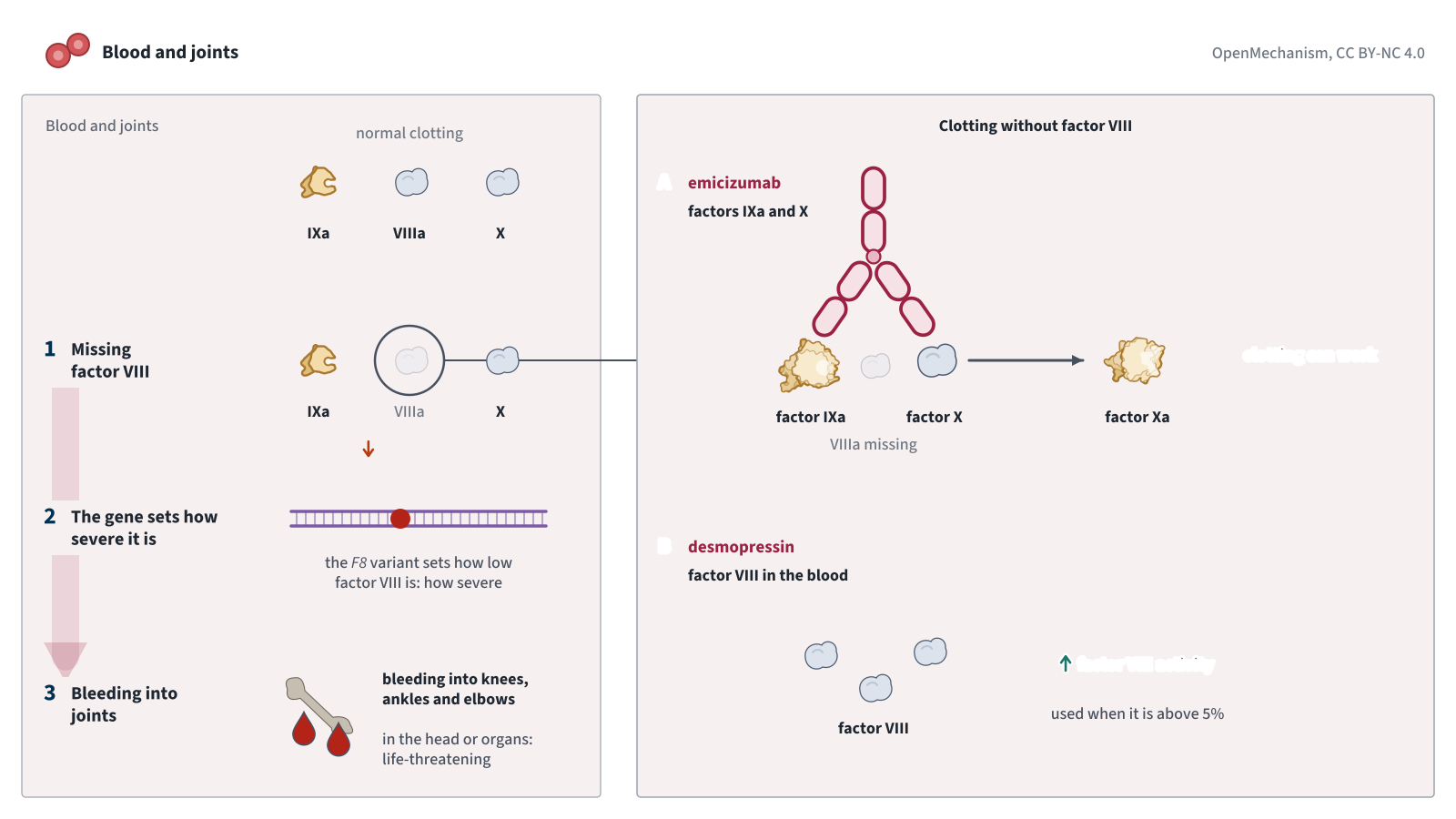
In hemophilia A, a rare inherited X-linked disorder, clotting factor VIII is missing or low; the lower it is, the more severe. Its hallmark is bleeding into large joints (knees, ankles, elbows); bleeding in the head or organs can be life-threatening. Emicizumab bridges factors and X, standing in for factor VIII; desmopressin raises factor VIII activity in milder disease.
- Where
- Blood and joints
- Body system
- Blood & clotting
- Medicines
- 2 medicines
For teachers: download this drawing.
Key terms in this drawing (5)
- F8
- F8 gene (coagulation factor VIII). The gene for clotting factor VIII; the kind of mutation in it sets how low factor VIII is, and so how severe hemophilia A is.
- factor IXa
- Activated coagulation factor IX. An activated clotting factor; factor VIIIa normally brings it together with factor X, and emicizumab does that job when factor VIII is missing.
- factor VIII
- Coagulation factor VIII. A clotting protein that is missing or low in hemophilia A.
- factor VIIIa
- Activated coagulation factor VIII. A clotting cofactor that helps factor IXa activate factor X; missing in hemophilia A.
- factor Xa
- Activated coagulation factor X. A clotting enzyme that turns prothrombin into thrombin.
What goes wrong
Missing factor VIII. Hemophilia A is a rare inherited X-linked disorder caused by missing or low clotting .1
What the source says
“Haemophilia A and B are rare congenital, recessive X-linked disorders caused by lack or deficiency of clotting factor VIII (FVIII) or IX (FIX), respectively.”
Source 1The gene sets how severe it is. How severe it is depends on how low factor VIII is, which depends on the variant in the gene.1
What the source says
“The severity of the disease depends on the reduction of levels of FVIII or FIX, which are determined by the type of the causative mutation in the genes encoding the factors (F8 and F9, respectively).”
Source 1Bleeding into joints. The hallmark is bleeding into large joints, which can damage them; bleeding in the head or organs can be life-threatening.1
What the source says
“The hallmark clinical characteristic, especially in untreated severe forms, is bleeding (spontaneous or after trauma) into major joints such as ankles, knees and elbows, which can result in the development of arthropathy.”
Source 1“Intracranial bleeds and bleeds into internal organs may be life-threatening.”
Source 1
Where medicines act
- A
Emicizumab: stands in for factor VIII
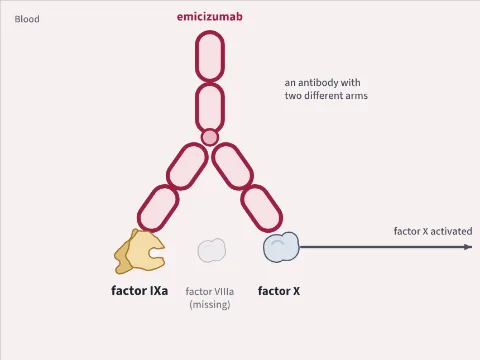
Emicizumab, a two-armed antibody, bridges activated factor IX and factor X, doing the job of the missing activated factor VIII; it prevents or reduces bleeding episodes in hemophilia A.2
What the source says
“HEMLIBRA bridges activated factor IX and factor X to restore the function of missing activated factor VIII that is needed for effective hemostasis.”
Source 2“HEMLIBRA is indicated for routine prophylaxis to prevent or reduce the frequency of bleeding episodes in adult and pediatric patients ages newborn and older with hemophilia A (congenital factor VIII deficiency) with or without factor VIII inhibitors.”
Source 2 - B
Desmopressin: factor VIII raised
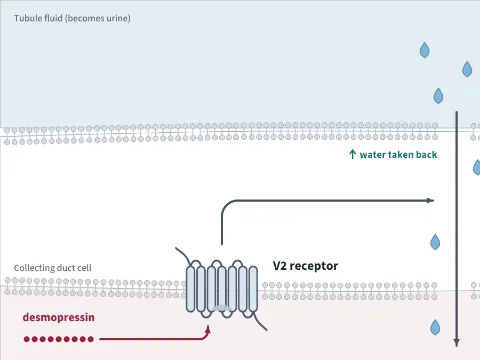
Desmopressin, a man-made form of vasopressin, raises factor VIII activity in the blood. It is used in hemophilia A when factor VIII activity is above 5%, to prevent bleeding in surgery and to reduce bleeding from injuries.3
What the source says
“Desmopressin acetate increases plasma levels of factor VIII activity in patients with hemophilia and von Willebrand's disease Type I.”
Source 3“Hemophilia A- for patients with factor VIII coagulant activity levels greater than 5% to maintain hemostasis during surgical procedures and postoperatively or reduce bleeding with episodes of spontaneous or traumatic injuries such as hemarthroses, intramuscular hematomas, or mucosal bleeding.”
Source 3
See also
Body system: blood & clotting.
Also used for it: antihemophilic factor (factor VIII) (“ADVATE® [Antihemophilic Factor (Recombinant)] is a recombinant antihemophilic factor indicated for use in children and adults with hemophilia A (congenital factor VIII deficiency) for: Control and prevention of bleeding episodes. Perioperative management. Routine prophylaxis to prevent or reduce the frequency of bleeding episodes.”4).
Other conditions: von Willebrand disease, bedwetting (nocturnal enuresis) and diabetes insipidus.
Sources
- 1HaemophiliaBerntorp E et al. Nat Rev Dis Primers 2021 (abstract). Saved copy
- 2Hemlibra (emicizumab): FDA label1 Indications and Usage; 12.1 Mechanism of Action. Saved copy
- 3DDAVP Injection (desmopressin): FDA label1.2 Hemophilia A; 12.1 Mechanism of Action. Saved copy
- 4Advate (antihemophilic factor, recombinant): FDA label1 Indications and Usage. Saved copy
- 5Human factor IXa (its protease domain and second EGF domain) with p-aminobenzamidine in its active sitePDB 1RFN; Hopfner, K.P. et al. Structure Fold.Des. 1999;7:989-996. The factor IXa outline in the drawing is traced from this structure. Saved copy
- 6Factor Xa with apixabanPDB 2P16; Pinto, D.J. et al. J.Med.Chem. 2007;50:5339-5356. The factor Xa outline in the drawing is traced from this structure. Saved copy
Notes and limits
- Many people develop antibodies (inhibitors) against infused factor, which remains a major hurdle.1
Notes that apply to every page are on How to read a page.
Spotted a mistake? Report an error (hello@openmechanism.com). Since launch, every published error we fix is listed on the corrections page.
Cite this page
Tran D. Hemophilia A [Internet]. OpenMechanism; 2026 [updated 2026 Oct 18; cited 2026 Oct 18]. Available from: https://openmechanism.com/conditions/hemophilia-a