Exagamglogene autotemcel
A patient's own blood stem cells are collected and edited with CRISPR to turn down in red-cell precursors. After infusion, their red-cell descendants make more fetal hemoglobin, which in sickle cell disease lowers the concentration and opposes sickling.
- Acts on
- BCL11A erythroid enhancer, gamma-globin expression
- Where
- The patient's own edited stem cells and red cells
- Medicine type
- Gene
- Used for
- Blood & clotting
Also called Casgevy.
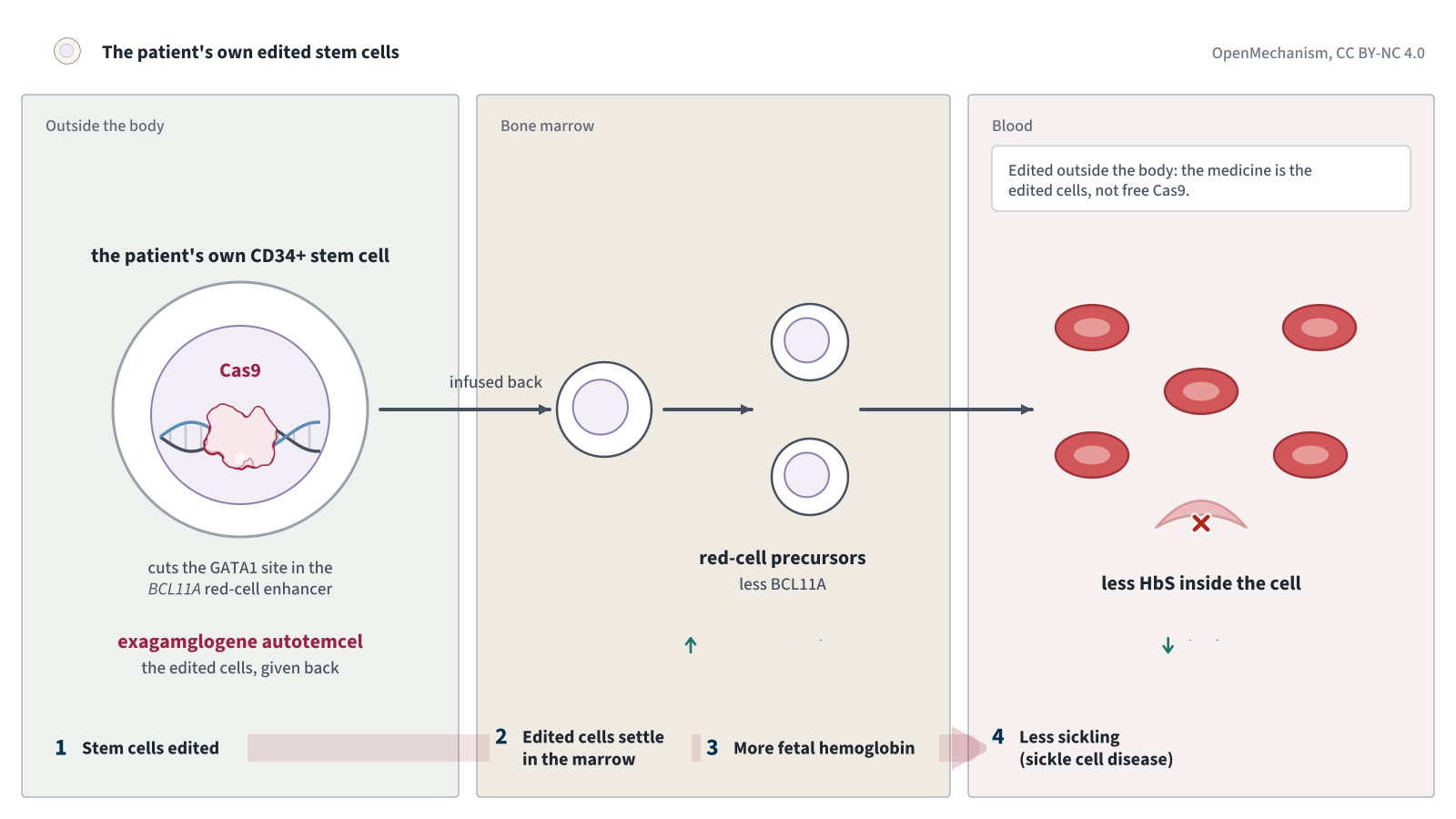
Key terms in this drawing (6)
- BCL11A
- B-cell lymphoma/leukemia 11A. A protein that turns down fetal hemoglobin in red-cell precursors.
- CD34
- CD34 protein. A surface marker used to collect blood-forming stem cells.
- CRISPR/Cas9
- CRISPR/Cas9 gene editing. A tool that cuts DNA at a chosen place to edit a gene.
- GATA1
- GATA-binding factor 1. A protein that switches genes on in red-cell precursors.
- HbF
- Fetal hemoglobin. The form of hemoglobin made mainly before birth.
- HbS
- Hemoglobin S (sickle hemoglobin). The form of hemoglobin in sickle cell disease.
How it works
Stem cells edited. editing in collected autologous cells disrupts the binding site in the BCL11A erythroid enhancer.1
Edited cells settle in the marrow. Infused edited cells engraft in marrow and differentiate into erythroid-lineage cells.1
More fetal hemoglobin. Reduced erythroid BCL11A expression increases gamma-globin expression and fetal hemoglobin production.1
Less sickling (sickle cell disease). In the sickle-cell route, greater fetal hemoglobin reduces intracellular HbS concentration and opposes red-cell sickling.1
For teachers: download this drawing or build a slide deck.
See also
Condition pages: beta-thalassemia and sickle cell disease.
More medicines for blood & clotting: alteplase, antihemophilic factor (factor VIII), apixaban, aspirin, clopidogrel, cyanocobalamin (vitamin B12), dabigatran etexilate, daprodustat and 18 more.
Body system: blood & clotting.
Sources
- 1Casgevy (exagamglogene autotemcel): FDA label11 product editing description; 12.1 cellular mechanism
- 2ChEMBL CHEMBL5095474Target and action classification: B-cell lymphoma/leukemia 11A gene editing negative modulator
Also used for the drawing
The Cas9 outline is traced from the crystal structure below.
- 3Streptococcus pyogenes Cas9 (made inactive for the study) with its guide RNA and target DNAPDB 4OO8; Nishimasu, H. et al. Cell(Cambridge,Mass.) 2014; 156:935-949
Spotted a mistake? Report an error (hello@openmechanism.com). Since launch, every published error we fix is listed on the corrections page.
Notes and limits
- A schematic teaching drawing: not to scale, not exact structures, binding poses or a complete pathway, and not a guide to dosing, treatment or how a person will respond.
- Other medicines in the same family may not follow every step or share the same clinical endpoint.
- The steps are in the order that explains them; one step is said to cause the next only where the source says so.
- Editing occurs ex vivo; the administered product is edited cells, not a freely circulating Cas9 medicine.
- Selected sickle-cell route; the distinct thalassemia globin-balance route is not collapsed into this one.
- Engraftment and clinical effects are source-described product biology, not guaranteed outcomes for every infused cell or patient.
All recorded limits are on the evidence page, and notes that apply to every page are on How to read a page. Version 1.0.0, not yet medically reviewed.
Cite this page
Tran D. Exagamglogene autotemcel [Internet]. OpenMechanism; 2026 [updated 2026 Oct 14; cited 2026 Oct 14]. Available from: https://openmechanism.com/medicines/exagamglogene-autotemcel