Dipyridamole
Dipyridamole blocks the uptake of adenosine into platelets, the cells lining blood vessels and red blood cells. The extra adenosine acts on the platelets' A2 receptors, which raises inside them, so platelets clump less. Dipyridamole also blocks phosphodiesterase enzymes, mainly the one that breaks down , adding to the cGMP made by .
- Acts on
- Adenosine uptake into platelets, endothelial cells and red cells; phosphodiesterase
- Where
- Platelets
- Medicine type
- Small molecule
- Used for
- Blood & clotting
- Drug class
- Antiplatelet medicines
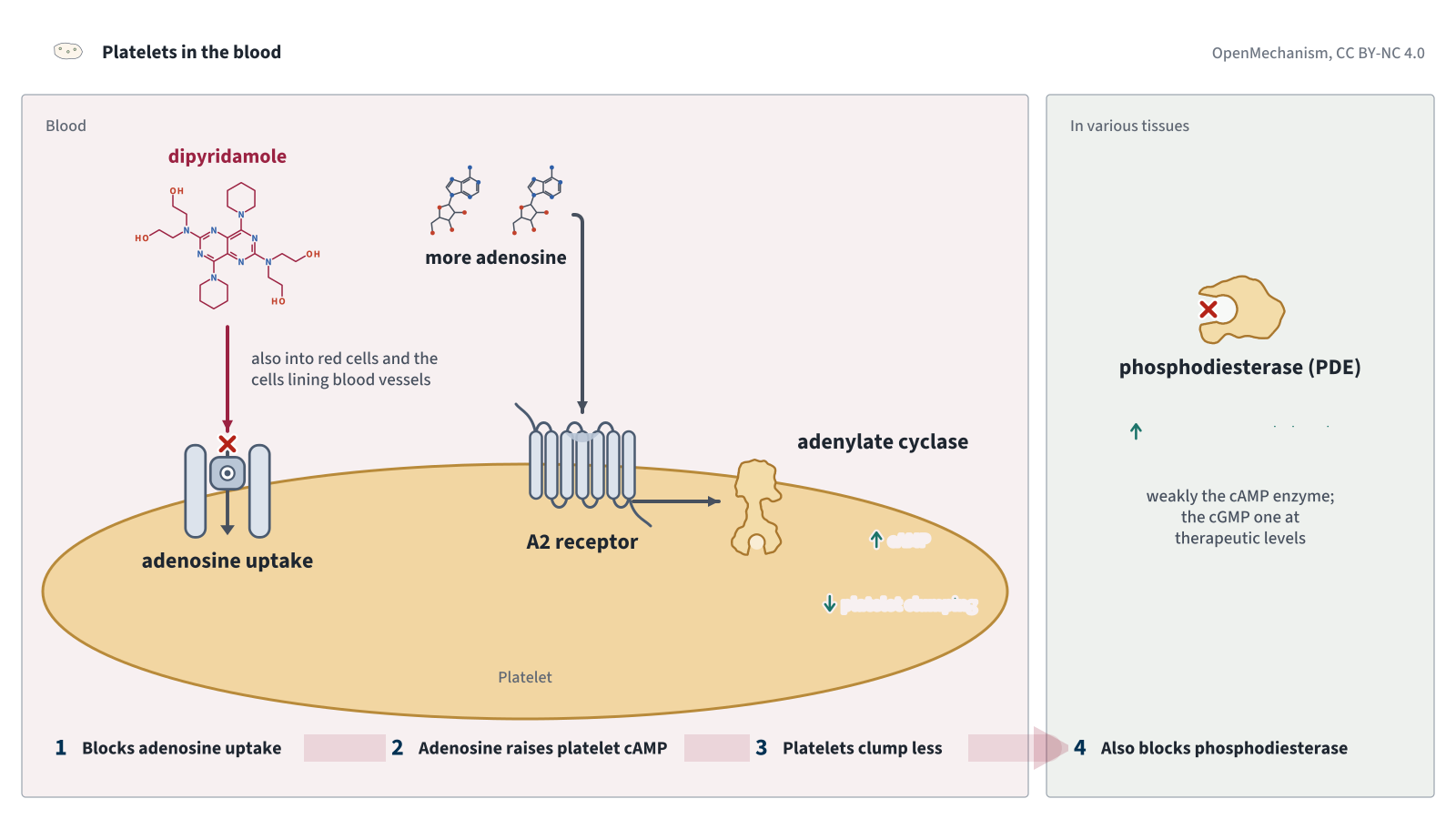
Key terms in this drawing
- cAMP
- Cyclic adenosine monophosphate (cyclic AMP). A signaling molecule inside cells; a rise in it activates protein kinase A.
- cGMP
- Cyclic guanosine monophosphate. A molecule that rises in smooth muscle when nitric oxide activates guanylate cyclase; the rise leads the vessels to widen.
- NO
- Nitric oxide. A signal molecule released by nerve endings and the cells lining blood vessels; it makes smooth muscle cells produce cGMP.
How it works
Blocks adenosine uptake. Dipyridamole blocks the uptake of adenosine into platelets, endothelial cells and red blood cells.1
Adenosine raises platelet cAMP. More adenosine stays around the cells and acts on the platelet's A2 receptor, which stimulates adenylate cyclase and raises cyclic AMP (cAMP) in the platelet.1
Platelets clump less. This way, platelets clump less in response to stimuli such as platelet activating factor (PAF), collagen and .1
Also blocks phosphodiesterase. Dipyridamole also blocks phosphodiesterase (PDE) in various tissues: only weakly the enzyme that breaks down cAMP, but at therapeutic levels the one that breaks down cGMP, adding to the cGMP made by nitric oxide.1
For teachers: download this drawing.
See also
Condition pages: blood clots on artificial heart valves.
Other antiplatelet medicines: aspirin, clopidogrel, eptifibatide, prasugrel and ticagrelor.
Body system: blood & clotting.
Sources
- 1Dipyridamole tablets (Amneal): FDA labelClinical Pharmacology: Mechanism of Action
- 2ChEMBL CHEMBL932Target and action classification: 3',5'-cyclic phosphodiesterase inhibitor; Equilibrative nucleoside transporter 1 inhibitor
Also used for the drawing
The adenylyl cyclase and phosphodiesterase outlines are traced from the electron microscopy and crystal structures below.
- 3Truncated adenylyl cyclase with MANT-GTP, forskolin and an activated stimulatory Gαs proteinPDB 6R4O; Qi, C. et al. Science 2019; 364:389-394
- 4The catalytic domain of human phosphodiesterase 5 (PDE5) with tadalafilPDB 1UDU; Sung, B.-J. et al. Nature 2003; 425:98-102
Spotted a mistake? Report an error (hello@openmechanism.com). Since launch, every published error we fix is listed on the corrections page.
Notes and limits
- A schematic teaching drawing: not to scale, not exact structures, binding poses or a complete pathway, and not a guide to dosing, treatment or how a person will respond.
All recorded limits are on the evidence page, and notes that apply to every page are on How to read a page. Version 1.0.0, not yet medically reviewed.
Cite this page
Tran D. Dipyridamole [Internet]. OpenMechanism; 2026 [updated 2026 Oct 18; cited 2026 Oct 18]. Available from: https://openmechanism.com/medicines/dipyridamole