Selexipag
An enzyme in the body (carboxylesterase 1) turns selexipag into a more potent active form. Both switch on the prostacyclin () receptor and not the other . In a study in adults with pulmonary arterial hypertension, resistance in the lung arteries fell. At the levels reached in the body, it had no effect on platelet tests in healthy people.
- Acts on
- Prostacyclin receptor (IP receptor)
- Where
- Lung arteries
- Medicine type
- Small molecule
- Used for
- Heart & circulation
- Drug class
- Prostacyclin receptor agonists
Also called Uptravi.
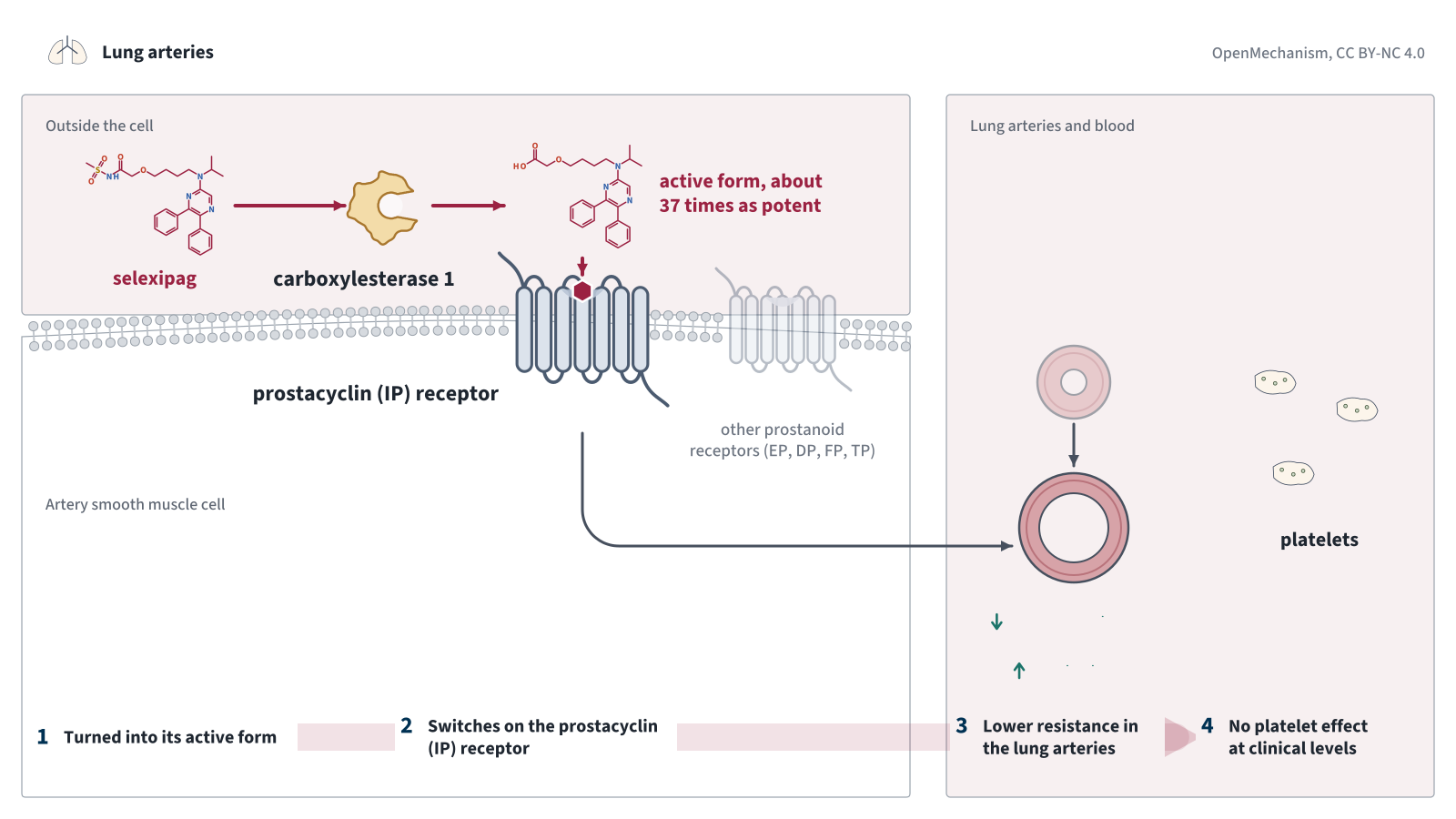
Key terms in this drawing
- IP receptor
- Prostacyclin receptor. The receptor that prostacyclin and its look-alike medicines are thought to act on; it is linked to making cAMP inside the cell.
- prostanoid receptors
- Prostanoid receptors (DP, EP, FP, IP and TP). A family of receptors that includes the prostacyclin (IP) receptor and the EP, DP, FP and TP receptors; selexipag acts on the IP receptor rather than the others.
How it works
Turned into its active form. Carboxylesterase 1 converts selexipag into its active metabolite, which is about 37 times as potent as selexipag.1
Switches on the prostacyclin (IP) receptor. Selexipag is a prostacyclin receptor (IP receptor) that is structurally distinct from prostacyclin; selexipag and its active metabolite are selective for the IP receptor over the other prostanoid receptors (EP1–4, DP, FP and TP).1
Lower resistance in the lung arteries. In a 17-week study in adults with PAH, selexipag lowered pulmonary vascular resistance by 30.3% and raised the cardiac index compared with placebo.1
No platelet effect at clinical levels. Selexipag and its active metabolite inhibit platelet aggregation in the lab, but at clinically relevant concentrations they had no effect on platelet aggregation tests in healthy people.1
For teachers: download this drawing.
See also
Condition pages: pulmonary arterial hypertension.
Other prostacyclin receptor agonists: epoprostenol.
Body systems: heart, vessels & cholesterol; and blood & clotting.
Sources
- 1Uptravi (selexipag) tablets and for injection: FDA label1 Indications and Usage; 12.1 Mechanism of Action; 12.2 Pharmacodynamics
- 2ChEMBL CHEMBL238804Target and action classification: Prostanoid IP receptor agonist
Also used for the drawing
The drawing places the prostacyclin (IP) receptor on the smooth muscle cells of the lung arteries. This source supports that part; the steps above come from the sources listed above. The carboxylesterase 1 outline is traced from the crystal structure below.
- 3Smooth muscle proliferation and role of the prostacyclin (IP) receptor in idiopathic pulmonary arterial hypertensionFalcetti E et al., Am J Respir Crit Care Med 2010 (abstract)
- 4Human liver carboxylesterase 1 with ethyl acetatePDB 1YAH; Fleming, C.D. et al. J.Mol.Biol. 2005; 352:165-177
Spotted a mistake? Report an error (hello@openmechanism.com). Since launch, every published error we fix is listed on the corrections page.
Notes and limits
- A schematic teaching drawing: not to scale, not exact structures, binding poses or a complete pathway, and not a guide to dosing, treatment or how a person will respond.
All recorded limits are on the evidence page, and notes that apply to every page are on How to read a page. Version 1.0.0, not yet medically reviewed.
Cite this page
Tran D. Selexipag [Internet]. OpenMechanism; 2026 [updated 2026 Oct 10; cited 2026 Oct 10]. Available from: https://openmechanism.com/medicines/selexipag