Blood clots on artificial heart valves
A mechanical heart valve lasts longer than a tissue valve but forms clots more easily, so it needs lifelong anticoagulation. Platelets reacting with the valve's surface are believed to matter. A clot can make the valve fail or travel in the arteries. Warfarin cuts the clotting factors the liver makes; dipyridamole, added to it, makes platelets clump less.
- Where
- Heart valves, liver and platelets
- Body systems
- Heart, vessels & cholesterol; Blood & clotting
- Medicines
- 2 medicines
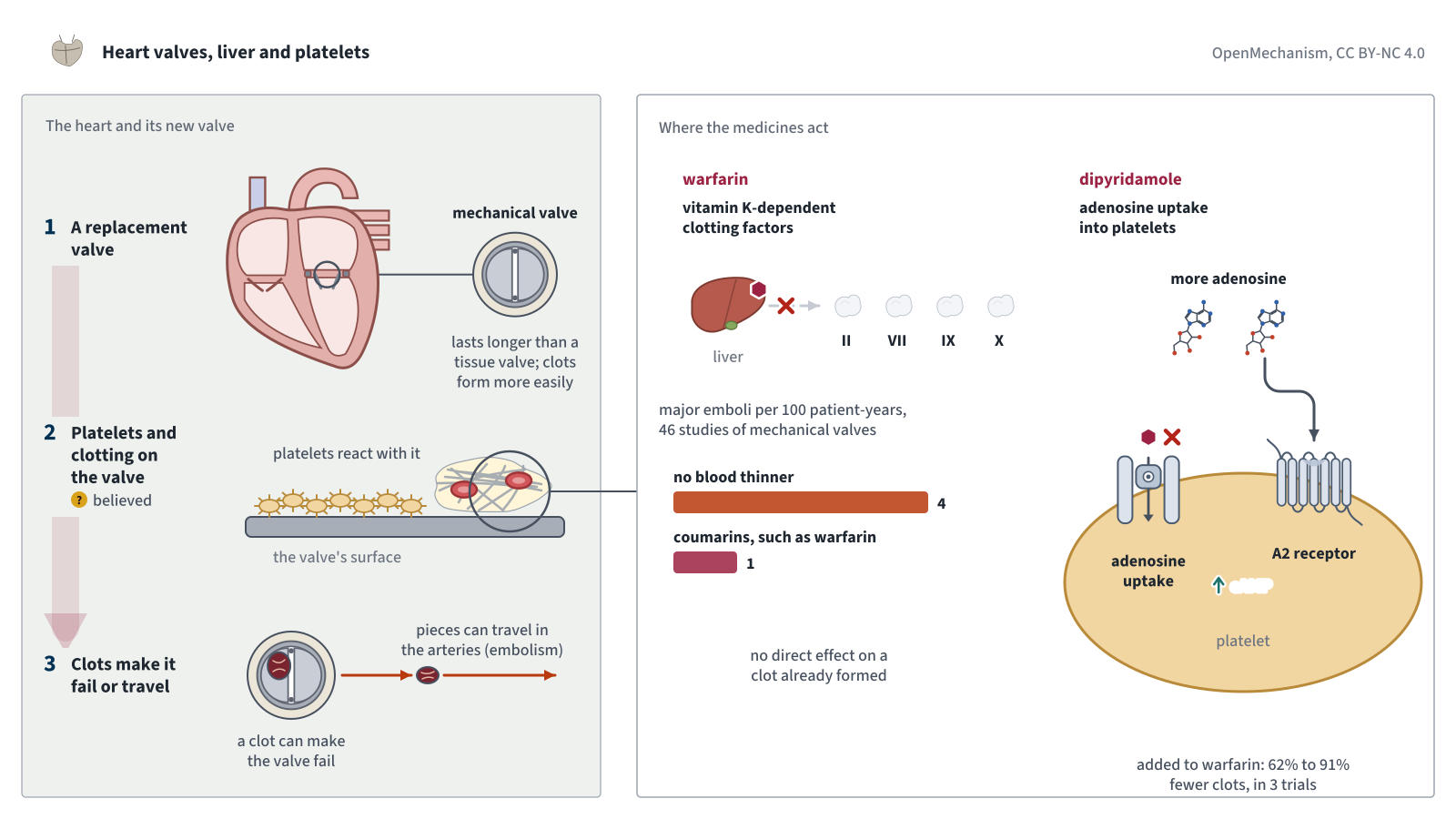
Step 2: believed
The dipyridamole label says: It is believed that platelet reactivity and interaction with prosthetic cardiac valve surfaces, resulting in abnormally shortened platelet survival time, is a significant factor in thromboembolic complications occurring in connection with prosthetic heart valve replacement.
Source 3: Dipyridamole tablets (Amneal): FDA label, Indications and Usage; Clinical Pharmacology
Clinical study: A Cochrane review of 13 randomized trials in 4,122 people with artificial heart valves, comparing an anticoagulant alone with an anticoagulant plus an antiplatelet medicine (aspirin or dipyridamole); it measured clots, deaths and bleeding, not platelets on the valve: Compared with anticoagulation alone, the addition of an antiplatelet agent reduced the risk of thromboembolic events (odds ratio (OR) 0.43, 95% confidence interval (CI) 0.32 to 0.59; P < 0.00001) and total mortality (OR 0.57, 95% CI 0.42 to 0.78; P = 0.0004). … Aspirin and dipyridamole reduced these events similarly.
Massel DR, Little SH, Cochrane Database Syst Rev 2013 (PMID 23839768)
This study was picked with a literature search and is not yet checked by our reviewer.
For teachers: download this drawing.
Key terms in this drawing
- cAMP
- Cyclic adenosine monophosphate (cyclic AMP). A signaling molecule inside cells; a rise in it activates protein kinase A.
What goes wrong
A replacement valve. Artificial heart valves are of two types: mechanical valves, put in by surgery, and bioprosthetic (tissue) valves. Mechanical valves last longer than tissue valves but form clots more easily, so they need lifelong anticoagulation.1,2
What the source says
“Two types of artificial heart valve exist: mechanical heart valves (MHV), which are implanted surgically, and bioprosthetic heart valves (BHV), which can be implanted via a surgical or transcatheter approach.”
Source 1“Mechanical prosthetic heart valves, though more durable than bioprostheses, are more thrombogenic and require lifelong anticoagulation.”
Source 2Platelets and clotting on the valve. Platelets reacting with the artificial valve's surface, which shortens their survival, are believed to be a significant factor in clots after valve replacement. Clots forming on them are a common reason that devices in contact with blood, such as heart valves, fail.3,4
What the source says
“It is believed that platelet reactivity and interaction with prosthetic cardiac valve surfaces, resulting in abnormally shortened platelet survival time, is a significant factor in thromboembolic complications occurring in connection with prosthetic heart valve replacement.”
Source 3“Blood-contacting medical devices, such as vascular grafts, stents, heart valves, and catheters, are often used to treat cardiovascular diseases. Thrombus formation is a common cause of failure of these devices.”
Source 4Clots make it fail or travel. A clot on the valve can make it fail, which can be life-threatening; it may show only on a scan or cause shock from a failing heart. Clots can also break off and travel in the arteries (embolism). Pooled across 46 studies of mechanical valves, major emboli came at 4 per 100 patient-years without any blood thinner, 2.2 with antiplatelet medicines and 1 with coumarins; a valve in the mitral position almost doubled the risk of one in the aortic position.2,5,6
What the source says
“Prosthetic valve thrombosis is one of the major causes of primary valve failure, which can be life-threatening.”
Source 5“Mechanical valve thrombosis (MVT) is a known complication with clinical presentation ranging from incidental imaging finding to cardiogenic shock.”
Source 2“Patients with mechanical heart valve prostheses may experience valve thrombosis and subsequent systemic embolism for which they are treated with oral anticoagulant therapy.”
Source 6“Forty-six studies were found, including 13,088 patients studied for 53,647 patient-years.”
Source 6“We found an incidence of major embolism in the absence of antithrombotic therapy of 4 per 100 patient-years. With antiplatelet therapy this risk was 2.2 per 100 patient-years, and with coumarin therapy it was reduced to 1 per 100 patient-years.”
Source 6“A prosthesis in mitral position increased the risk almost twice as compared with the aortic position.”
Source 6
Where medicines act
In the liver
- A
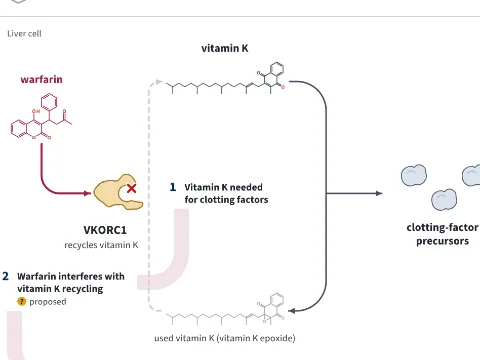
Warfarin targets Vitamin K-dependent clotting factors
Blocks the making of the vitamin K-dependent clotting factors II, VII, IX and X; it has no direct effect on a clot already formed.6,7,8
Used forClots linked to heart valve replacement: prevention and treatment
What the label says
“Prophylaxis and treatment of thromboembolic complications associated with atrial fibrillation (AF) and/or cardiac valve replacement.”
Source 7“Warfarin acts by inhibiting the synthesis of vitamin K-dependent clotting factors, which include Factors II, VII, IX, and X, and the anticoagulant proteins C and S.”
Source 7“The chemical name of warfarin sodium is 3-(α-acetonylbenzyl)-4-hydroxycoumarin sodium salt”
Source 8“We found an incidence of major embolism in the absence of antithrombotic therapy of 4 per 100 patient-years. With antiplatelet therapy this risk was 2.2 per 100 patient-years, and with coumarin therapy it was reduced to 1 per 100 patient-years.”
Source 6“Warfarin sodium has no direct effect on an established thrombus, nor does it reverse ischemic tissue damage.”
Source 7
In platelets
- B
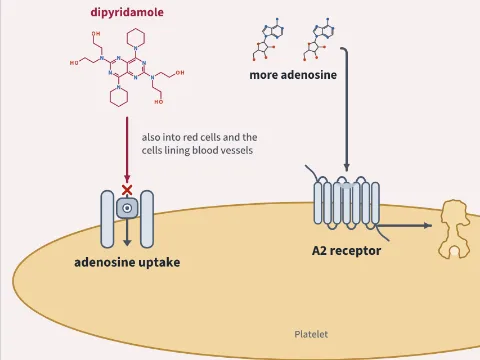
Dipyridamole targets Adenosine uptake
Blocks adenosine uptake, so adenosine raises platelet and platelets clump less.3
Used forClots after heart valve replacement: added to coumarin anticoagulants such as warfarin
What the label says
“Dipyridamole tablets are indicated as an adjunct to coumarin anticoagulants in the prevention of postoperative thromboembolic complications of cardiac valve replacement.”
Source 3“Dipyridamole inhibits the uptake of adenosine into platelets, endothelial cells and erythrocytes in vitro and in vivo ; the inhibition occurs in a dose-dependent manner at therapeutic concentrations (0.5 mcg/mL to 1.9 mcg/mL).”
Source 3“This inhibition results in an increase in local concentrations of adenosine which acts on the platelet A 2 -receptor thereby stimulating platelet adenylate cyclase and increasing platelet cyclic-3',5'-adenosine monophosphate (cAMP) levels.”
Source 3“Via this mechanism, platelet aggregation is inhibited in response to various stimuli such as platelet activating factor (PAF), collagen and adenosine diphosphate (ADP).”
Source 3“In three randomized controlled clinical trials involving 854 patients who had undergone surgical placement of a prosthetic heart valve, dipyridamole tablets, in combination with warfarin, decreased the incidence of postoperative thromboembolic events by 62% to 91% compared to warfarin treatment alone.”
Source 3
See also
Body systems: heart, vessels & cholesterol; and blood & clotting.
Other conditions: atrial fibrillation; blood clots in the veins; ischemic stroke; bleeding on blood thinners; bloodstream infections and endocarditis; and heart attack.
Interactions: vitamin K and warfarin; and warfarin and NSAIDs or aspirin.
The medicine in the body: warfarin and the CYP2C9 and VKORC1 genes.
Sources
- 1Prosthetic heart valve thrombosisDangas GD et al. J Am Coll Cardiol 2016 (abstract). Saved copy
- 2Management of mechanical prosthetic heart valve thrombosisSoria Jiménez CE et al. J Am Coll Cardiol 2023 (abstract). Saved copy
- 3Dipyridamole tablets (Amneal): FDA labelIndications and Usage; Clinical Pharmacology. Saved copy
- 4Medical device-induced thrombosis: what causes it and how can we prevent it?Jaffer IH et al. J Thromb Haemost 2015 (abstract). Saved copy
- 5A global perspective on mechanical prosthetic heart valve thrombosisGürsoy MO et al. Anatol J Cardiol 2016 (abstract). Saved copy
- 6Thromboembolic and bleeding complications in patients with mechanical heart valve prosthesesCannegieter SC et al. Circulation 1994 (abstract). Saved copy
- 7Warfarin sodium tablets: FDA label1 Indications and Usage; 12.1 Mechanism of Action. Saved copy
- 8Warfarin sodium tablets: FDA labelBoxed Warning; 5.7 Use in Pregnant Women with Mechanical Heart Valves; 11 Description. Saved copy
- 9Antiplatelet and anticoagulation for patients with prosthetic heart valvesMassel DR, Little SH. Cochrane Database Syst Rev 2013 (abstract). Saved copy
- 10Pradaxa (dabigatran etexilate) capsules: FDA label5.4 Thromboembolic and Bleeding Events in Patients with Prosthetic Heart Valves. Saved copy
- 11Eliquis (apixaban): FDA label5.4 Patients with Prosthetic Heart Valves. Saved copy
Notes and limits
- In a review of 13 randomized trials, adding an antiplatelet medicine (dipyridamole or aspirin) to an anticoagulant lowered clots and deaths but raised major bleeding; the trials, mostly from the 1970s and 1980s, tended to be of low quality. An older pooled analysis had found more bleeding without fewer clots.6,9
- The labels of two other blood thinners rule them out or advise against them with artificial valves. In the RE-ALIGN trial, dabigatran led to more clots (on the valve, strokes and heart attacks) and more major bleeding than warfarin, and its label rules it out for anyone with a mechanical valve; the apixaban label says it has not been studied in people with artificial heart valves and is not recommended for them.10,11
- Warfarin can cause major or fatal bleeding. It can harm an unborn baby, but its label says the benefits may outweigh the risks for pregnant women with mechanical valves at high risk of clots.8
- A 2016 review says long-term anticoagulation is needed after a mechanical valve to prevent clots, but that its value after a tissue valve is uncertain; clots on tissue valves can lead to emboli too.1
Notes that apply to every page are on How to read a page.
Spotted a mistake? Report an error (hello@openmechanism.com). Since launch, every published error we fix is listed on the corrections page.
Cite this page
Tran D. Blood clots on artificial heart valves [Internet]. OpenMechanism; 2026 [updated 2026 Nov 18; cited 2026 Nov 18]. Available from: https://openmechanism.com/conditions/heart-valve-clots