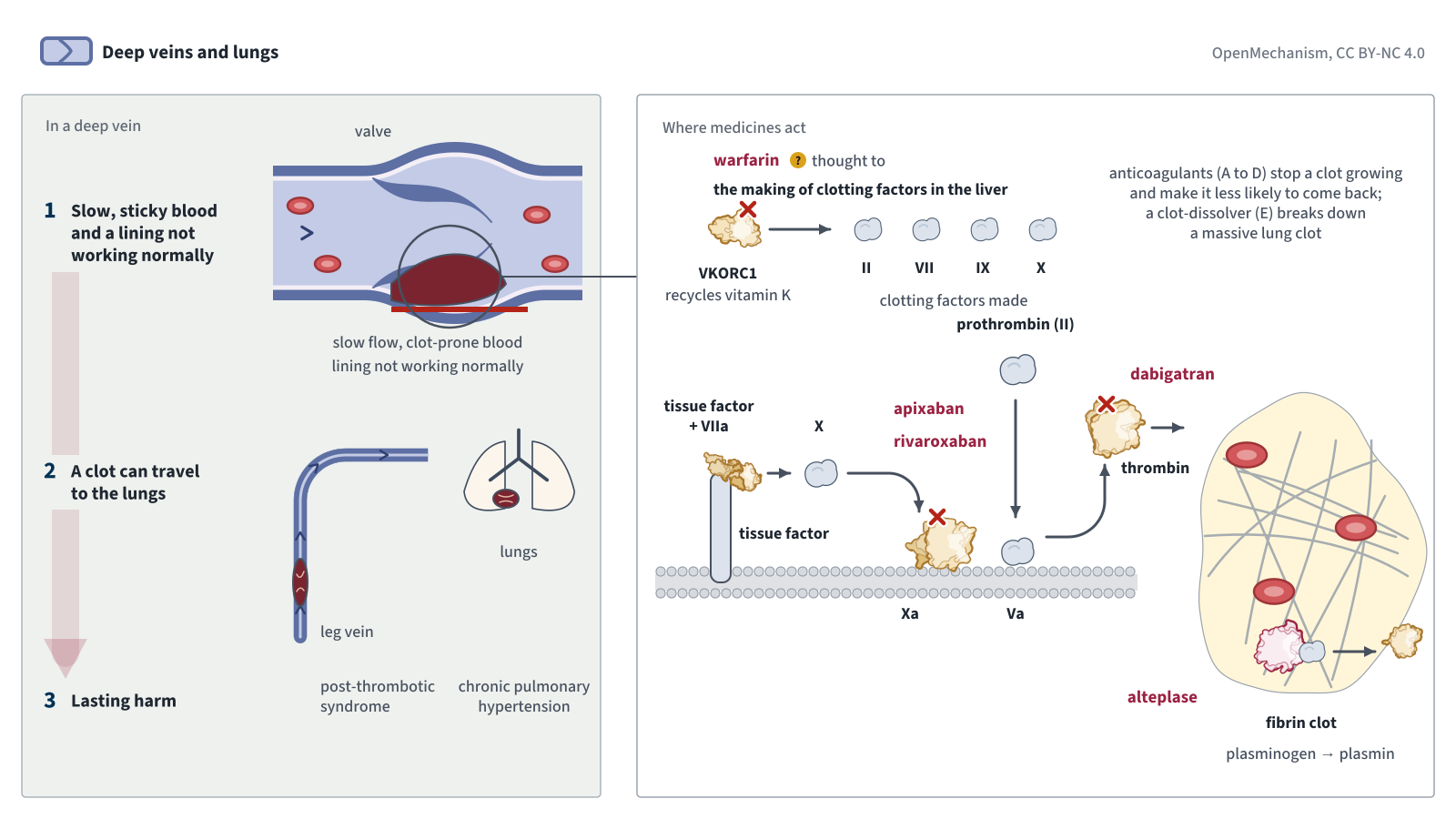
Venous thromboembolism is a clot in a deep vein that can travel to the lungs. Slow flow, blood that clots too easily and an abnormal lining are thought to start it, most often in a valve pocket; surgery, hospital stays and long journeys raise the risk. Anticoagulants stop a clot growing and make it less likely to come back; a clot-dissolver treats a massive lung clot.
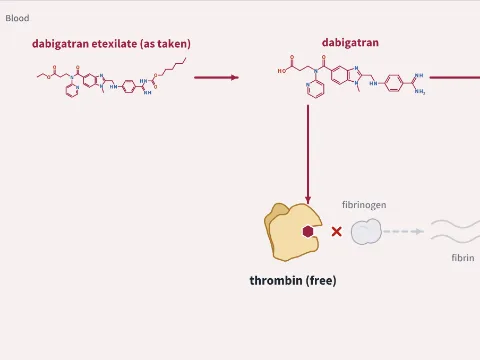
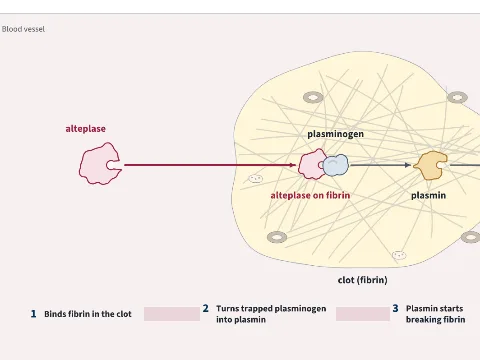
What goes wrong in blood clots in the veins, and where medicines act. Schematic, not to scale. Alteplase outline from the catalytic domain of tPA. Plasmin outline from microplasmin, plasmin's catalytic part. License CC BY-NC 4.0.
?Thought to
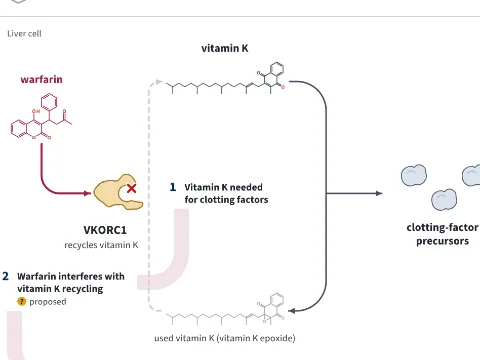
The warfarin label says: Warfarin is thought to interfere with clotting factor synthesis by inhibition of the C1 subunit of vitamin K epoxide reductase (VKORC1) enzyme complex
Clinical study: In a 2005 retrospective study of European-American patients on long-term warfarin, versions of the VKORC1 gene (grouped as A and B) went with different warfarin doses: VKORC1 haplotype groups A and B explained approximately 25 percent of the variance in dose.Rieder MJ et al., N Engl J Med 2005 (PMID 15930419)
Activated coagulation factor VII. A clotting enzyme that, bound to tissue factor, starts clotting by switching on factors IX and X.
VKORC1
Vitamin K epoxide reductase complex subunit 1. Part of the enzyme complex that recycles used vitamin K so it can be used again.
What goes wrong
Slow, sticky blood and a lining not working normally. Slow blood flow, blood that clots too easily and a dysfunctional vessel lining together are thought to start a clot, most often in the valve pockets of large veins.1
What the source says
“A combination of blood stasis, plasma hypercoagulability and endothelial dysfunction is thought to trigger thrombosis, which starts most often in the valve pockets of large veins.”
A clot can travel to the lungs. Venous thromboembolism covers a clot in a deep vein (deep vein thrombosis) and a clot in the lungs (pulmonary embolism).1,2
What the source says
“Venous thromboembolism (VTE) encompasses deep-vein thrombosis (DVT) and pulmonary embolism.”
Lasting harm. Deep vein thrombosis can leave lasting leg problems (post-thrombotic syndrome), and pulmonary embolism can leave lasting high blood pressure in the lungs (chronic pulmonary hypertension); venous thromboembolism is the third leading cause of cardiovascular death in the world.1
What the source says
“DVT leads to post-thrombotic syndrome, whereas pulmonary embolism can cause chronic pulmonary hypertension, both of which reduce quality of life.”
Thought to block , part of the enzyme complex that recycles vitamin K, which clotting factors need to become active, so fewer active clotting factors II, VII, IX and X are made; it has no direct effect on a clot already formed.3,4
Used forVenous thrombosis and pulmonary embolism: prevention and treatment
What the label says
“Warfarin acts by inhibiting the synthesis of vitamin K-dependent clotting factors, which include Factors II, VII, IX, and X, and the anticoagulant proteins C and S.”
“Warfarin is thought to interfere with clotting factor synthesis by inhibition of the C1 subunit of vitamin K epoxide reductase (VKORC1) enzyme complex”
“vitamin K, which is necessary for the production via the liver of active prothrombin (factor II), proconvertin (factor VII), plasma thromboplastin component (factor IX), and Stuart factor (factor X)”
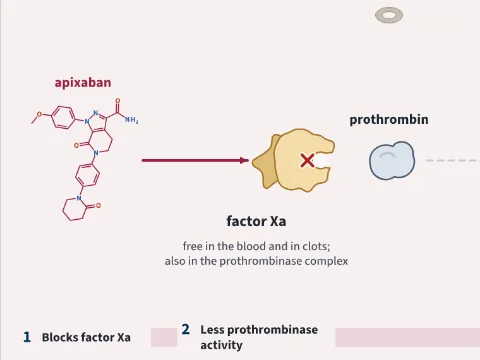
Blocks , free, in clots and in the prothrombinase complex, so less thrombin and less clot are made.2
Used forDeep vein thrombosis and pulmonary embolism: treatment, in adultsRecurrence: reduce the risk, in adults after initial treatmentPrevention after hip or knee replacement, in adults
What the label says
“By inhibiting FXa, apixaban decreases thrombin generation and thrombus development.”
“prophylaxis of deep vein thrombosis (DVT), which may lead to pulmonary embolism (PE), in adult patients who have undergone hip or knee replacement surgery”
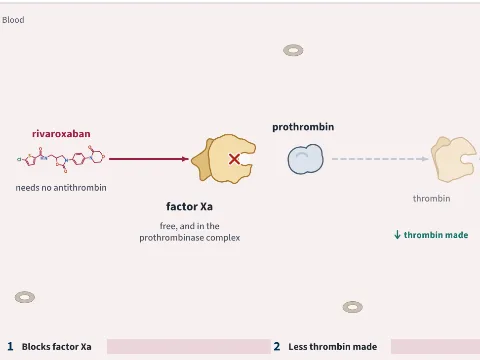
Used forDeep vein thrombosis and pulmonary embolism: treatmentRecurrence: reduce the risk, in adults still at risk after at least 6 months of treatmentPrevention after knee or hip replacement, in adults
“XARELTO is indicated for the reduction in the risk of recurrence of DVT and/or PE in adult patients at continued risk for recurrent DVT and/or PE after completion of initial treatment lasting at least 6 months.”
Its active form, dabigatran, blocks thrombin directly, free and clot-bound, so fibrinogen is not turned into fibrin.6,7
Used forDeep vein thrombosis and pulmonary embolism: treatment, in adults after 5 to 10 days of an injected anticoagulantRecurrence: reduce the risk, in adults treated beforePrevention after hip replacement, in adults
What the label says
“Dabigatran etexilate mesylate is absorbed as the dabigatran etexilate ester. The ester is then hydrolyzed, forming dabigatran, the active moiety.”
“Because thrombin (serine protease) enables the conversion of fibrinogen into fibrin during the coagulation cascade, its inhibition prevents the development of a thrombus.”
“For the treatment of deep venous thrombosis (DVT) and pulmonary embolism (PE) in adult patients who have been treated with a parenteral anticoagulant for 5-10 days”
Also used for it: heparin (“Prophylaxis and treatment of venous thrombosis and pulmonary embolism”9); and enoxaparin (“Prophylaxis of deep vein thrombosis (DVT) in abdominal surgery, hip replacement surgery, knee replacement surgery, or medical patients with severely restricted mobility during acute illness”, and “the inpatient treatment of acute deep vein thrombosis with or without pulmonary embolism , when administered in conjunction with warfarin sodium”10).
The Prothrombin-Prothrombinase InteractionStojanovski BM et al. Subcell Biochem 2024 (abstract). The prothrombinase complex (factor Xa with factor Va) and its prothrombin-to-thrombin step in the drawing rest on this review. Saved copy
Factor Xa with apixabanPDB 2P16; Pinto, D.J. et al. J.Med.Chem. 2007;50:5339-5356. The factor Xa outline in the drawing is traced from this structure. Saved copy
text c56e038b0778…; drawings a811a02a214c…; notes 5869e06229cf…
AI source check
Claude Opus 5.5 (AI source check), 29 October 2026: 58 statements compared with their sources, 15 flagged for the reviewer. An automated check, not a medical review.
Conflict of interest
Apixaban: Pfizer, the reviewer's former employer, makes or markets this medicine. Heparin: Pfizer, the reviewer's former employer, makes or markets this medicine. Details
Next review due
29 April 2028
Cite this page
Tran D. Blood clots in the veins [Internet]. OpenMechanism; 2026 [updated 2026 Oct 29; cited 2026 Oct 29]. Available from: https://openmechanism.com/conditions/venous-thromboembolism