Phytonadione (vitamin K1)
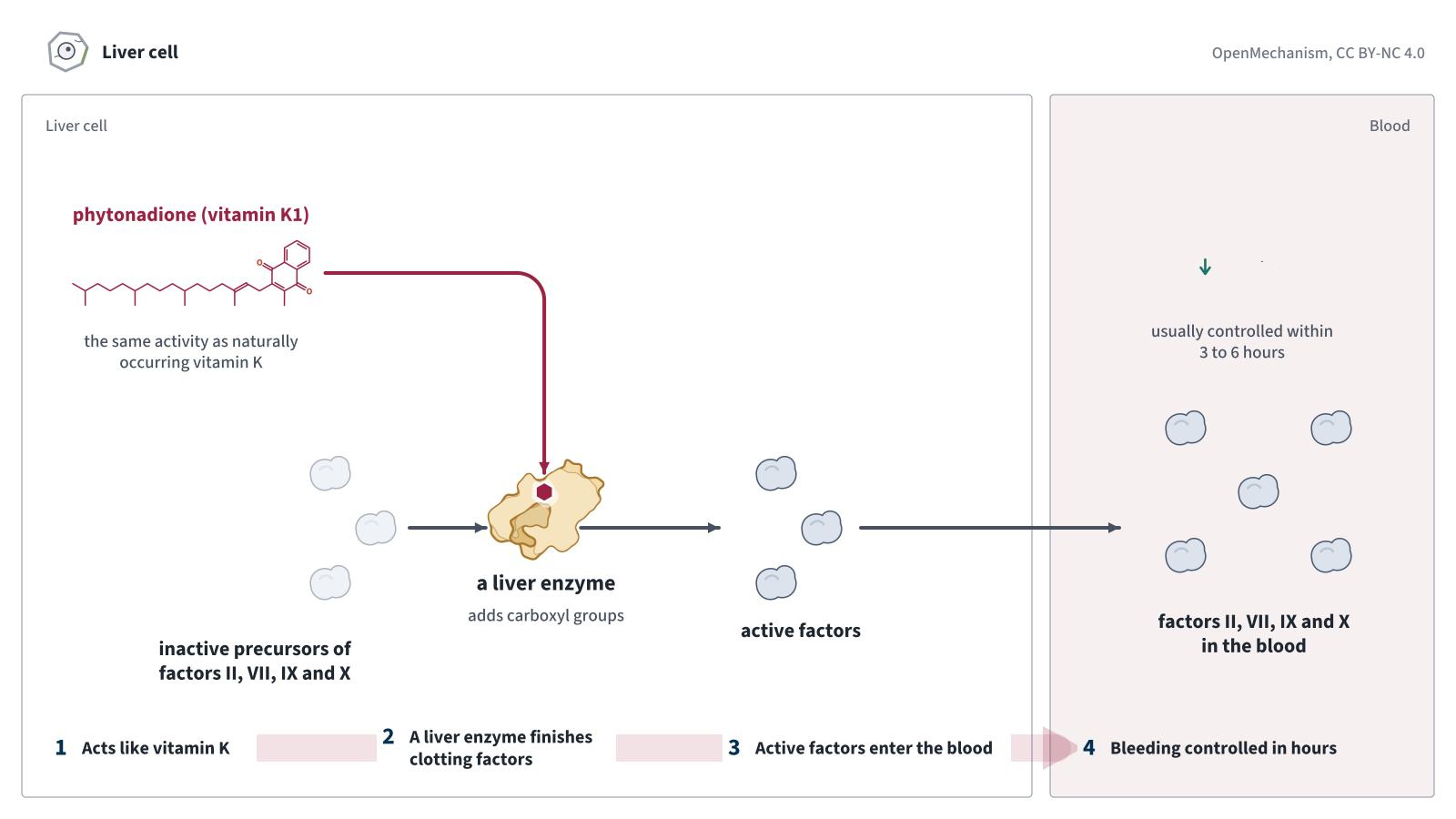
Phytonadione is vitamin K1, with the same activity as naturally occurring vitamin K. Vitamin K is the cofactor a liver enzyme needs to add carboxyl groups to the inactive precursors of clotting factors II, VII, IX and X; this makes them active, and liver cells release them into the blood. It treats bleeding from too little vitamin K, or from blocked vitamin K activity, as with coumarin . Given into a vein, it usually controls bleeding within 3 to 6 hours.
- Acts on
- The liver enzyme that carboxylates the precursors of clotting factors II, VII, IX and X
- Where
- Liver cells
- Medicine type
- Small molecule
- Used for
- Blood & clotting
How it works
Acts like vitamin K. Phytonadione (vitamin K1) has the same kind and degree of activity as naturally occurring vitamin K, which the liver needs to make active clotting factors II (prothrombin), VII, IX and X.1
A liver enzyme finishes clotting factors. Vitamin K is an essential cofactor for a liver enzyme that adds carboxyl groups to specific glutamic acid residues in the inactive precursors of factors II, VII, IX and X.1
Active factors enter the blood. The gamma-carboxy-glutamic acid residues made this way turn the precursors into active clotting factors, which liver cells release into the blood.1
Bleeding controlled in hours. Given into a vein, its action is usually detectable within an hour or two, bleeding is usually controlled within 3 to 6 hours, and a normal INR may often be reached in 12 to 14 hours.1
For teachers: download this drawing.
See also
Condition pages: bleeding on blood thinners.
More medicines for blood & clotting: alteplase, antihemophilic factor (factor VIII), apixaban, aspirin, clopidogrel, cyanocobalamin (vitamin B12), dabigatran etexilate, daprodustat and 18 more.
Explained: vitamin K and warfarin.
Related drawings: warfarin (a coumarin anticoagulant that blocks the recycling of vitamin K).
Body system: blood & clotting.
Sources
- 1Phytonadione injectable emulsion (Sagent): FDA label12.1 Mechanism of Action; 12.2 Pharmacodynamics
- 2ChEMBL CHEMBL1550Target and action classification
Also used for the drawing
The vitamin K-dependent carboxylase outline is traced from the electron microscopy structure below.
- 3Human vitamin K-dependent gamma-carboxylase with a factor IX precursor peptide and vitamin K1 hydroquinonePDB 9BVK; Cao, Q. et al. Nature 2025; 639:816-824
Spotted a mistake? Report an error (hello@openmechanism.com). Since launch, every published error we fix is listed on the corrections page.
Notes and limits
- A schematic teaching drawing: not to scale, not exact structures, binding poses or a complete pathway, and not a guide to dosing, treatment or how a person will respond.
- In people and animals with normal vitamin K, phytonadione has virtually no activity: it acts where vitamin K is lacking or its activity is blocked (the label, 12.1).
All recorded limits are on the evidence page, and notes that apply to every page are on How to read a page. Version 1.0.0, not yet medically reviewed.
Cite this page
Tran D. Phytonadione (vitamin K1) [Internet]. OpenMechanism; 2026 [updated 2026 Oct 18; cited 2026 Oct 18]. Available from: https://openmechanism.com/medicines/phytonadione