Clopidogrel
The body converts clopidogrel into an active form, which permanently blocks the receptor on platelets. Platelets are activated less and clump together less.
- Acts on
- P2Y12 ADP receptor
- Where
- Platelets
- Medicine type
- Small molecule
- Used for
- Blood & clotting
- Drug class
- Antiplatelet medicines
Also called Plavix.
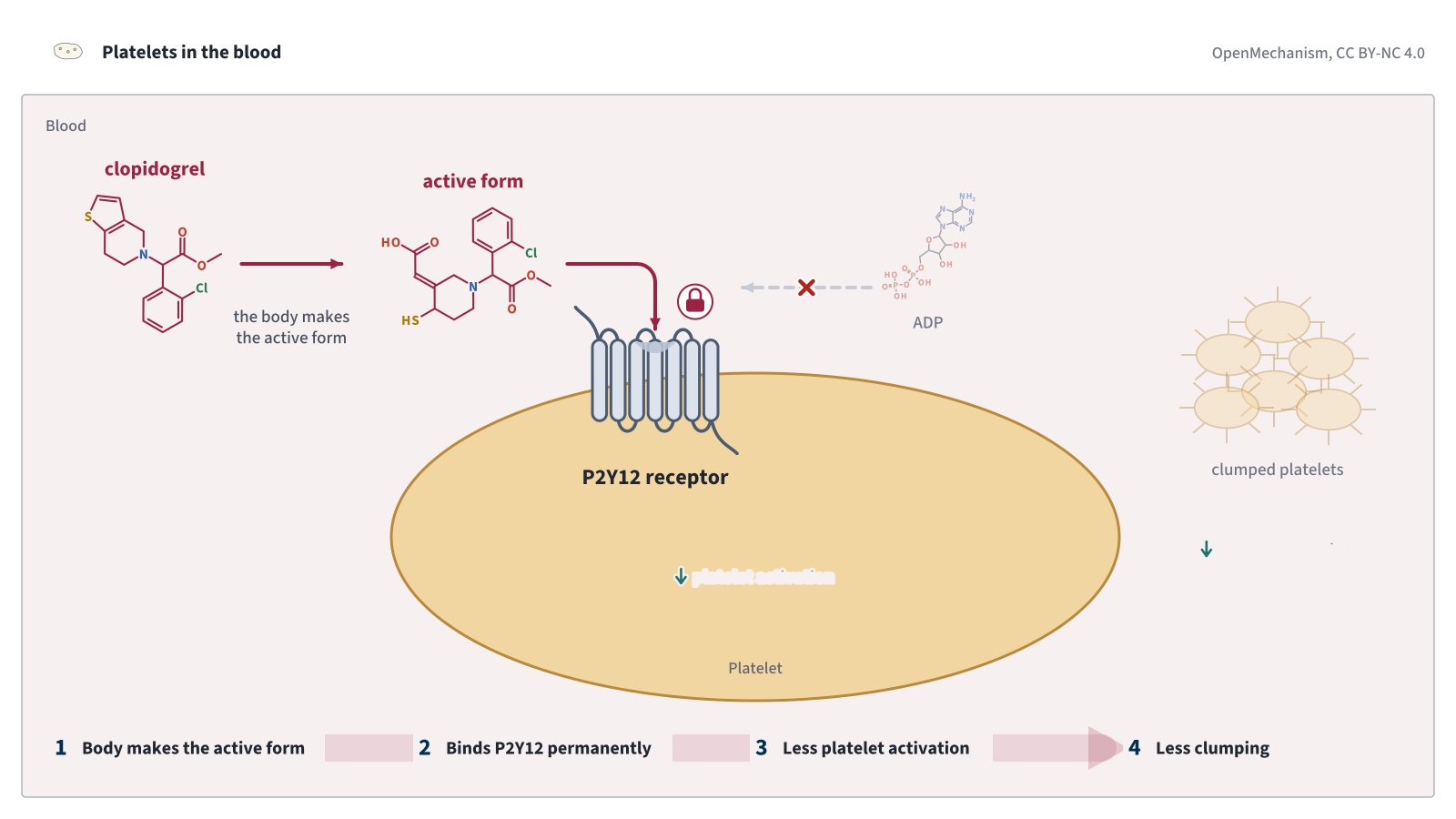
Key terms in this drawing
- ADP
- Adenosine diphosphate. A signal that binds the P2Y12 receptor on platelets and helps switch them on.
- P2Y12 receptor
- P2Y12 receptor. A receptor on platelets for ADP (adenosine diphosphate), a signal that helps switch them on.
How it works
Body makes the active form. Clopidogrel action is mediated by an active metabolite.1
Binds P2Y12 permanently. The metabolite binds irreversibly to platelet P2Y12 ADP receptors.1
Less platelet activation. The resulting receptor blockade inhibits platelet activation.1
Less clumping. Platelet aggregation is inhibited.1
For teachers: download this drawing or build a slide deck.
More detail
Turned into its active form
Absorbed, then needs activating. Orally administered clopidogrel is absorbed and requires metabolic activation.1
CYP enzymes make an intermediate. oxidize clopidogrel to 2-oxo-clopidogrel.1,2
Then the active form, mainly by CYP2C19. The label describes further metabolism to an active thiol, principally through with other CYP contributions.1,2
What the source says
“Clopidogrel must be metabolized by CYP450 enzymes to produce the active metabolite that inhibits platelet aggregation.”
Source 1
“Cytochromes first oxidize clopidogrel to a 2-oxo-clopidogrel intermediate metabolite.”
Source 1
“The active metabolite is formed mostly by CYP2C19 with contributions from several other CYP enzymes, including CYP1A2, CYP2B6 and CYP3A.”
Source 1
Most of it is made inactive
Blocking the platelet ADP receptor
Binds P2Y12 for good, blocking ADP. The active thiol irreversibly binds platelet P2Y12 receptors and blocks ADP binding.1
Less platelet activation and clumping. P2Y12 inhibition reduces ADP-mediated GPIIb/IIIa activation and platelet aggregation.1
Platelets stay affected for their lifespan. Platelets exposed to the active form are affected for the rest of their lifespan (about 7 to 10 days). Clumping set off by signals other than ADP is also inhibited, because the boost that released ADP gives to platelet activation is blocked.1
What the source says
“Consequently, platelets exposed to clopidogrel's active metabolite are affected for the remainder of their lifespan (about 7 to 10 days).”
Source 1
“Platelet aggregation induced by agonists other than ADP is also inhibited by blocking the amplification of platelet activation by released ADP.”
Source 1
Genes that change activation
Variants of the CYP2C19 gene change how much active form is made. CYP2C19 genotype alters active-metabolite exposure and ex-vivo platelet inhibition in label-described studies.1
What the source says
“Clopidogrel active metabolite pharmacokinetics and antiplatelet effects, as measured by ex vivo platelet aggregation assays, differ according to CYP2C19 genotype.”
Source 1
How the body clears it
Bleeding risk
Raises the risk of bleeding. Clopidogrel increases the risk of bleeding.1
See also
Condition pages: angina, heart attack and ischemic stroke.
Other antiplatelet medicines: aspirin, dipyridamole, eptifibatide, prasugrel and ticagrelor.
Explained: clopidogrel and the CYP2C19 gene; and clopidogrel and omeprazole.
Body system: blood & clotting.
Sources
- 1Plavix (clopidogrel): FDA label12.1 Mechanism of Action; 12.3 Pharmacokinetics; 12.2 Pharmacodynamics; 5.1 Diminished Antiplatelet Activity in Patients with Impaired CYP2C19 Function; 5.2 General Risk of Bleeding; 12.5 Pharmacogenomics
- 2Zahno et al. 2010 (a study of clopidogrel biotransformation and platelet effect in vitro)Abstract, Experimental approach and Conclusions; Figure 5 caption; Br J Pharmacol 161(2):393–404; DOI 10.1111/j.1476-5381.2010.00881.x
- 3ChEMBL CHEMBL1771Target and action classification: Purinergic receptor P2Y12 antagonist
Spotted a mistake? Report an error (hello@openmechanism.com). Since launch, every published error we fix is listed on the corrections page.
Notes and limits
- A schematic teaching drawing: not to scale, not exact structures, binding poses or a complete pathway, and not a guide to dosing, treatment or how a person will respond.
- The steps are in the order that explains them; one step is said to cause the next only where the source says so.
- This page covers clopidogrel taken by mouth and the pharmacology its label describes in people; it does not predict any one person's outcome from their genes.
- Lab work with human liver microsomes supports a liver setting for the CYP steps; the share each enzyme took in the lab is not its share in people.
All recorded limits are on the evidence page, and notes that apply to every page are on How to read a page. Version 1.1.1, medically reviewed by Daniel Tran, PharmD, on 29 October 2026.
Cite this page
Tran D. Clopidogrel [Internet]. OpenMechanism; 2026 [updated 2026 Oct 29; cited 2026 Oct 29]. Available from: https://openmechanism.com/medicines/clopidogrel