Methemoglobinemia
In methemoglobinemia, the iron of hemoglobin is oxidized to a ferric form that cannot carry oxygen, faster than red cells can turn it back. Most cases are acquired, from substances such as some medicines; some are inherited. Methylene blue, made into leucomethylene blue, turns the iron back.
- Where
- Red blood cells
- Body system
- Blood & clotting
- Medicines
- 1 medicine
For teachers: download this drawing.
What goes wrong
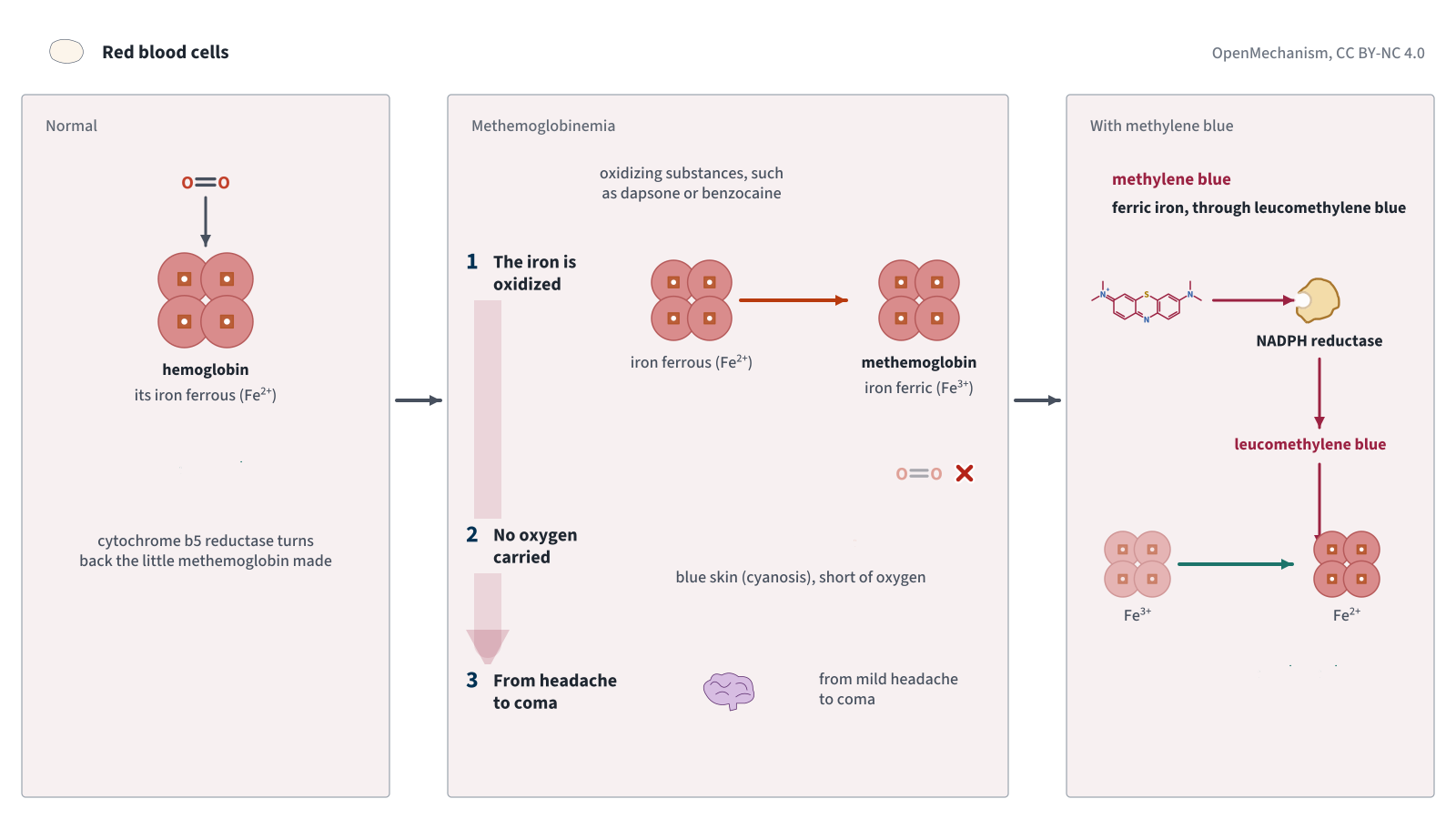
The iron is oxidized. Hemoglobin's ferrous iron is slowly oxidized to methemoglobin by the oxygen around it, and the red cell's cytochrome b5 reductase normally turns it back so efficiently that there is almost none in the blood. In methemoglobinemia, ferrous iron is oxidized to ferric iron faster: most often after exposure to substances that oxidize hemoglobin, such as dapsone or benzocaine, and in inherited forms through changes in the CYB5R3 gene or in the globin genes (hemoglobin M).1,2,3
What the source says
“The ferrous iron of hemoglobin is exposed continuously to high concentrations of oxygen and, thereby, is oxidized slowly to methemoglobin, a protein unable to carry oxygen.”
Source 1“Under physiological conditions, methemoglobin reduction is accomplished mainly by red cell NADH-cytochrome b5 reductase (NADH-methemoglobin reductase) so efficiently that there is insignificant amounts of methemoglobin in the circulating blood.”
Source 1“However, should methemoglobin formation be increased--e.g., due to the presence of oxidant drugs, or an abnormal methemoglobin not amenable to reduction (hemoglobin M), or a deficiency in red cell cytochrome b5 reductase--methemoglobinemia will result.”
Source 1“Methemoglobinemia is a rare disorder associated with oxidization of divalent ferro-iron of hemoglobin (Hb) to ferri-iron of methemoglobin (MetHb).”
Source 2“Acquired forms are the most common, mainly due to the exposure to substances that cause oxidation of the Hb both directly or indirectly.”
Source 2“A variety of frequently used medications are capable of inducing methemoglobinemia, with dapsone and benzocaine being common culprits.”
Source 3“Inherited forms are due either to autosomal recessive variants in the CYB5R3 gene or to autosomal dominant variants in the globin genes, collectively known as HbM disease.”
Source 2No oxygen carried. Methemoglobin cannot carry oxygen. People with methemoglobinemia can come with blue skin (cyanosis) and too little oxygen (hypoxia).1,3
What the source says
“The ferrous iron of hemoglobin is exposed continuously to high concentrations of oxygen and, thereby, is oxidized slowly to methemoglobin, a protein unable to carry oxygen.”
Source 1“The diagnosis of methemoglobinemia should be considered in patients presenting with cyanosis and hypoxia.”
Source 3From headache to coma. Symptoms range from mild headache to coma and death, and may not match the measured level; heart, lung or blood disease can make it worse.4
Where medicines act
In red blood cells
- A
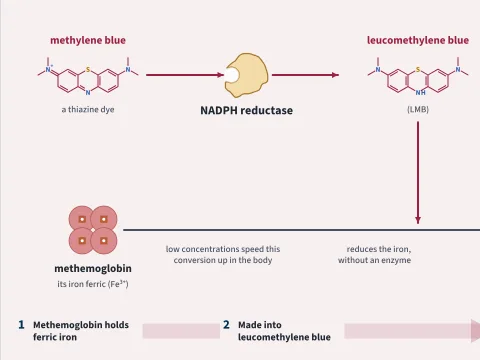
Methylene blue targets Methemoglobin's iron, through leucomethylene blue
Becomes leucomethylene blue, which turns ferric iron back to ferrous.5
Used forAcquired methemoglobinemia: children and adults
What the label says
“PROVAYBLUE is indicated for the treatment of pediatric and adult patients with acquired methemoglobinemia.”
Source 5“Methylene blue is a water soluble thiazine dye that promotes a non-enyzmatic redox conversion of metHb to hemoglobin.”
Source 5“In situ, methylene blue is first converted to leucomethylene blue (LMB) via NADPH reductase.”
Source 5“It is the LMB molecule which then reduces the ferric iron of metHb to the ferrous state of normal hemoglobin.”
Source 5“Low concentrations of methylene blue speeds up the in vivo conversion of methemoglobin to hemoglobin.”
Source 5
See also
Body system: blood & clotting.
Can raise or cause it: metoclopramide (“Reglan tablets are not recommended for use in pediatric patients due to the risk of developing tardive dyskinesia (TD) and other extrapyramidal symptoms as well as the risk of methemoglobinemia in neonates”6).
Other conditions: acetaminophen overdose; ethylene glycol and methanol poisoning; cyanide poisoning; heavy metal poisoning; acid reflux (GERD); and chemotherapy nausea and vomiting.
The medicine in the body: primaquine and G6PD deficiency.
Sources
- 1Concise review: methemoglobinemiaMansouri A, Lurie AA. Am J Hematol 1993 (abstract). Saved copy
- 2Recommendations for diagnosis and treatment of methemoglobinemiaIolascon A et al. Am J Hematol 2021 (abstract). Saved copy
- 3Methemoglobinemia: pathogenesis, diagnosis, and managementSkold A et al. South Med J 2011 (abstract). Saved copy
- 4Methemoglobinemia: etiology, pharmacology, and clinical managementWright RO et al. Ann Emerg Med 1999 (abstract). Saved copy
- 5ProvayBlue (methylene blue): FDA label1 Indications and Usage; 12.1 Mechanism of Action; 12.2 Pharmacodynamics. Saved copy
- 6Reglan (metoclopramide) tablets: FDA label1 Indications and Usage. Saved copy
- 7Human flavin reductase (NADPH), also called biliverdin IX beta reductase, with NADP+ and FMNPDB 1HE4; Pereira, P.J.B. et al. Nat.Struct.Biol. 2001;8:215. The NADPH reductase outline in the drawing is traced from this structure. Saved copy
Notes and limits
- Treatment with methylene blue can be complicated by enzyme deficiencies, including G6PD deficiency.4
- Methemoglobin can upset blood gas and pulse oximeter readings, and other abnormal hemoglobins can be mistaken for it.4
Notes that apply to every page are on How to read a page.
Spotted a mistake? Report an error (hello@openmechanism.com). Since launch, every published error we fix is listed on the corrections page.
Cite this page
Tran D. Methemoglobinemia [Internet]. OpenMechanism; 2026 [updated 2026 Oct 20; cited 2026 Oct 20]. Available from: https://openmechanism.com/conditions/methemoglobinemia