Cyanocobalamin (vitamin B12)
Vitamin from food needs from the stomach to be absorbed, so people without it, as in pernicious anemia, cannot rely on B12 by mouth. Injected cyanocobalamin is absorbed quickly and completely, carried to the tissues by transcobalamins and stored in the liver. B12 is essential for making blood cells, nucleoproteins and myelin, and prompt injections stop nerve damage from progressing.
- Acts on
- Vitamin B12 stores (via transcobalamins to the tissues)
- Where
- Bone marrow and nerves
- Medicine type
- Small molecule
- Used for
- Blood & clotting
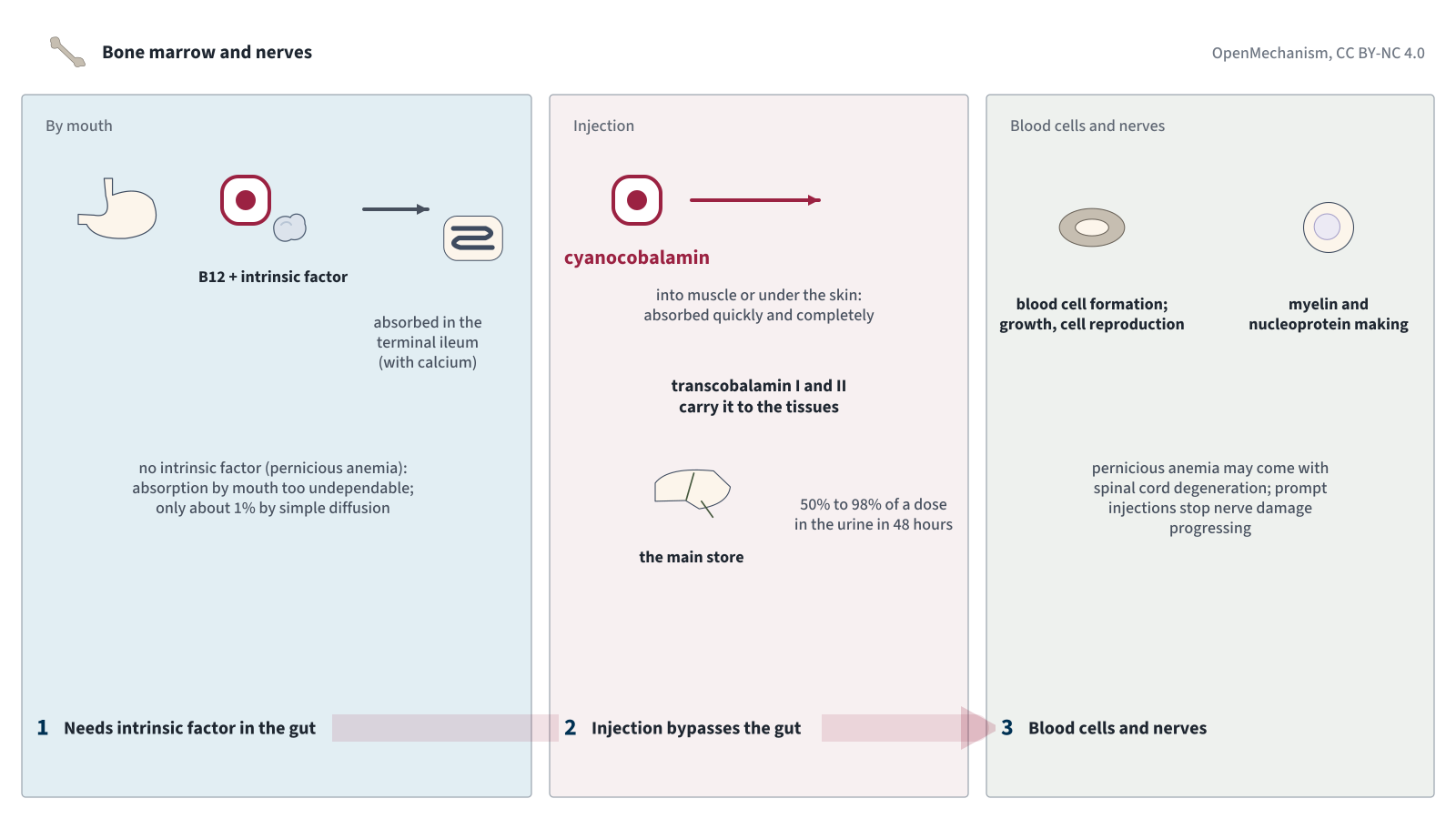
Key terms in this drawing
- intrinsic factor
- Intrinsic factor. Made by the stomach's parietal cells, it binds vitamin B12 and carries it to the end of the small intestine (the terminal ileum), where the B12 is absorbed.
- vitamin B12
- Vitamin B12 (cobalamin). A vitamin the body needs for growth, cell division, making blood cells and making myelin.
How it works
Needs intrinsic factor in the gut. Vitamin B12 from food is bound to intrinsic factor as it passes through the stomach; in the terminal ileum it separates, with calcium present, and enters the lining cells. Only about 1% of what is eaten is absorbed by simple diffusion, enough only with very large doses. Without enough intrinsic factor (pernicious anemia), oral absorption is too undependable to rely on.1
Injection bypasses the gut. Injected into muscle or under the skin, cyanocobalamin is absorbed quickly and completely, peaking within an hour. Binding proteins, transcobalamin I and II, carry it to the tissues, and the liver is the main store; 50% to 98% of an injected dose may appear in the urine within 48 hours.1
Blood cells and nerves. Vitamin B12 is essential to growth, cell reproduction, blood cell formation (hematopoiesis) and the making of nucleoproteins and myelin. Pernicious anemia may come with subacute combined degeneration of the spinal cord; prompt B12 injections prevent the neurologic damage from progressing.1
For teachers: download this drawing.
See also
Condition pages: vitamin B12 and folate deficiency.
Explained: why PPIs and metformin can lower vitamin B12.
Related drawings: hydroxocobalamin (the hydroxylated form of vitamin B12, which binds cyanide and becomes cyanocobalamin).
Body system: blood & clotting.
Sources
- 1Cyanocobalamin injection (Somerset): FDA labelIndications and Usage; Clinical Pharmacology
- 2ChEMBL CHEMBL2110563Target and action classification: Diagnostic agent; Supplement
Spotted a mistake? Report an error (hello@openmechanism.com). Since launch, every published error we fix is listed on the corrections page.
Notes and limits
- A schematic teaching drawing: not to scale, not exact structures, binding poses or a complete pathway, and not a guide to dosing, treatment or how a person will respond.
All recorded limits are on the evidence page, and notes that apply to every page are on How to read a page. Version 1.0.0, not yet medically reviewed.
Cite this page
Tran D. Cyanocobalamin (vitamin B12) [Internet]. OpenMechanism; 2026 [updated 2026 Oct 11; cited 2026 Oct 11]. Available from: https://openmechanism.com/medicines/cyanocobalamin