Tranexamic acid
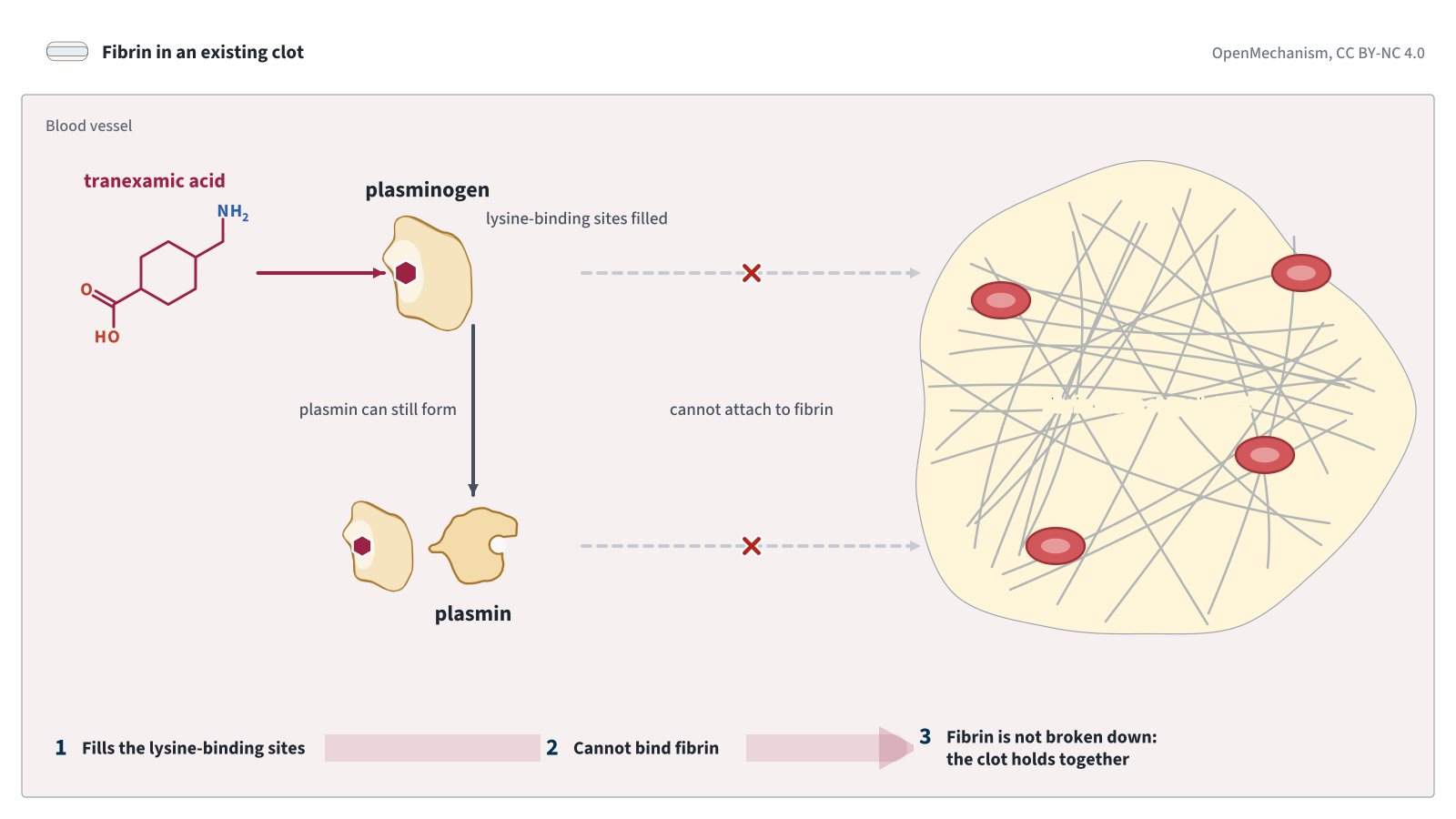
Tranexamic acid blocks the sites that plasminogen and plasmin use to attach to fibrin. Plasmin cannot break the fibrin mesh down, so the clot holds together.
- Acts on
- Plasminogen, plasmin, fibrin
- Where
- Fibrin in an existing clot
- Medicine type
- Small molecule
- Used for
- Blood & clotting
How it works
Fills the lysine-binding sites. Tranexamic acid reversibly engages lysine-binding sites involved in plasminogen/plasmin binding to fibrin.1
Cannot bind fibrin. Occupation of those sites displaces plasminogen and prevents plasmin binding to fibrin.1
Fibrin is not broken down: the clot holds together. Even when plasmin forms, binding and dissolution of the fibrin matrix are inhibited, preserving its structure.1
For teachers: download this drawing or build a slide deck.
See also
Condition pages: heavy menstrual bleeding.
More medicines for blood & clotting: alteplase, antihemophilic factor (factor VIII), apixaban, aspirin, clopidogrel, cyanocobalamin (vitamin B12), dabigatran etexilate, daprodustat and 18 more.
Body system: blood & clotting.
Sources
- 1Tranexamic acid: FDA label12.1 Mechanism of Action
- 2ChEMBL CHEMBL877Target and action classification: Plasminogen inhibitor
Also used for the drawing
The plasminogen and plasmin outlines are traced from the crystal structures below.
- 3Kringle 1 of human plasminogen with tranexamic acid in its lysine-binding sitePDB 1CEB; Mathews, I.I. et al. Biochemistry 1996; 35:2567-2576
- 4Microplasmin, the catalytic part of plasmin, in a complex with staphylokinasePDB 1BUI; Parry, M.A. et al. Nat.Struct.Biol. 1998; 5:917-923
Spotted a mistake? Report an error (hello@openmechanism.com). Since launch, every published error we fix is listed on the corrections page.
Notes and limits
- A schematic teaching drawing: not to scale, not exact structures, binding poses or a complete pathway, and not a guide to dosing, treatment or how a person will respond.
- Other medicines in the same family may not follow every step or share the same clinical endpoint.
- The steps are in the order that explains them; one step is said to cause the next only where the source says so.
- Binding-site affinity classes are described by the label; exact site counts or poses are not encoded by the schematic.
All recorded limits are on the evidence page, and notes that apply to every page are on How to read a page. Version 1.0.0, not yet medically reviewed.
Cite this page
Tran D. Tranexamic acid [Internet]. OpenMechanism; 2026 [updated 2026 Oct 16; cited 2026 Oct 16]. Available from: https://openmechanism.com/medicines/tranexamic-acid