Heparin
Heparin binds antithrombin, a protein in the blood, and changes its shape so it becomes much more active. Antithrombin then blocks activated clotting factors, mainly and thrombin: small amounts of heparin block factor Xa, larger amounts thrombin. Heparin also stops a stable fibrin clot from forming. It does not break down fibrin, so it will not dissolve a clot that has already formed.
- Acts on
- Antithrombin III, and through it factor Xa and thrombin (factor IIa)
- Where
- The blood
- Medicine type
- Oligosaccharide
- Used for
- Blood & clotting
- Drug class
- Anticoagulants
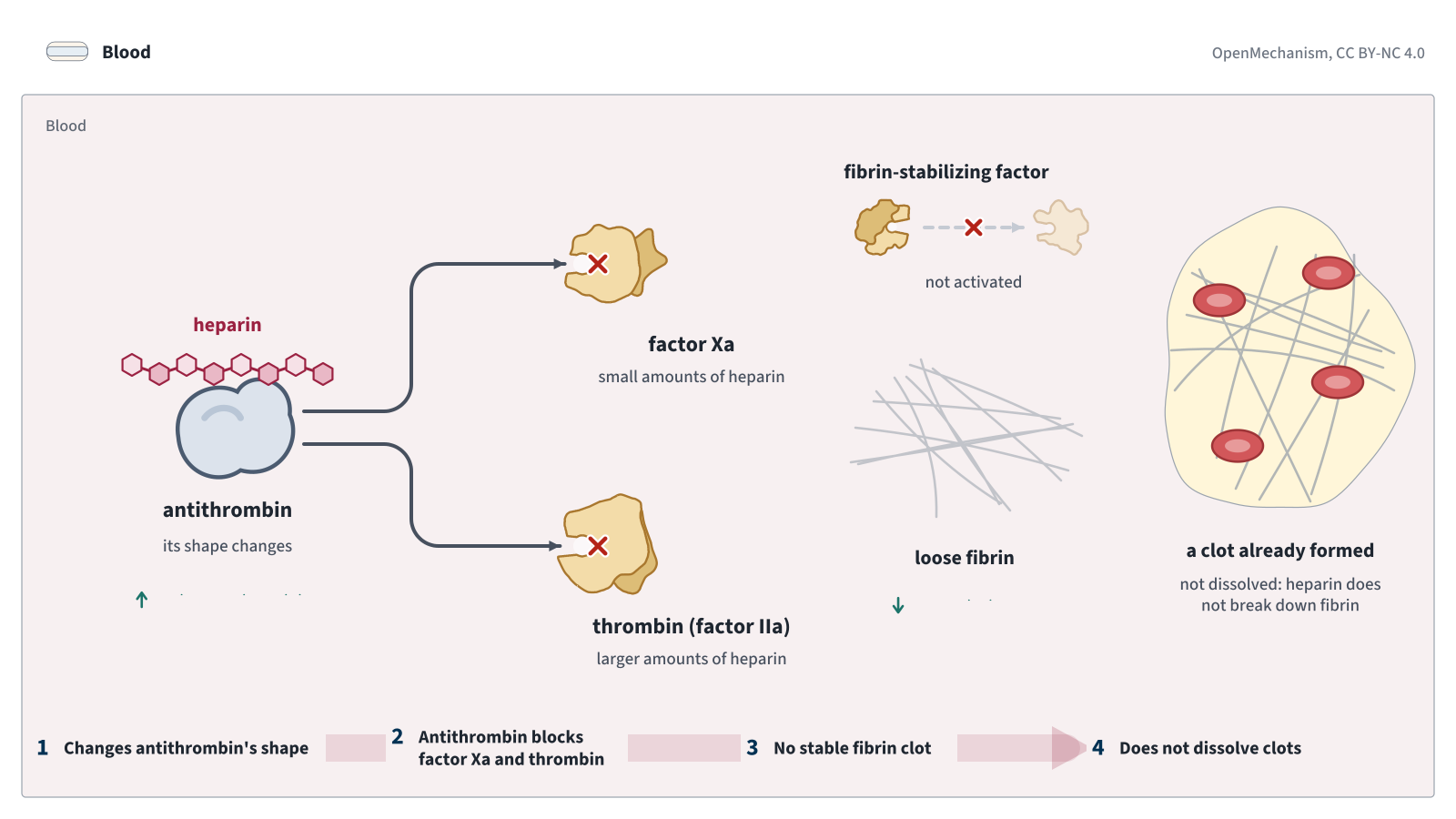
Key terms in this drawing
- factor Xa
- Activated coagulation factor X. A clotting enzyme that turns prothrombin into thrombin.
How it works
Changes antithrombin's shape. Heparin interacts with antithrombin III, a protein naturally present in the blood, and changes its shape (a conformational change), which greatly increases antithrombin's activity.1
Antithrombin blocks factor Xa and thrombin. Antithrombin then blocks activated clotting factors, mainly factor Xa and thrombin (factor IIa): small amounts of heparin block factor Xa, and larger amounts block thrombin.1
No stable fibrin clot. Heparin also stops a stable fibrin clot from forming by blocking the activation of the fibrin-stabilizing factor.1
Does not dissolve clots. Heparin does not break down fibrin (it has no fibrinolytic activity), so it will not dissolve clots that have already formed.1
For teachers: download this drawing.
See also
Condition pages: atrial fibrillation and blood clots in the veins.
Side effects: bleeding on blood thinners.
Other anticoagulants: apixaban, dabigatran etexilate, enoxaparin, rivaroxaban and warfarin.
Explained: why heparin can raise potassium; why heparin can lower platelets and cause clots; and protamine and heparin.
Related drawings: protamine (binds heparin and stops its effect after an overdose).
Body system: blood & clotting.
Sources
- 1Heparin sodium injection (Fresenius Kabi): FDA label12.1 Mechanism of Action
- 2ChEMBL CHEMBL4650299Target and action classification: Antithrombin-III activator
Also used for the drawing
The factor Xa, thrombin and fibrin-stabilizing factor outlines are traced from the crystal structures below.
- 3Factor Xa with apixabanPDB 2P16; Pinto, D.J. et al. J.Med.Chem. 2007; 50:5339-5356
- 4Human alpha-thrombin with an active-site inhibitor (PPACK)PDB 1PPB; Bode, W. et al. EMBO J. 1989; 8:3467-3475
- 5Human factor XIII (fibrin-stabilizing factor), its inactive form: two A chains, the catalytic cysteine, histidine and aspartate marking the active sitePDB 1F13; Weiss, M.S. et al. FEBS Lett. 1998; 423:291-296
- 6Human factor XIIIa, the active form switched on by calcium, with an inhibitor at its active sitePDB 4KTY; Stieler, M. et al. Angew.Chem.Int.Ed.Engl. 2013; 52:11930-11934
Spotted a mistake? Report an error (hello@openmechanism.com). Since launch, every published error we fix is listed on the corrections page.
Notes and limits
- A schematic teaching drawing: not to scale, not exact structures, binding poses or a complete pathway, and not a guide to dosing, treatment or how a person will respond.
All recorded limits are on the evidence page, and notes that apply to every page are on How to read a page. Version 1.0.0, not yet medically reviewed.
Cite this page
Tran D. Heparin [Internet]. OpenMechanism; 2026 [updated 2026 Oct 17; cited 2026 Oct 17]. Available from: https://openmechanism.com/medicines/heparin