Beta-thalassemia
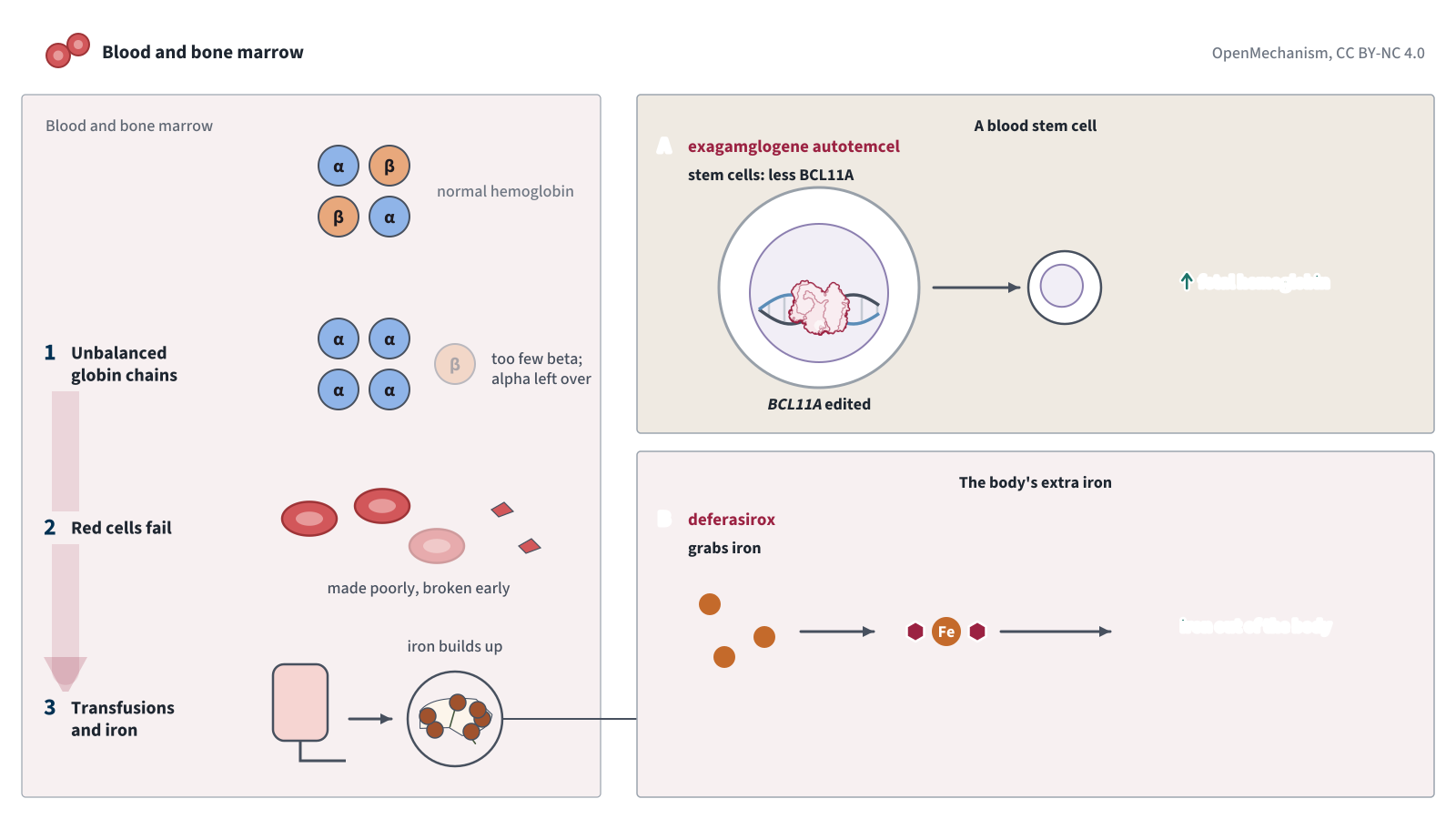
Thalassemias are inherited disorders in which hemoglobin's globin chains are made out of balance, so red cells are made poorly and break down early, and iron handling goes wrong. Severe forms need lifelong transfusions, and the iron they bring builds up. Exagamglogene autotemcel edits a patient's own stem cells so red cells make fetal hemoglobin again; deferasirox removes extra iron.
- Where
- Blood and bone marrow
- Body system
- Blood & clotting
- Medicines
- 2 medicines
For teachers: download this drawing.
Key terms in this drawing
- BCL11A
- B-cell lymphoma/leukemia 11A. A protein that turns down fetal hemoglobin in red-cell precursors.
What goes wrong
Unbalanced globin chains. Thalassemias are inherited disorders, found worldwide, in which globin chains are made out of balance.1
Red cells fail. As a result, red cells are made poorly and break down early, and iron handling goes wrong.1
What the source says
“leading to ineffective erythropoiesis, increased haemolysis, and deranged iron homoeostasis.”
Source 1Transfusions and iron. Severe forms need lifelong transfusions. The iron they bring builds up and adds complications; transfusions with iron removal have turned severe thalassemia into a long-term illness with longer life.1,2
What the source says
“severe requiring lifelong transfusion support.”
Source 1“The complications of iron overload, arising from transfusions that represent the basis of disease management in most patients with severe thalassaemia, might further complicate the clinical phenotype.”
Source 2“Conservative treatment with transfusion and iron chelation has transformed the natural history of thalassaemia major into a chronic disease with a prolonged life expectancy”
Source 1
Where medicines act
- A
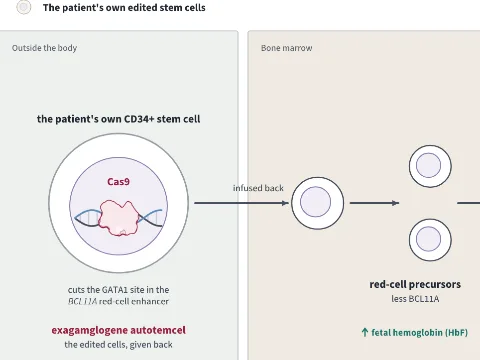
Exagamglogene autotemcel: fetal hemoglobin switched back on
The patient's own edited stem cells make less , so new red cells make fetal hemoglobin (). It treats transfusion-dependent beta-thalassemia.3
- B
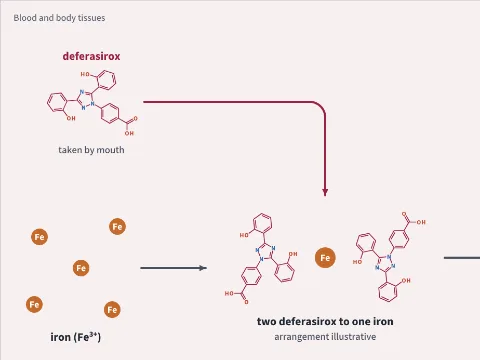
Deferasirox: extra iron removed
Deferasirox grabs iron and carries it out of the body. It treats long-term iron overload, including in thalassemia that does not need regular transfusions.4
See also
Body system: blood & clotting.
Other conditions: iron overload and sickle cell disease.
Sources
- 1ThalassaemiaKattamis A et al. Lancet 2022 (abstract). Saved copy
- 2ThalassaemiaTaher AT et al. Lancet 2018 (abstract). Saved copy
- 3Casgevy (exagamglogene autotemcel): FDA label1 Indications and Usage; 12.1 Mechanism of Action. Saved copy
- 4Exjade (deferasirox): FDA label1 Indications and Usage; 12.1 Mechanism of Action. Saved copy
- 5Streptococcus pyogenes Cas9 (made inactive for the study) with its guide RNA and target DNAPDB 4OO8; Nishimasu, H. et al. Cell(Cambridge,Mass.) 2014;156:935-949. The Cas9 outline in the drawing is traced from this structure. Saved copy
Notes and limits
- Most people with thalassemia live where health care is hard to reach.1
Notes that apply to every page are on How to read a page.
Spotted a mistake? Report an error (hello@openmechanism.com). Since launch, every published error we fix is listed on the corrections page.
Cite this page
Tran D. Beta-thalassemia [Internet]. OpenMechanism; 2026 [updated 2026 Oct 16; cited 2026 Oct 16]. Available from: https://openmechanism.com/conditions/beta-thalassemia