Tenecteplase
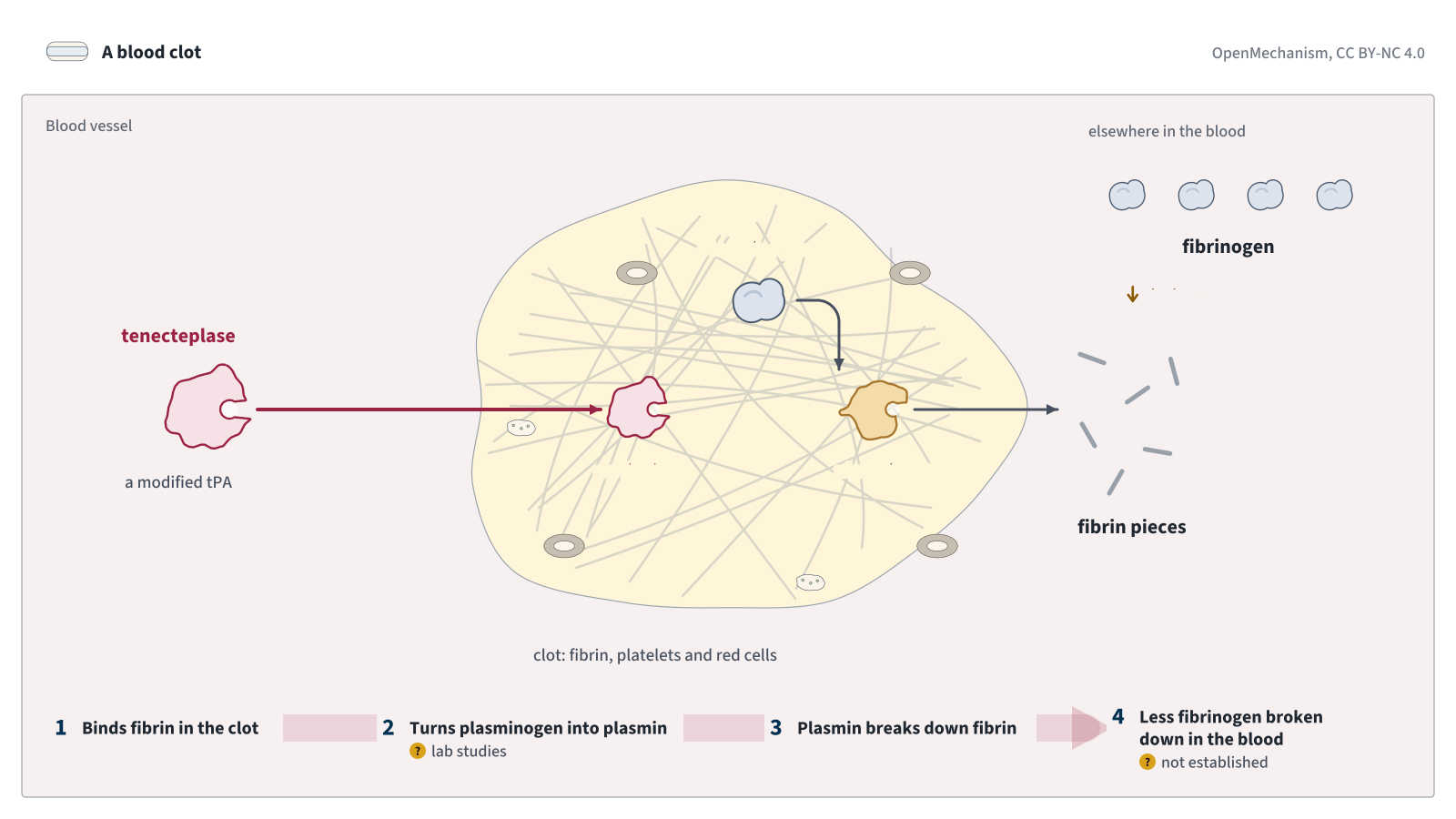
Tenecteplase is a modified form of human tissue plasminogen activator (). It binds fibrin in a clot and turns plasminogen into plasmin, which breaks the fibrin down. In lab studies it does this more when fibrin is present, so less fibrinogen is broken down in the rest of the blood; whether that matters for bleeding or benefit has not been established.
- Acts on
- Fibrin and plasminogen in a blood clot
- Where
- A blood clot
- Medicine type
- Enzyme
- Used for
- Blood & clotting
- Drug class
- Clot-dissolving medicines
Also called TNKase.
Step 2: lab studies
The TNKase label says: In the presence of fibrin, in vitro studies demonstrate that tenecteplase-mediated conversion of plasminogen to plasmin is increased relative to its conversion in the absence of fibrin.
Source 1: TNKase (tenecteplase): FDA label, 12.1 Mechanism of Action; 12.2 Pharmacodynamics
Clinical study: In a dose-ranging study in 113 people with a heart attack (TIMI 10A), fibrinogen and plasminogen in the blood were measured after tenecteplase (TNK-TPA): Systemic fibrinogen and plasminogen levels fell by only 3% and 13%, respectively, at 1 hour after TNK-TPA administration.
Cannon CP et al., Circulation 1997 (PMID 9008448)
This study was picked with a literature search and is not yet checked by our reviewer.
Step 4: not established
The TNKase label says: The clinical significance of fibrin-specificity on safety (e.g., bleeding) or efficacy has not been established.
Source 1: TNKase (tenecteplase): FDA label, 12.1 Mechanism of Action; 12.2 Pharmacodynamics
Clinical study: In a double-blind randomized trial in 16,949 people with a heart attack (ASSENT-2), tenecteplase was compared with alteplase; the trial measured deaths and bleeding, not fibrin specificity itself: Covariate-adjusted 30-day mortality rates were almost identical for the two groups--6.18% for tenecteplase and 6.15% for alteplase. … Rates of intracranial haemorrhage were similar (0.93% for tenecteplase and 0.94% for alteplase), but fewer non-cerebral bleeding complications (26.43 vs 28.95%, p=0.0003) and less need for blood transfusion (4.25 vs 5.49%, p=0.0002) were seen with tenecteplase.
Assessment of the Safety and Efficacy of a New Thrombolytic (ASSENT-2) Investigators et al., Lancet 1999 (PMID 10475182)
This study was picked with a literature search and is not yet checked by our reviewer.
Key terms in this drawing
- tPA
- Tissue plasminogen activator. An enzyme that binds the fibrin in a clot and turns the plasminogen trapped there into plasmin, which starts dissolving the clot; alteplase is one.
How it works
Binds fibrin in the clot. Tenecteplase, a modified form of human tissue plasminogen activator (tPA), binds to fibrin.1
Turns plasminogen into plasmin. It converts plasminogen to plasmin; in lab (in vitro) studies, it does so more when fibrin is present than when it is absent.1
Plasmin breaks down fibrin. Plasmin breaks down the fibrin within the clot, which reopens the blocked vessel.2
Less fibrinogen broken down in the blood. This fibrin specificity means less plasminogen is activated in the rest of the blood and less circulating fibrinogen is broken down than with a molecule lacking it: after 30 to 50 mg in people with a heart attack (STEMI), fibrinogen fell by 4% to 15% and plasminogen by 11% to 24%. Whether fibrin specificity matters for bleeding or for how well it works has not been established.1
For teachers: download this drawing.
See also
Condition pages: heart attack and ischemic stroke.
Other clot-dissolving medicines: alteplase.
Body system: blood & clotting.
Sources
- 1TNKase (tenecteplase): FDA label12.1 Mechanism of Action; 12.2 Pharmacodynamics
- 2Fibrinolytic Agents in Thromboembolic Diseases: Historical Perspectives and Approved IndicationsRashedi S et al., Semin Thromb Hemost 2024 (abstract)
- 3ChEMBL CHEMBL2108791Target and action classification: Tissue-type plasminogen activator exogenous protein
- 4TNK-tissue plasminogen activator in acute myocardial infarction. Results of the Thrombolysis in Myocardial Infarction (TIMI) 10A dose-ranging trialCannon CP et al. Circulation 1997 (abstract)
- 5Single-bolus tenecteplase compared with front-loaded alteplase in acute myocardial infarction: the ASSENT-2 double-blind randomised trialAssessment of the Safety and Efficacy of a New Thrombolytic (ASSENT-2) Investigators et al. Lancet 1999 (abstract)
Also used for the drawing
The tenecteplase and plasmin outlines are traced from the crystal structures below.
- 6The catalytic domain of human tissue plasminogen activator (tPA) with an inhibitorPDB 1A5H; Renatus, M. et al. J.Biol.Chem. 1997; 272:21713-21719
- 7Microplasmin, the catalytic part of plasmin, in a complex with staphylokinasePDB 1BUI; Parry, M.A. et al. Nat.Struct.Biol. 1998; 5:917-923
Spotted a mistake? Report an error (hello@openmechanism.com). Since launch, every published error we fix is listed on the corrections page.
Notes and limits
- A schematic teaching drawing: not to scale, not exact structures, binding poses or a complete pathway, and not a guide to dosing, treatment or how a person will respond.
- The label shows the effect of fibrin on this step in lab (in vitro) studies.
- The label says the clinical significance of fibrin specificity for safety or efficacy has not been established.
All recorded limits are on the evidence page, and notes that apply to every page are on How to read a page. Version 1.0.0, not yet medically reviewed.
Cite this page
Tran D. Tenecteplase [Internet]. OpenMechanism; 2026 [updated 2026 Oct 16; cited 2026 Oct 16]. Available from: https://openmechanism.com/medicines/tenecteplase